Santorini Wineries Compared: Which One to Visit
Which Santorini winery should I visit?
Santo Wines has the best caldera view and the easiest logistics for a first-timer. Venetsanos wins on history and setting above Athinios port. Gavalas, Estate Argyros and Domaine Sigalas suit visitors who care more about the wine in the glass than the view, and Art Space adds a small-scale, artistic setting in Exo Gonia.
Santorini makes wine unlike anywhere else in Europe, and it does it from vines trained low to the ground in coiled baskets, on ash-black soil, with no irrigation at all. Once you’ve read how Assyrtiko survives the island’s dry summers, the next question is where to actually taste it. That’s a harder question than it looks, because the island’s wineries are not interchangeable: some are built for the view, some for the history, and some purely for what’s in the glass.
This page puts the main names side by side — Santo Wines, Venetsanos, Gavalas, Estate Argyros, Domaine Sigalas and Art Space — so you can pick a winery, or a small combination of them, that matches what you actually want from the visit. For a deep dive on any single estate, see the dedicated guides to visiting Santo Wines and visiting Venetsanos; this page is the comparison, not a replacement for either.
The seven names people mix up
Before comparing, it helps to separate what’s actually a winery from what isn’t. Santorini has one wine museum, several working estates, and one cooperative that behaves a bit like both.
| Name | Type | Location | Known for |
|---|---|---|---|
| Santo Wines | Cooperative, large scale | Pyrgos, caldera rim | The view, sunset tastings, easy logistics |
| Venetsanos | Family estate, historic building | Above Athinios port | Oldest surviving winery building on the island |
| Gavalas | Small family estate | Megalochori | Old vines, traditional field blends |
| Estate Argyros | Family estate | Inland Santorini | Benchmark old-vine Assyrtiko among specialists |
| Domaine Sigalas | Estate, modern winemaking | Near Oia | Precise, minimalist single-variety wines |
| Art Space | Small winery and gallery | Exo Gonia | Wine tasting combined with contemporary art |
| Wine Museum | Museum, not a working winery | Vothonas | Cave-tunnel history of winemaking, ends in a tasting |
That last row matters. The Wine Museum at Vothonas is a genuinely good stop, but it’s a museum built into a cave, walked as a self-guided tour through old equipment, and it isn’t producing a current-vintage range the way the six wineries above it are. Treat it as a history stop before or after your tastings, not as one of the wineries to choose between.
Santo Wines: the view, and the easiest first visit
Santo Wines sits directly on the caldera rim near Pyrgos, and it’s built at a scale none of the family estates attempt: a large terrace, several tasting flights of different sizes, and a restaurant that runs sunset dinners paired with wine. As a cooperative bringing together grapes from many small growers across the island, it doesn’t have the single-vineyard story of a family domaine, but it makes up for that with consistency and range — you can taste Assyrtiko, Nykteri and Vinsanto side by side without booking days ahead.
For a first Santorini wine visit, or for a group where not everyone is equally into wine, Santo Wines is the least risky choice. The view alone justifies the stop, and the full guide to visiting Santo Wines covers flight options and timing in more detail. If a sunset tasting on that terrace is specifically what you’re after, an organized sunset wine-tasting outing on the caldera bundles the timing and the pours without you having to plan around sunset yourself.
Venetsanos: the oldest cellar, above the port
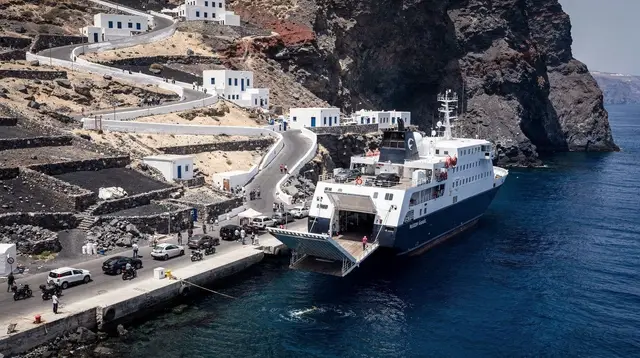
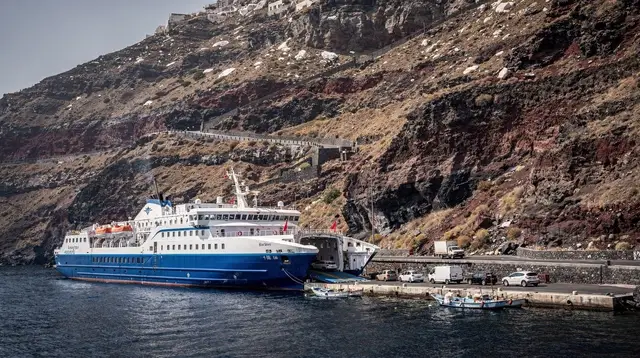
Venetsanos occupies the oldest surviving winery building on the island, perched on the cliff directly above Athinios port. It was built in the early twentieth century to use gravity: grapes came in at the top, and juice and wine moved downward through the building by height alone, rather than being pumped. That building is now a small museum in its own right as much as a working cellar, and the terrace looks straight down onto the ferries queueing into Athinios — a very different angle on the caldera than the postcard view from Oia or Imerovigli.
Because it sits so close to the port, Venetsanos is an easy stop to combine with arrival or departure by ferry, or with a half-day covering both it and Santo Wines, since the two are only a short drive apart along the caldera’s south-western edge. The dedicated Venetsanos visit guide covers the building and the tasting room layout in more detail than fits here.
Gavalas: old vines in Megalochori
Gavalas is a small family producer based in Megalochori, one of the inland villages away from the cliff. It has none of the scale of Santo Wines and none of the industrial-heritage draw of Venetsanos; what it offers instead is old-vine fruit and a genuinely traditional approach, including field blends that mix varieties the way growers here did before single-variety bottling became the norm. Visits are smaller and quieter, usually by appointment rather than walk-in, and the tasting happens close to where the wine is actually made rather than on a purpose-built terrace.
This is the kind of stop that suits visitors who’ve already done the caldera-view winery and want to taste something less polished and more traditional next. It pairs naturally with a wider walk through Megalochori village, which is one of the quieter inland settlements worth seeing on its own terms.
Estate Argyros: the specialists’ Assyrtiko
Among people who write and judge Greek wine professionally, Estate Argyros comes up more often than any other Santorini name, largely on the strength of very old, ungrafted Assyrtiko vines that produce a mineral, concentrated wine unlike the lighter styles sold in most tavernas. It’s a family estate rather than a visitor-scale operation, and tastings tend to be smaller and more focused on the wine itself than on ceremony or setting.
If your priority for the day is drinking the best possible glass of Assyrtiko rather than the best possible photo, Estate Argyros is usually the name specialists point to first. It’s worth building an appointment here around one other stop rather than trying to add it as a fourth or fifth winery in a single afternoon — the visit rewards unhurried attention more than the view-driven estates do.
Domaine Sigalas: precision near Oia
Domaine Sigalas takes a more modern, controlled approach to winemaking than most of the island’s older family cellars, and it sits close enough to Oia that it’s an easy add-on to a day built around the village and its sunset. The style here favors clarity and precision over the heavier, oxidative notes some traditional producers lean into, and the range extends from a crisp entry-level Assyrtiko up to more serious single-vineyard bottlings.
Because of the location, Sigalas works well as the wine stop on a day that’s really built around Oia — arrive earlier in the afternoon for the tasting, then walk into the village itself before the crowds thicken for sunset. For a broader read on timing that walk, Oia without the sunset crowds covers the same stretch of the caldera from a different angle.
Art Space: wine and art in Exo Gonia
Art Space, in the inland village of Exo Gonia, is the outlier on this list: a small winery built inside a disused structure that now doubles as a contemporary art gallery, so the tasting happens surrounded by paintings and sculpture rather than vineyard views or industrial cellar architecture. The wine list is small and experimental compared with the bigger names, including some barrel-aged styles you won’t find at the larger producers.
It’s a good third or fourth stop for visitors who’ve already covered the obvious names and want something that doesn’t feel like a repeat of the last tasting. Exo Gonia itself is one of the least-visited inland villages on the island, which adds to the sense of having found something off the main circuit.
Choosing based on what matters to you
| If you want… | Go to |
|---|---|
| The best caldera view with a tasting | Santo Wines |
| History and a dramatic old building | Venetsanos |
| Traditional, old-vine, low-key winemaking | Gavalas |
| The most highly regarded Assyrtiko | Estate Argyros |
| A precise, modern style near Oia | Domaine Sigalas |
| Something unusual, art plus wine | Art Space |
| The full history of the industry, not a tasting flight alone | Wine Museum, Vothonas |
Most visitors do best picking two, occasionally three, rather than trying to cover the whole list in one day. Santorini’s inland roads are narrow, tastings are meant to be unhurried, and cramming in five estates tends to leave you rushing the last one and driving on wine you shouldn’t be driving on.
Doing it as an organized tour instead
Because someone has to stay sober to drive, and because Santorini’s back roads between inland villages aren’t always well signposted, a good number of visitors book an organized route rather than self-drive between estates. A guided option built specifically around multiple stops, such as a private guided route covering three wineries with a sommelier and small plates, removes the driving question entirely and adds context on the Assyrtiko grape and the island’s soil that’s easy to miss tasting alone at the counter.
For a lighter, single-stop option that still comes with guidance rather than a self-serve flight, a general guided wine-tasting experience covers the basics — Assyrtiko, Nykteri, Vinsanto — without committing a whole afternoon to multiple estates. And if food matters as much as the wine to your group, pairing the tastings with a Greek cheese-tasting session rounds out the visit with the island’s other agricultural product, which shows up on most winery terraces anyway.
What’s actually in the glass
Nearly every winery on this list pours some version of the same core lineup, which is worth understanding before you go so the differences between estates make sense. Assyrtiko is the dry white that defines the island — mineral, high in acid despite the heat, and grown without irrigation on vines trained low in coiled baskets to protect the grapes from wind. Vinsanto is the sweet wine made from sun-dried grapes and aged in barrel for years; it’s the bottle most visitors end up buying to take home.
Nykteri is a dry style vinified traditionally overnight, giving it more body than a standard Assyrtiko. A broader introduction to how a flight is usually structured is in the Santorini wine-tasting guide, and since wine on this island is inseparable from what’s served alongside it, the Santorini food guide is worth a look too, especially for the fava and tomato fritters that turn up at almost every winery terrace.
If wine is the reason for your trip rather than one stop among many, it’s also worth looking at the dedicated Santorini wine itinerary, which sequences several of the estates above across a day or two rather than squeezing them into a single afternoon, and the general things-to-do hub for wine tasting if you want to see every bookable option in one place before deciding.
Practical notes before you book
A few details apply across almost every estate on this page. Tastings are usually a fixed flight of three to six wines for a set fee, sometimes reduced or waived against a bottle purchase, and fees vary enough by estate and season that it’s worth checking directly rather than assuming.
The smaller family producers — Gavalas, Estate Argyros, Art Space — run more limited hours and appreciate advance notice, especially in July and August, while Santo Wines and Venetsanos are set up to take walk-ins more comfortably. None of the estates are on the caldera’s sunset-facing cliff at Oia or Imerovigli itself, so if a wine terrace at golden hour is the goal, Santo Wines near Pyrgos comes closest, with the widest unobstructed view of any winery on the island.
Popular Santorini experiences on GetYourGuide
Verified deep-linked GetYourGuide tours. Book through these links and we earn a small commission at no cost to you.
GetYourGuide does not provide a product photo for this activity — the image shows the meeting point, photographed by us.