Santorini Food and Wine: An Island Primer
What is Santorini actually known for eating and drinking?
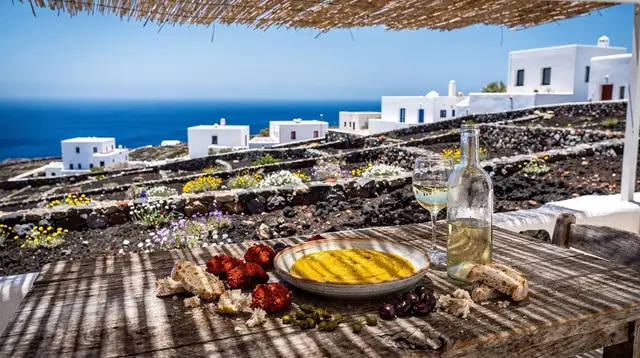
Fava (a yellow split-pea puree) and tomatokeftedes (cherry tomato fritters) are the two dishes visitors ask about most. Wine is built around Assyrtiko, a dry white grown in low, basket-shaped vines called kouloura without any irrigation.
Most islands sell a view. Santorini sells a view and a plate of food grown in the ash beneath it, which is the part first-time visitors tend to miss. The volcanic soil that shaped the caldera also produces some of the most distinctive small-scale agriculture in Greece — tomatoes, legumes, and grapes that taste different here because the ground genuinely is different. This page is the overview: what to know before you choose a taverna, a cooking class, or a wine tasting, and where to go for the detail on each.
A Table Built on Volcanic Soil
Santorini has no rivers, no springs, and no reliable rainfall through the growing season. What it has instead is porous volcanic ash — locally called aspa — that holds nighttime humidity and releases it slowly to plant roots through the dry months. Farmers here have worked around the absence of fresh water for centuries rather than against it, which is why the island’s food identity is built on a short list of crops that thrive in exactly this soil: small cherry tomatoes, a pale-yellow split pea, capers that grow wild on stone walls, and a white eggplant variety found almost nowhere else.
The result is produce that tends to taste more concentrated than its mainland equivalent, because it grows slower and smaller. Several of these products — the tomato, the fava, the caper — carry Protected Designation of Origin or Protected Geographical Indication status specific to Santorini, which is a formal way of saying the variety and the growing conditions cannot be reproduced elsewhere and still carry the name. Travelers curious to see the growing conditions in person often fold a stop into one of the island’s day trips beyond the caldera rim, several of which pass wineries and inland farmland on the way to Akrotiri.
The Two Dishes Everyone Asks About
If a visitor arrives having read only one thing about Santorini food, it is usually about fava and tomatokeftedes. Fava here is not the broad bean known by that name elsewhere in Europe — it is a smooth puree made from a local yellow split pea, usually served warm with olive oil, raw onion, and capers on top. Tomatokeftedes are fritters made from the island’s small, intensely sweet cherry tomatoes, mixed with herbs and fried to order rather than pre-made, so a good version arrives hot with a crisp edge.
Both dishes appear on almost every taverna menu on the island, which makes them easy to try but also easy to get a mediocre version of — quality varies more than the ubiquity suggests. The full breakdown of how each is made, what a good one looks like, and which preparations to be wary of lives on its own page: /guides/fava-and-tomatokeftedes-explained/. This page stays at the overview level; that one goes into the detail worth having before you order.
Wine Grown Without Rain
The same dry, mineral-rich soil that shapes the vegetables shapes the wine, and Santorini’s wine identity is arguably more distinctive than its food. The signature grape is Assyrtiko, a dry white with unusually high acidity for a warm climate, alongside lesser-known local varieties like Aidani and Athiri, and the reds Mandilaria and Mavrotragano. The two bottles worth knowing before a tasting are Vinsanto, a sweet wine made from sun-dried grapes and aged in barrel, and Nykteri, a dry white traditionally harvested and pressed through the night to avoid the daytime heat.
What makes all of it possible without irrigation is a training method called kouloura — vines woven into low, basket-like coils that sit on the ground rather than climbing a trellis. The coil shelters the grapes from wind and captures overnight moisture, and it is the single most distinctive thing to look at in the vineyards after the caldera itself. Vintages here also come early: harvest often starts in late July or August, weeks ahead of most of Europe, which is worth weighing against general guidance on the best time to visit Santorini if grape season is part of the appeal.
A handful of wineries anchor most tastings: Santo Wines, a cooperative with a terrace over the caldera; Venetsanos, built into the island’s oldest surviving winery structure above the port at Athinios; Domaine Sigalas near Oia; Estate Argyros; Gavalas; and Art Space, a winery built into old quarry caves in Exo Gonia. Reaching several of these independently in one afternoon usually means renting a car or scooter, since the wineries sit far enough apart that walking between them is impractical.
The full comparison of what each offers — and how a tasting differs from a cellar tour — is at /guides/santorini-wineries-compared/, with grape-by-grape detail at /guides/assyrtiko-explained/ and /guides/vinsanto-guide/, and single-winery guides at /guides/santo-wines-visit/ and /guides/venetsanos-winery-visit/. The island’s wine museum in Vothonas, which explains the production history rather than pouring tastings, has its own page at /guides/santorini-wine-museum-vothonas/. For a broader walk through how to plan an afternoon around all of this, see /guides/santorini-wine-tasting-guide/.
For a first taste that goes beyond wine alone, a farm-to-table visit pairs the produce with the growing conditions directly.
a farm-to-table tour that visits a working local farm before the meal puts the soil-to-plate connection in front of you rather than leaving it as background reading.
Beyond Fava and Wine: The Rest of the Table
Fava and tomatokeftedes get the attention, but they are two dishes among many built from the same short list of local ingredients. Capers and caper leaves — pickled and used as a garnish or a salad ingredient — show up more here than almost anywhere else in Greece, again because the caper bush is one of the few things that thrives in dry stone walls.
White eggplant, smaller and less bitter than the purple variety, turns up fried, stewed, or in dips. Chloro, a soft, tangy local cheese, appears grated over dishes or eaten on its own with bread. Seafood follows the coastline rather than the caldera: catches change with the season and the port, and the better seafood tavernas tend to sit in Ammoudi Bay, Vlychada, and around Kamari rather than on the clifftop. Reaching these coastal spots independently is often easiest by electric bike, since public buses along the coast road run less frequently than routes into the caldera villages.
None of this needs to be memorised before arrival — a decent taverna menu will offer most of it — but knowing the names in advance means recognising a genuinely local dish rather than defaulting to a Greek salad every time.
Choosing a Village to Eat In
Where you eat changes the experience as much as what you order. The caldera-rim villages — Oia, Imerovigli, Fira — charge a premium tied to the view, and the food is not always proportional to the price. Inland villages built around agriculture rather than sunset photography tend to run cheaper and, in several cases, cook better: Pyrgos, Megalochori, and Emporio all have tavernas that serve locals as much as visitors, without a caldera view to lean on. Vothonas and Exo Gonia sit close to several wineries, which makes them convenient for combining a meal with a tasting on the same afternoon. Reaching them independently is straightforward on Santorini’s bus network, which connects Fira to most inland villages within twenty minutes.
A full village-by-village breakdown of where to eat and why — including which caldera restaurants are worth the markup and which are not — is at /guides/where-to-eat-by-village/. For background on the villages themselves rather than just their food, /guides/santorini-villages-guide/, /guides/pyrgos-village-guide/, and /guides/megalochori-village-guide/ go further. Travelers who prefer driving between villages themselves should read up on driving in Santorini first, since road width and parking near village centers are tighter than they look on a map.
Learning to Cook It Yourself
For visitors who want more than a meal, cooking classes are the most common way to go deeper. Most run as a half-day session: a market or garden visit, hands-on preparation of several dishes — fava and tomatokeftedes are near-universal on the menu — and a shared meal of what was made. It suits travellers who want to take something home beyond photographs, and it works well as a rainy-day or high-wind alternative when a boat trip or beach day is not appealing.
The detail on formats, what a typical class covers, and how to choose between the options on offer is at Santorini Cooking Classes: What to Know Before You Book.
Organised Formats: Tours, Farms, and Themed Dinners
Beyond a class, several organised formats exist for travellers who would rather have the food curated than choose a taverna at random. Food tours typically walk between several small stops in a single village, sampling rather than sitting down to a full meal, and are often paired with a “Greek night” format — a fixed set menu with live music at a single taverna, aimed at groups. Both formats and how they differ are covered at /guides/food-tours-and-greek-nights/. Travelers who would rather compare formats side by side than book one at random can also see how combo tours pair a caldera cruise or village stop with a wine tasting in a single booking.
A farm-to-table visit goes further upstream, starting at the source rather than the table.
an ATV route that combines the villages with a stop for wine tasting is a way to cover more ground — several villages and a winery — in a single afternoon, for travellers who want the food-and-wine theme without dedicating a full separate day to each.
Evening formats add the caldera back into the equation. A themed dinner at sunset works differently depending on whether it happens on land or on water:
a sunset dinner cruise around the caldera replaces a table with a view of Oia’s cliffs from the water, which avoids the crowding that a clifftop restaurant reservation at the same hour usually involves. More on how these compare to a clifftop table is at /guides/sunset-cruise-santorini-compared/ and /guides/oia-sunset-without-the-crowds/. For the daytime version of the same route, the Santorini caldera cruise guide covers the Nea Kameni and hot springs stop that the sunset version usually skips.
For visitors arriving from or departing through Athens rather than staying on the island for a full trip, the theme travels with you:
a Santorini-themed tasting experience based in Athens is worth knowing about if your itinerary only allows a short island stop, or none at all. Cruise passengers facing the same time squeeze ashore will find a similar tradeoff covered at best shore excursions in Santorini.
How Much Time to Set Aside
Food and wine rarely need a dedicated day on their own — most visitors fold a farm visit, a tasting, or a cooking class into a broader itinerary rather than building a trip around it. That said, travellers with a specific interest in the subject sometimes prefer to structure a day or two around it deliberately: a morning market or farm visit, an afternoon winery, and dinner in an inland village rather than on the caldera rim. A pre-built version of that structure is at /itineraries/santorini-wine-itinerary/, and general pacing guidance — how many days on the island overall — is at /guides/how-many-days-in-santorini/.
Practical Notes Before You Book Anything
A few things are worth knowing before choosing where to eat or what to book. Village tavernas rarely need reservations outside the first two weeks of August; caldera-view restaurants in Oia and Imerovigli generally do, especially around sunset, and often involve stairs or uneven cobblestone paths to reach — see accessibility in Santorini for what limited-mobility travelers should expect. Cash remains useful in smaller village tavernas even though cards are widely accepted elsewhere on the island. And because the island imports almost everything that its own soil cannot produce, seafood and imported ingredients carry a noticeably higher price than the locally grown dishes built around fava, tomato, and caper — a useful rule of thumb when a menu looks unexpectedly expensive.
Frequently Asked Questions About Santorini’s Food and Wine
Is Santorini food expensive compared to the rest of Greece?
Village tavernas away from the caldera villages price close to mainland Greek averages. Caldera-view restaurants in Oia, Imerovigli, and Fira charge a premium for the view rather than the food, which is worth knowing before you pick a table.
What makes Santorini’s produce different from other Greek islands?
The volcanic soil holds moisture and minerals unusually well, so tomatoes, fava, capers, and white eggplant grown here are smaller, more concentrated, and often sold under their own island-specific PDO or PGI labels.
Do I need to book a food tour, or can I just eat at tavernas?
Neither is required. Village tavernas need no booking outside August; organised formats like farm visits, cooking classes, or themed dinners exist for travellers who want context or company rather than just a meal.
Is Assyrtiko the only wine worth trying here?
It is the signature dry white, but Vinsanto, the island’s sun-dried sweet wine, and Nykteri, a night-harvested dry white, are both distinct enough to try alongside it, especially at a tasting rather than by the glass at dinner.
Which villages are best for eating rather than just sunset views?
Pyrgos, Megalochori, and Emporio are inland villages built around tavernas rather than photo spots, generally with lower prices and fewer crowds than the caldera rim.
Can vegetarians eat well in Santorini?
Yes — fava, tomatokeftedes, capers, white eggplant, and Greek salad are all vegetarian by default, and most tavernas build several courses around them rather than treating them as sides.
Food and drink tours on GetYourGuide
Verified deep-linked GetYourGuide tours. Book through these links and we earn a small commission at no cost to you.
GetYourGuide does not provide a product photo for this activity — the image shows the meeting point, photographed by us.