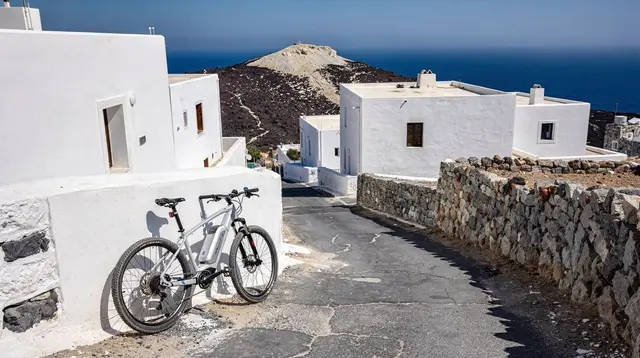
Exploring Santorini by Electric Bike
Is it realistic to get around Santorini by bicycle?
Only with electric assistance. The island's hills, heat and wind make a plain bicycle hard work outside a short flat stretch, but a pedal-assist e-bike handles the climbs between the inland villages and needs no motorcycle licence, unlike a quad or scooter.
Why an E-Bike Makes Sense Here
Santorini looks made for slow travel: whitewashed villages a short ride apart, vineyards running down volcanic slopes, sea on every horizon. What the postcards don’t show is the terrain underneath. The caldera villages of Fira, Imerovigli and Oia sit 250 to 300 metres above the sea on a cliff edge, and the inland road network between them never really flattens out. Add a dry summer heat that sits in the high 20s and 30s Celsius for months, and a north wind, the meltemi, that can turn a headwind leg into hard work, and a plain bicycle stops being a relaxed way to see the island and starts being a fitness test.
That is the gap an electric bike closes. Pedal-assist motors flatten the climbs between villages, take the sting out of a midday headwind, and let a rider cover in two or three hours what would otherwise take most of a day on a standard bicycle.
Unlike a quad or scooter, an e-bike is legally a bicycle in Greece: no motorcycle licence, no vehicle category, none of the paperwork or age restrictions that apply to the motorised options covered in Driving in Santorini and ATV and Quad Rental in Santorini. It sits in a useful middle ground: faster and far less exhausting than walking, quieter and simpler than renting a scooter, and open to riders who don’t want to deal with a motor vehicle at all.
This guide is for that middle-ground traveller: someone who wants to move around the island under their own power, minus the long walk and minus the motor. It covers where an e-bike works well, where it doesn’t, what the wind and heat actually do to a ride, and how self-guided riding compares with a booked tour.
What an E-Bike Is Good For, and What It Isn’t
An e-bike earns its keep on rolling, paved roads between inland villages, where the assist turns a steady climb into a manageable one and the descents are simply enjoyable. It is a poor tool for two specific things people often assume it handles. First, it is not a substitute for the Fira-Oia caldera path: long stretches of that trail are narrow, uneven, and in places stepped, built for walking feet rather than wheels, and riding it is neither comfortable nor, on some sections, physically possible.
Second, it is not a beach-hopping vehicle. The distances from the caldera down to Kamari, Perissa or Perivolos involve a long descent and, on the way back, a long climb that even a good motor feels on a hot afternoon.
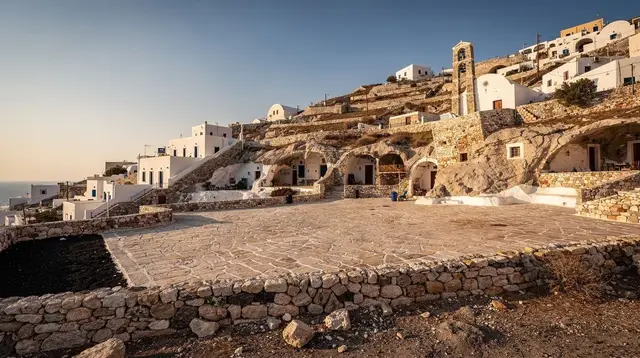
Where an e-bike genuinely shines is the inland loop away from the cliff-edge crowds: Pyrgos with its hilltop kastro, Megalochori, Emporio and its own fortified quarter, Exo Gonia and Vothonas, threading between the wine estates that make up much of this side of the island.
Traffic here is lighter than on the Fira-Oia road, the villages are smaller and quieter, and the riding rewards a slower pace anyway, since there is a kastro, a chapel or a tasting room worth stopping for every few kilometres. For background on the villages themselves before you plan a route, see Santorini’s Villages Compared, Pyrgos and Megalochori Village Guide.
Heat, Wind and When to Ride
Two forces shape every e-bike ride on Santorini more than the terrain does. The first is heat. From June to September, the island runs a dry, direct heat with little shade on open roads, and riding through the middle of the day is uncomfortable even with electric assistance doing most of the work. The second is the meltemi, a strong, persistent north wind that builds through July and August and can turn an exposed stretch of road into a real headwind, sometimes strong enough to slow an e-bike to a crawl on the way out and push it fast and twitchy on the way back. Neither force is dangerous in itself, but both make timing matter more than route choice.
The practical fix is the same one that works for hiking the caldera path: ride early, before roughly 10-11am, or later in the afternoon once the sun has lost its edge, and check the wind before committing to an exposed loop. For a fuller picture of what to expect by month, Santorini Weather, Month by Month and The Meltemi Wind in Santorini, Explained are worth reading before you book anything. If your dates fall in the shoulder months, April-May or October, riding is noticeably easier: cooler air, a gentler wind, and the same routes with far less traffic, as described in Santorini in the Shoulder Season.
| Riding window | Heat | Meltemi risk | Verdict |
|---|---|---|---|
| Before 10am | Mild | Usually calm | Best window most days |
| 11am-4pm, June-Sept | High | Variable | Avoid on inland climbs |
| Late afternoon | Cooling | Can pick up | Good for shorter loops |
| Shoulder season (Apr-May, Oct) | Comfortable | Lower average | Easiest riding overall |
Renting an E-Bike vs Booking a Guided Ride
Two ways to do this exist side by side, and which one suits you depends more on how much route-planning you want to do yourself than on fitness.
Self-guided rental means picking up a bike, usually from a shop in or near Fira, and choosing your own route and pace. It gives full freedom over timing and stops but leaves you responsible for reading the map, judging how much battery a given loop needs, and knowing which roads carry heavy tour-bus and rental-car traffic. Prices vary by shop, bike quality and how many days you rent for, so treat any number you see as a rough guide rather than a fixed rate, and confirm the current price and battery range when you book.
A guided e-bike tour removes that planning entirely. A local guide sets the pace, picks the day’s route around the wind forecast, and handles the mechanical side of things if a bike needs adjusting mid-ride. For a first visit, or for anyone not confident reading terrain from a map, this is the lower-friction option:
a guided electric mountain bike outing through Santorini’s inland terrain covers the hillier routes with a group and a support vehicle nearby, while a more relaxed guided e-bike tour suits riders who want the villages and viewpoints without pushing the pace. Riders specifically chasing the caldera view without walking the full trail can also look at a guided tour to Oia, which reaches the village by a manageable route and timed stop rather than the open-ended hike.
Both approaches work. The rule of thumb: rent and go it alone if you already know the island a little and want flexibility over your day; book a guide if this is a first trip, if you’d rather not navigate inland roads yourself, or if you’re riding in peak summer heat and want someone else tracking the wind for you.
How an E-Bike Compares to the Alternatives
Santorini’s terrain rules some options out faster than visitors expect. This table lines up the realistic ways to move around the island against the terrain described above.
| Option | Handles the hills | Licence needed | Best for |
|---|---|---|---|
| Walking | Poorly over distance | No | Short village strolls, not cross-island trips |
| Plain bicycle | Poorly | No | Flat coastal stretches only |
| Electric bike | Well | No | Inland villages, wineries, self-paced sightseeing |
| Scooter / ATV / quad | Well | Yes | Longer distances, beach access, more cargo |
| Rental car | Well | Yes | Groups, luggage, multi-stop days |
An e-bike sits deliberately between the muscle-powered and motorised categories: it needs no licence and produces no exhaust, but it still climbs. For anyone weighing a scooter or quad instead, the licence requirements and road rules are laid out in ATV and Quad Rental in Santorini and Driving in Santorini; for those who’d rather not ride anything at all, Santorini Without a Car covers getting around by bus and on foot instead.
Riders drawn to the wine side of the island specifically may prefer to pair an e-bike loop with tastings along the way; the wine geography and estates worth stopping at are covered separately in Santorini Wine Tasting, and a motorised version of the same idea, for those who’d rather not pedal between cellars, exists as a guided ATV route linking several wine estates.
Safety and Practical Notes
A few points matter more here than on a typical cycling holiday. Roads outside the main villages often have no shoulder, and rental cars, quads and tour buses share the same narrow lanes, so riding single file and staying visible matters more than usual. Volcanic road surfaces can be loose with gravel on unpaved stretches near the villages, which catches an inattentive front wheel.
Water matters more than it seems: the dry heat pulls moisture out of a rider faster than it feels, and Santorini’s tap water is desalinated and drinkable but tastes brackish, so most visitors carry bottled water rather than relying on refills. Finally, check your e-bike’s charge and range before setting off on the inland loop; running out of assist halfway up a climb to Pyrgos on a hot afternoon turns a pleasant ride into an unpleasant one fast.
The 2025 seismic swarm between Santorini and Amorgos, which lasted roughly forty days and produced tens of thousands of tremors before ending without an eruption, is sometimes raised by visitors asking whether the island is safe to explore actively. It isn’t a live concern for cycling: the swarm ended, and the everyday hazards for a rider are the ones above, not seismic activity. More detail on that event and how the island has moved on from it is in Santorini Safety and the 2025 Earthquakes.
For riders curious about the wider island beyond a single loop, the caldera’s volcanic origins are explained in How the Santorini Caldera Was Formed, and a longer, non-cycling hike along the cliff edge is detailed in The Fira–Oia Caldera Path and Hiking in Santorini Beyond the Fira–Oia Caldera Path for anyone who wants to combine a day of riding with a day on foot.
Santorini E-Bike FAQ
Do I need an e-bike, or is a regular bicycle enough on Santorini?
A regular bicycle struggles here. The caldera villages sit 250-300 metres above sea level, the inland roads roll constantly, and summer heat plus the meltemi wind add resistance a plain bicycle rarely overcomes for a full day. An e-bike’s pedal assist is what makes cycling a realistic way to get around rather than a workout.
Can I ride an e-bike from Fira to Oia along the caldera?
Much of the Fira-Oia caldera path is a narrow, uneven walking trail rather than a cycling route, and parts are stepped or too rocky for wheels. Riders who want the caldera view by bike generally use the paved inland roads instead. The full walking route, about 10.5 km, is covered separately in The Fira–Oia Caldera Path.
Is an e-bike allowed without a special licence?
In Greece, pedal-assist e-bikes are legally treated as bicycles, not motor vehicles, so no motorcycle licence or vehicle category is required to rent or ride one. That is the main practical difference from a quad or scooter, both of which need a valid licence and are covered in ATV and Quad Rental in Santorini and Driving in Santorini.
How much does e-bike rental cost per day?
Prices vary by shop, bike quality and season, so treat any figure as a rough order of magnitude rather than a fixed rate. Guided half-day and full-day e-bike tours bundle a bike, a guide and route planning into one price, which some riders find simpler than negotiating a standalone rental.
What happens if the meltemi is blowing?
The meltemi is a strong, dry north wind that peaks in July and August. On an exposed ridge or a coastal road it can slow an e-bike to walking pace on the headwind leg and push it uncomfortably fast on the way back. Riding early in the day, before the wind builds, is the standard workaround.
Are there guided e-bike tours, and are they worth it?
Yes, and for a first visit they solve the two hardest parts of self-guided riding: route-finding on unmarked inland roads and reading how much climb is left in the battery. A guide also knows which stretches to skip when the wind is up that day.
Where can I ride an e-bike away from traffic?
The inland loop through Pyrgos, Megalochori, Emporio, Exo Gonia and Vothonas carries far less traffic than the Fira-Oia road and passes vineyards, kastro villages and wine estates rather than tour buses. It is the route most self-guided e-bike riders end up choosing.
Is Santorini safe for cycling given the 2025 earthquakes?
The seismic swarm of early 2025 lasted around forty days, produced tens of thousands of tremors and prompted a temporary local state of emergency, but no eruption followed and the swarm has ended. It has no bearing on road conditions today; the real hazards for a cyclist are the heat, the wind and shoulderless roads shared with rental cars, which apply in any season. More context is in Santorini Safety and the 2025 Earthquakes.
Cycling on GetYourGuide
Verified deep-linked GetYourGuide tours. Book through these links and we earn a small commission at no cost to you.
GetYourGuide does not provide a product photo for this activity — the image shows the meeting point, photographed by us.