Santorini's Villages Compared
Which Santorini village should I choose — Fira, Oia, Imerovigli or Pyrgos?
Fira is the walkable base with the most restaurants, shops and nightlife but no sea access; Oia has the famous sunset and the highest prices; Imerovigli and Firostefani sit quietly above the caldera with fewer crowds; Pyrgos, Megalochori and Emporio are inland villages away from the caldera rim, closer to the vineyards. None of these villages has a beach — those are on the east and south coasts, a taxi or bus ride away.
Caldera Villages vs Inland Villages
Santorini’s villages fall into two families, and mixing them up is the fastest way to book the wrong base. The first family sits directly on the rim of the caldera — the flooded volcanic crater on the island’s west side — and includes Fira, Firostefani, Imerovigli and Oia.
These are the villages in every postcard: whitewashed cubes stacked on a cliff, blue domes, a view straight down into the water. The second family sits inland, away from the cliff edge, and includes Pyrgos, Megalochori and Emporio. These villages trade the caldera view for lower prices, quieter evenings and closer access to the island’s vineyards.
Both families are worth understanding before you book, because they solve different problems. This page compares them side by side to help you choose where to stay or where to spend an evening out; it does not go deep on any single village, since Fira, Oia, Pyrgos, Megalochori and Emporio each have their own detailed guide.
The One Thing No Caldera Village Has
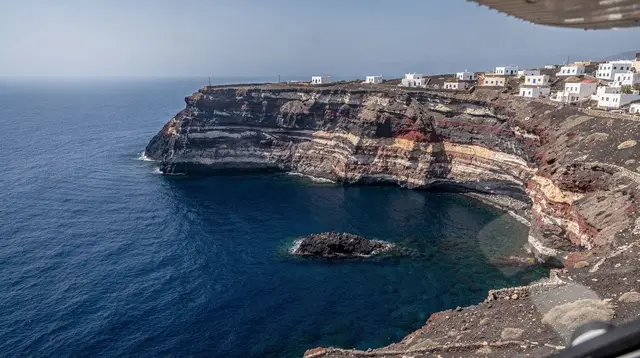
Before anything else: none of Fira, Firostefani, Imerovigli or Oia has a beach. The caldera villages sit on top of a cliff that rises 250 to 300 metres above the water in places, a wall of pumice and lava left by the Bronze Age eruption that carved out the crater in the first place. There is no path down to a swimming spot from any of them — only stairs and cobbled lanes leading to viewpoints, restaurants and, in Fira’s case, a cable car down to the old port for boat excursions, not for swimming.
Santorini’s actual beaches — Kamari, Perissa, Perivolos and Vlychada — sit on the opposite, lower side of the island and require a bus, taxi or rental car to reach. If a sea view from your balcony matters more than swimming from your hotel, the caldera villages deliver; if you want to walk out of your room and into the water, none of them will.
Villages at a Glance
| Village | Type | View | Evening scene | Price level | Best for |
|---|---|---|---|---|---|
| Fira | Caldera rim | Caldera, sunset (partial) | Busiest — restaurants, bars, shops | High | First-timers who want to walk everywhere |
| Firostefani | Caldera rim | Caldera, sunset | Quiet, a 10-minute walk from Fira’s centre | High | Fira’s convenience without Fira’s noise |
| Imerovigli | Caldera rim | Best unobstructed caldera view | Very quiet, upscale hotels | Highest | Honeymoons, long quiet evenings |
| Oia | Caldera rim | The classic sunset view | Crowded at sunset, calmer after | Highest | The sunset, photography, one splurge night |
| Pyrgos | Inland | Whole-island panorama from the kastro | Quiet, a handful of tavernas | Moderate | Wine country, views without crowds |
| Megalochori | Inland | Village lanes, no sea view | Very quiet, a couple of restaurants | Moderate | Peace, proximity to wineries |
| Emporio | Inland | Village lanes, kastro alleys | Near-silent after dark | Lower | A short visit, not a multi-night stay |
Prices shift with the season and with how close a room sits to the caldera edge — a cliffside room in Imerovigli or Oia can cost several times a comparable room a few streets back, or in an inland village altogether.
Fira: The Walkable Base
Fira is Santorini’s capital and its most practical base. Everything a first-time visitor needs is within walking distance: the bus station that serves the whole island, the old port and cable car down to the water for boat excursions, the archaeological museum, and the highest concentration of restaurants and bars on the island.
The trade-off is exactly that concentration — Fira is the loudest and busiest of the caldera villages, especially around its main square in the evening and whenever a cruise ship is in port. Its caldera-edge terraces catch a version of the sunset, though not as directly as Oia’s, and the walk north along the Fira-to-Oia caldera path starts right from town.
Firostefani and Imerovigli: Fira’s Calmer Neighbours
Walk ten minutes north from Fira’s centre and the crowds thin out considerably at Firostefani, then almost disappear by the time the path reaches Imerovigli, perched at the caldera’s highest point next to Skaros Rock — the dark volcanic promontory that was once the medieval capital’s fortress.
Imerovigli has the most uninterrupted caldera view on the island and a reputation for quiet, design-led hotels, which is also why it tends to be the most expensive place to sleep. Firostefani sits in between: close enough to Fira to walk in for dinner, far enough to sleep without the noise. Neither village has its own bus station or the same restaurant density as Fira, so many visitors treat them as a place to sleep and watch the sky, not a place to spend the whole evening.
Oia: The Sunset, At a Price
Oia is the village most people picture when they picture Santorini, and it earns that reputation honestly — its position at the northern tip of the caldera gives an open, uninterrupted line to the horizon that makes it the island’s most searched sunset spot. That fame comes with a cost: Oia’s Kastro viewpoint fills ninety minutes to two hours before sunset in high season, and its steep lanes were built for a fraction of the daytime foot traffic they now carry. Rooms in Oia, particularly anything with a caldera-facing balcony, sit at the top of the island’s price range.
Staying in Oia makes sense if the sunset and the photographs are the priority and you don’t mind paying for proximity; staying elsewhere and visiting Oia for an afternoon and evening works just as well for everyone else, and this is exactly what most multi-village day plans do — an approach covered in the sunset guide and in alternatives beyond Oia for anyone who would rather skip the crowd.
A single tour built around Oia, Pyrgos and a winery stop — like this sunset tour that pairs Oia’s viewpoint with Pyrgos and a wine tasting on the same evening — is a straightforward way to see both without arranging your own transport.
Pyrgos: The Island’s Best View, Without the Caldera Crowd
Pyrgos sits inland, on a hill crowned by a ruined Venetian kastro, and it makes a case that no caldera village can: it’s the only point on Santorini from which you can see nearly the whole island at once, caldera included, without standing on the caldera rim itself. Pyrgos is quiet, sparsely visited compared with Fira or Oia, and sits close to several of the island’s wineries and to the Profitis Ilias monastery at Santorini’s highest point.
Rooms here cost noticeably less than an equivalent room in Fira or Oia, which makes Pyrgos a common choice for visitors prioritising value and views over caldera-front proximity. A half-day built around the village and a nearby winery — for instance a guided walk through Pyrgos’s kastro lanes followed by a winery tasting — covers the village properly without needing a rental car.
Megalochori and Emporio: Quiet, Inland, Close to the Vines
Megalochori and Emporio sit further from the tourist circuit than any of the villages above. Megalochori is a small, low-key village with a handful of good restaurants and easy access to several wineries in the surrounding countryside — it’s often described as one of the prettiest villages on the island precisely because so few visitors make the trip.
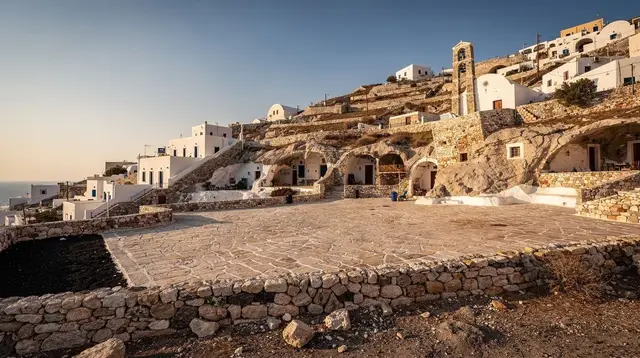
Emporio has Santorini’s best-preserved kastro, a genuine defensive settlement of narrow, winding lanes built to confuse pirate raiders rather than tourists, and today it’s closer to a living village than a destination — worth an hour or two on foot, less commonly a multi-night base. Neither village has a caldera view, a beach, or the restaurant density of Fira, so they suit travellers who have already seen the caldera villages and want a quieter, cheaper corner of the island, or who are basing a trip around Santorini’s wine country from the start.
Choosing Between Them
A few questions cut through most of the indecision:
- Do you want to walk to dinner without a car or taxi? Choose Fira or Firostefani.
- Is watching the sunset from your own balcony the priority? Choose Oia, and book the caldera-facing room well ahead — those sell out first.
- Do you want the caldera view without the crowd or the price tag? Choose Imerovigli, or visit Skaros Rock from Fira on foot.
- Do you care more about value, wine, and quiet evenings than a sea view? Choose Pyrgos or Megalochori.
- Are you spending most of your time on beaches or boat excursions anyway? A caldera village still makes sense for the view at either end of the day, but don’t expect to walk to the water from it.
Many visitors solve this by splitting the difference rather than picking one village for an entire stay: a few nights in Fira or Imerovigli for the caldera, then a night or two inland near Pyrgos for the view and the vineyards. If you’d rather see the highlights of several villages in a single day without committing to a base for all of them, a private tour through the traditional villages with lunch included or a custom best-of itinerary built with a local guide both let you sample the caldera and the inland villages before deciding where you’d stay next time.
Getting Between the Villages
Buses run from Fira’s central station to Oia, the airport and the main beaches, and are the cheapest way to move between the caldera villages — though services thin out in the evening, which matters if you’re staying inland and planning to be in Oia for sunset. Taxis are genuinely scarce, with only a few dozen serving the entire island, so booking a transfer ahead of time is standard practice rather than a fallback.
For visitors staying in Pyrgos, Megalochori or Emporio, a rental car or scooter gives the most flexibility, since these villages sit off the main bus routes that connect the caldera towns. Whichever village you choose as a base, most of the island’s other villages are a short drive or bus ride away — close enough to visit for an evening even if you don’t sleep there.
Frequently Asked Questions About Santorini’s Villages
Which Santorini village has the best sunset?
Oia is the most famous sunset spot and its Kastro fills up ninety minutes to two hours before sunset in high season. Imerovigli, Firostefani and Skaros Rock give a similar view of the caldera with far fewer people, and Pyrgos is the only spot high enough to see the whole island at once. A sunset cruise avoids the crowd question entirely by watching the cliffs from the water.
Is Fira or Oia better to stay in?
Fira is more central, cheaper, and walkable to restaurants, bars and the old port cable car, which makes it the practical base for a first visit. Oia is quieter, more romantic and photogenic, but costs more and empties out for day-trippers once the sunset crowd leaves in the evening.
Do any Santorini caldera villages have a beach?
No. Fira, Firostefani, Imerovigli and Oia all sit on top of the caldera cliff, thirty to three hundred metres above the water, with no direct beach access. The sand and pebble beaches are on the opposite side of the island, at Kamari, Perissa, Perivolos and Vlychada.
What’s the difference between Imerovigli and Firostefani?
Imerovigli sits at the highest point of the caldera rim, next to Skaros Rock, and is known for uninterrupted views and quiet, upscale hotels. Firostefani is a short walk from Fira’s centre, slightly cheaper, and works as a compromise between Fira’s convenience and Imerovigli’s calm.
Why stay in Pyrgos or Megalochori instead of the caldera?
Pyrgos and Megalochori sit inland, away from the cliff, so rooms cost less and evenings are quieter. Pyrgos has the island’s best all-round view from its kastro, and both villages put you closer to the vineyards and wineries than any caldera village does.
Is Emporio worth visiting?
Emporio has the best-preserved kastro (fortified settlement core) on the island, a maze of narrow lanes built for defence against pirate raids, and almost no tourist infrastructure compared with Fira or Oia. It suits an afternoon visit or an evening walk more than a multi-night stay.
How do I get between the villages without a car?
KTEL buses run from Fira’s central station to Oia, Imerovigli, the airport and the beaches, though services thin out after early evening. Taxis are scarce — the island has only around thirty — so booking a transfer ahead is normal rather than a backup plan, and a scooter or ATV rental gives the most flexibility if you’re comfortable driving Santorini’s narrow roads.
Villages and Culture on GetYourGuide
Verified deep-linked GetYourGuide tours. Book through these links and we earn a small commission at no cost to you.
GetYourGuide does not provide a product photo for this activity — the image shows the meeting point, photographed by us.