Oia Village Guide: Streets, Kastro and Daily Life Beyond the Sunset
What is there to do in Oia besides watching the sunset?
Oia's daytime appeal is its architecture: cave houses and restored captain's mansions stacked along the caldera rim, a ruined Byzantine kastro, marble-paved lanes of galleries and jewellers, and the fishing harbour of Ammoudi reached by around 300 steps. Visiting in the morning or early afternoon avoids the crowd that builds before sunset.
At the northern tip of the caldera crescent, Oia is the smallest of Santorini’s headline villages and, for most of the day, the least understood. Nearly everyone who mentions it means the sunset — the queue for the kastro walls, the crowd shuffling along the rim from around ninety minutes before dusk. That is a real and separate subject, covered on its own page. This one is about the village itself: the houses cut into the cliff, the fortress that predates the tourism by roughly seven centuries, and the streets that are, for a few hours each morning, just a village again.
A Village Stacked on the Rim
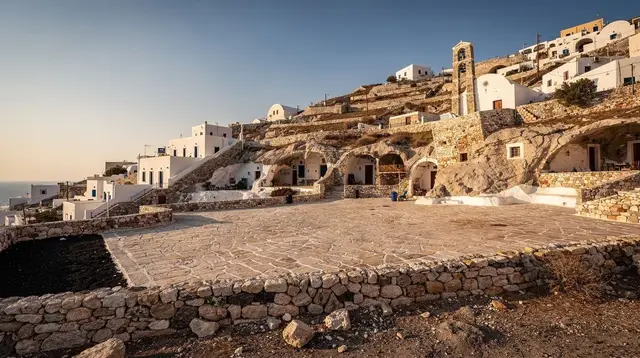
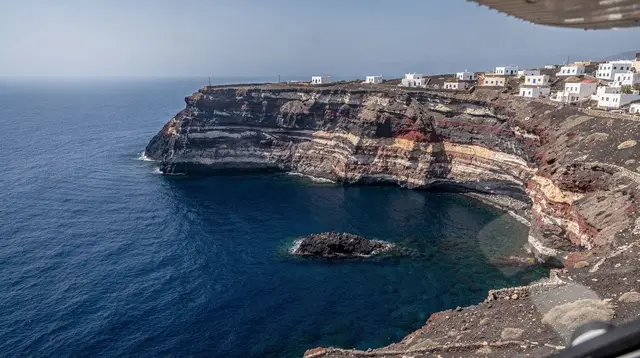
Oia sits higher and further out than Fira, on a narrower stretch of the caldera edge where the cliff drops close to 300 metres to the water. There is no flat ground to build on, so the village does what every settlement on this side of the island does: it stacks. Houses are cut into the pumice and terraced downward in tiers, roofs doubling as the terrace of the house above, so that from a boat below the whole village reads as one continuous white-and-blue structure rather than individual buildings.
The view from the rim takes in Thirassia across the water and the full sweep of the Santorini caldera toward Fira and Imerovigli. Because the ground falls away so steeply, almost none of Oia has road access for cars; deliveries, luggage and even furniture move by handcart or, on the steepest lanes, by mule. This is worth knowing before booking a room here — arriving with heavy suitcases is a genuinely different experience than in a village with a car park.
Captain’s Houses and a Village Rebuilt
Oia’s most photographed buildings are its so-called captain’s houses — the larger, more formal mansions built by the island’s 19th-century shipowning families, distinguishable from ordinary cave houses by their neoclassical doorways, higher ceilings and, in a few surviving examples, painted interiors. Oia was a wealthier maritime village than most of the island for exactly this reason: its captains sailed as far as the Black Sea and Egypt, and the money came home into stone.
Much of what stands today, though, is not original. A powerful earthquake struck the southern Aegean in 1956, and Oia — more exposed on the cliff edge than the villages set further back — suffered some of the worst damage on the island. Many captain’s houses collapsed outright, and a large share of the population left for Athens or Piraeus in the years that followed.
The village’s current form, cave houses restored in the traditional style, mansions rebuilt or reconstructed from photographs, is largely a product of the decades after that earthquake, not an unbroken line back to the 18th or 19th century. It is a detail that changes how the architecture reads once you know it: less an untouched relic, more a deliberate act of putting a place back together.
The Kastro: A Byzantine Fortress, Not an Ancient Site
The single most common misunderstanding about Oia is the kastro itself. It is often described loosely as “ruins,” which invites the assumption that it belongs to the same era as Akrotiri or the Minoan Bronze Age. It does not. Oia’s kastro is a Byzantine-era fortress, later reinforced and held during the centuries of Venetian and Ottoman contest over the Cyclades, built for the plain purpose of watching the sea for pirate raids — a role shared with fortified hilltop settlements elsewhere on the island, including Pyrgos and Emporio, both built inland and away from the coast for the same defensive logic.
Little of the structure survives as a recognisable building; what remains is mostly wall footings and terracing, which is precisely why it now works so well as an informal viewing platform. During the day, with the crowds absent, the site is easier to read for what it actually is: the highest, most defensible point of a medieval settlement, not a monument staged for photographs. If the sunset gathering itself is what you’re planning around, that belongs to a different piece — see Oia’s sunset without the crowd for the practical side of that hour.
Streets, Shops and the Village by Day
Oia’s main pedestrian street runs the length of the village roughly parallel to the caldera edge, paved in the pale marble slabs common to Santorini’s older settlements, worn smooth and bright by more than a century of foot traffic. Away from the two or three busiest stretches, the side lanes are narrow enough that two people have to turn sideways to pass, threading between blue-domed chapels, whitewashed walls and the occasional resident cat asleep in a doorway.
The commercial character of the street has shifted over the decades from working village to a concentration of art galleries, jewellery shops working in gold and in local volcanic stone, and small boutiques, alongside the handful of grocers and bakeries that still serve residents rather than visitors. It is worth walking the street once purely as a village rather than a shopping stop: several of the private chapels are still in use, marked by small candle-lit interiors visible through open doors rather than by any signage.
The clearest way to see this side of Oia is simply timing. The village empties out for an hour or two around midday, when day-trippers have moved on to lunch elsewhere and the evening crowd hasn’t arrived, and again properly quiets after the sunset crowd disperses toward dinner. Both windows are described, with more texture on the human side of it, in the village nobody photographs.
Down to Ammoudi Bay
From the western end of the village, a stepped path drops roughly 300 steps to Ammoudi Bay, Oia’s small working harbour. Unlike the sweeping caldera views above, Ammoudi puts you at sea level, among a handful of fishing boats, a short stone jetty and a row of tavernas serving the day’s catch a few metres from the water. It is also where small boats to Thirassia and short excursions along the base of the cliff depart, giving a different, closer angle on the caldera wall than anything visible from the rim.
The walk down is easy; the walk back up, in the midday heat with no shade for most of the climb, is the part visitors underestimate. Early morning or the couple of hours before sunset — when the temperature has dropped but the crowd for the kastro hasn’t yet formed — are the more comfortable times to make the trip.
Finikia: Oia’s Quieter Neighbour
A ten-to-fifteen-minute walk southeast from the main street, along a road that gently climbs away from the caldera edge, is Finikia, a small hamlet built in the same cave-house style as Oia but with almost none of its visitor volume. Finikia was historically the more residential side of the settlement, set back from the cliff and the sea view that made Oia’s rim so desirable to build on, and it still functions closer to an ordinary village: fewer galleries, more houses with washing on the line.
It is not a separate attraction so much as a useful contrast — walking from Oia’s main street into Finikia in the space of fifteen minutes is the fastest way to feel the difference between the restored, gallery-lined version of a Cycladic village and one that never fully turned toward tourism.
The Naval Maritime Museum
Set inside a restored 19th-century captain’s mansion near the eastern end of the village, the Naval Maritime Museum is a small, single-building collection tracing Oia’s seafaring history through ship models, navigational instruments, photographs and a few salvaged fittings from vessels once owned by local families. It is a modest visit, rarely more than half an hour, but it fills in the context behind the captain’s houses scattered through the rest of the village, and it is a sound indoor option if the weather or the midday heat makes walking the open lanes unappealing.
Getting to and Around Oia
Oia has no car access to most of its interior, and parking at its edges fills early in the day in high season. The practical options for reaching it from elsewhere on the island are limited to a few:
| Option | From | Notes |
|---|---|---|
| KTEL bus | Fira | Frequent in high season, thins out in the evening |
| Taxi | Anywhere on the island | Book ahead; the island has very few taxis |
| Rental car or ATV | Anywhere on the island | Park at the village edge, walk in |
| Fira–Oia caldera path | Fira | Roughly 10.5 km, 3–5 hours on foot, no shade |
Public buses run from Fira throughout the day in season, thinning out toward the evening, which is worth planning around if you’re staying elsewhere and want to see Oia by day rather than only at sunset. Given how few taxis operate on the island, arranging one in advance is standard practice, not an afterthought. Walkers coming from Fira or Imerovigli can follow the marked Fira-to-Oia caldera path, which arrives into Oia from its southern edge after passing above Skaros Rock — a route best started early in the morning, well before the midday heat.
Seeing Oia Without the Rush
The single most useful piece of planning advice for Oia is separating the village from the event that made it famous. The kastro, the captain’s houses and the stepped path to Ammoudi are worth a full morning or early afternoon on their own, on a schedule that has nothing to do with dusk. Save the evening crowd, the fight for a spot on the wall and the question of where else to watch from for a different visit — or for comparing Oia against the island’s other villages altogether in the Santorini villages guide, which sets its cliffside character against Fira’s role as the island’s capital.
For travellers building the wider caldera into a single day, several small-group tours combine Oia with other villages rather than treating it in isolation:
a village-hopping day combining Pyrgos’s kastro with an Assyrtiko winery tasting, a longer tour pairing Oia and Pyrgos with a wine stop before the evening light, and a customisable private itinerary with local guide pickup, useful for reaching Oia’s quieter morning hours without relying on the bus schedule.
Oia Village FAQ: Kastro, Steps and Practical Details
Is Oia’s kastro an ancient ruin?
No. It is a Byzantine-era fortress, later held during the period of Venetian rule over the Cyclades, built to watch for pirate raids rather than a monument from antiquity. Little remains beyond sections of wall, which now double as informal viewing terraces.
How do I get from Fira to Oia?
KTEL buses run between Fira and Oia throughout the day, a taxi can be booked ahead since the island has very few of them, and walkers can follow the Fira-to-Oia caldera path in roughly three to five hours.
What is the best time to see Oia’s streets without the sunset crowd?
Mid-morning, once the first coach groups have moved on, and the early afternoon are the calmest windows. The lanes fill again from around ninety minutes before sunset, once visitors start claiming a spot on the kastro walls.
Why do so many houses in Oia look recently rebuilt rather than centuries old?
A powerful earthquake struck the island in 1956 and destroyed much of Oia, including many of its captain’s houses. What stands today is largely a careful postwar and later restoration that kept the cave-house and cliffside style rather than the original stonework.
Is the walk down to Ammoudi Bay from Oia worth it?
Yes, if you don’t mind the roughly 300 steps back up. Ammoudi is a small working harbour with seafood tavernas at the water’s edge and a different, closer view of the caldera cliff than anything from the village above.
Can you visit Oia and skip the sunset entirely?
Easily. The village’s streets, kastro, galleries and Ammoudi steps are a full half-day on their own, and several are more pleasant without the evening crowd competing for the same narrow lanes.
What is Finikia, and is it part of Oia?
Finikia is a small hamlet adjoining Oia to the southeast, built in the same cave-house style but with a fraction of the visitors. It is an easy walk from Oia’s main street and a good gauge of what the village looked like before tourism reshaped it.
Is there a museum in Oia itself?
Yes, the Naval Maritime Museum, housed in a restored 19th-century captain’s mansion, with ship models, instruments and photographs tracing the island’s seafaring history.
Villages and Culture on GetYourGuide
Verified deep-linked GetYourGuide tours. Book through these links and we earn a small commission at no cost to you.
GetYourGuide does not provide a product photo for this activity — the image shows the meeting point, photographed by us.