The Village Nobody Photographs
An hour that had nothing to do with the caldera
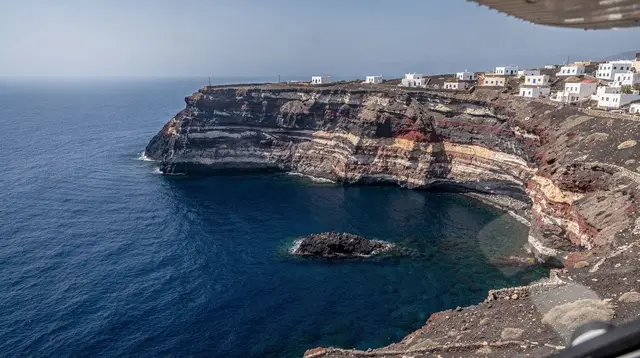
I had already done the caldera properly. Three sunsets from three different terraces, a walk along the cliff path until my shoes were full of white dust, and a boat trip that circled Nea Kameni close enough to smell the sulphur. By my fourth day I knew what Santorini looks like from a photograph, because I had taken most of the photographs myself. What I hadn’t seen was what the island looks like when nobody is trying to show it to you.
A friend who has lived near Messaria for a decade told me, almost as an aside, to go and look at Vothonas. Not because there was much to see — her words, not a guidebook’s — but because there was almost nothing to see, and that was the point. I looked it up before going and found exactly what she meant: a scattering of practical listings, a mention in the Santorini villages guide, and a wine museum. No sunset ranking, no photo-spot roundup, nothing sold as an experience. So I drove the ten minutes inland from Fira, past Karterados, and parked on a street that wasn’t wide enough for two cars to pass.
Streets that aren’t posing for anything
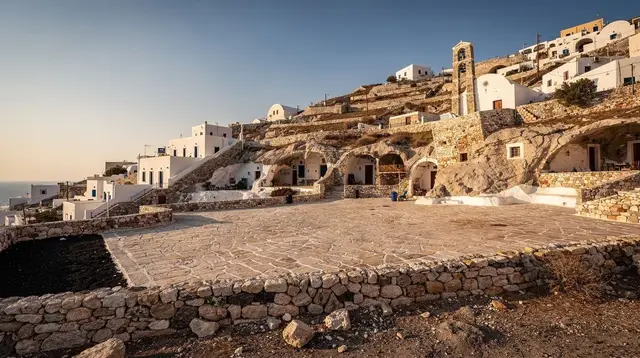
Vothonas doesn’t announce itself. There’s no gate, no viewpoint sign, no cluster of tour buses idling at the entrance the way there sometimes is outside Pyrgos or Oia. You just arrive at a village that looks the way Santorini villages must have looked before caldera views became the island’s main export: low white houses close enough to touch on both sides, a church bell that rang for no obvious reason while I was standing under it, a man carrying folded chairs across the street who didn’t look up.
I’d read, before coming, that a few of the local chapels here are carved directly into the volcanic rock rather than built up from stone — a construction style that shows up in several of Santorini’s inland villages and rarely makes it into a highlight reel. I found two of them within ten minutes of wandering without a map: small, dark, doors usually unlocked, no ticket booth, no queue. One had a hand-lettered sign asking visitors to be quiet, which felt less like a rule than a fact about the place. I stood inside for a minute in the cool and the dark, and it was the first moment on the whole trip that had nothing to do with a view.
This is the difference between Vothonas and everywhere else I’d been on the island. In Oia, the entire town is arranged, consciously or not, around the fact that people are going to stand still and look at something. In Vothonas, the streets are arranged around the fact that people live there. Laundry hung between balconies. Someone had left a crate of tomatoes outside a door with no one watching it. A cat slept across the width of a step that was clearly the most-used step in the neighbourhood.
The cellar that goes underground instead of up
The one stop with an actual door and an actual name is the Koutsoyannopoulos wine museum, built into a nineteenth-century underground canava — a wine cellar cut into the rock rather than built above it, which on an island this exposed to sun and wind turns out to be the more sensible way to store anything.
I hadn’t planned to spend long there, but the tunnels go further back than the entrance suggests, past old fermentation vats, tools, and a reconstruction of how the harvest and pressing worked before electricity reached this part of the island. It’s a smaller, more specific stop than the big cooperative tastings on the caldera side, and it pairs naturally with the wider picture in the wineries compared guide if you’re building a day around Assyrtiko rather than sunsets.
Vothonas isn’t a wine village in the way Exo Gonia is, with its cluster of small producers and Art Space nearby, and it isn’t a lookout village in the way Pyrgos is, with its kastro giving you the one view of the whole island. It’s smaller than both, and it doesn’t try to be either. That’s exactly why it works as a counterweight: a stop that isn’t selling you a photograph or a bottle, just a village going about its afternoon.
Why I’d send someone here, carefully
I want to be honest about what Vothonas is not. It is not a day out. There’s no beach, no view of the caldera, no restaurant strip, and if you arrive expecting a smaller version of Megalochori or Emporio with their own kastro walls, you’ll find less structure here, not more. What it offers instead is proportion: after several days of villages built to be looked at, one built to be lived in resets your sense of what the island actually is when the cruise ships haven’t docked yet.
I’d pair it with a loop rather than a dedicated trip — Vothonas, then on to Pyrgos or Megalochori, the kind of route covered loosely in the walking tours guide and the broader villages and culture listings, or slotted into a longer stay using something like the three-day itinerary as a backbone. If you’d rather have someone else handle the driving and the village-hopping, the Cat Tour through Santorini’s villages and vineyards covers a version of this inland side without you needing to find parking on a one-lane street.
None of which is to talk you out of Oia. I went back for one more sunset after Vothonas, on the sunset and traditional villages tour that ends in Oia, and it was exactly as good as the first time. I just noticed, standing in the crowd at the kastro, that I was thinking about a quiet street with a sleeping cat on it more than I was thinking about the view in front of me.
If your Santorini so far has been all caldera, that’s usually the sign you’re ready for a village that isn’t performing for anyone — including, for one afternoon, you. Some travellers prefer to see the interior at first light instead, before the day’s tour groups arrive; the private sunrise tour from Fira reaches the villages while the streets are still nearly empty.
Questions people ask about visiting Vothonas
Is Vothonas worth visiting on Santorini?
Yes, if you already have your caldera photographs. Vothonas has no view of the volcano and no sunset crowd; it has a wine museum built into a cellar, a couple of rock-cut chapels, and streets where nobody is performing for a camera.
How do I get to Vothonas?
Vothonas sits a few minutes inland from Fira and Messaria, off the road toward Pyrgos and Kamari. A rented car or scooter is the easiest way; there is no dedicated bus route, and a taxi works for a one-way trip if you plan to walk onward.
What is there to actually do in Vothonas?
The main stop is the Koutsoyannopoulos wine museum, set inside a nineteenth-century underground canava carved into the rock. Beyond that, the village itself is the point: narrow lanes, whitewashed houses, and small chapels cut directly into the volcanic rock.
What are the troglodyte churches in Vothonas?
They are small chapels carved into the soft volcanic rock rather than built up from it, a construction style found in a handful of Santorini’s inland villages. In Vothonas they sit at the edge of ordinary streets, unlit and usually unlocked, with no signage pushing you toward them.
How long should I spend in Vothonas?
An hour is enough for the wine museum and a walk through the lanes around it. It works best as one stop on a wider loop through the island’s interior, paired with a village like Pyrgos or Megalochori rather than visited on its own.
Is Vothonas better than the caldera villages for a quiet visit?
It is quieter, but it is not a substitute experience. Vothonas has no caldera, no sunset, and no restaurant strip; it is worth the detour precisely because it is not trying to be Oia.
Photoshoots on GetYourGuide
Verified deep-linked GetYourGuide tours. Book through these links and we earn a small commission at no cost to you.
GetYourGuide does not provide a product photo for this activity — the image shows the meeting point, photographed by us.