Three Days in Santorini: The Classic First Itinerary
Three days is the length most first-time visitors actually book, and it is enough to see the version of Santorini that shows up in every photograph — if you spend it on the right four things instead of trying to fit in everything the island offers. This route sticks to the caldera villages of Fira and Oia, the excavated Bronze Age town at Akrotiri, a black-sand afternoon at Perissa, and a stop among the Santorini wineries tasting Assyrtiko. It leaves out the active volcano islets and the inland villages on purpose — there simply isn’t room for them without rushing something that deserves more time.
What three days actually covers
This itinerary assumes no rental car — everything here is reachable by the KTEL buses that radiate from Fira’s central station, by taxi, or by joining a small guided tour, which is often the more relaxed option on a short trip since it removes the guesswork around bus timetables and where to get out. If you do want the flexibility of driving yourself, the same four stops work just as well with a car; you’ll simply cut some of the waiting.
Day 1: Fira and Oia, the caldera introduction
Start in Fira itself. However you arrive — flying into the airport six kilometres away or coming up from the old port by cable car, on foot down the switchback stairs, or by donkey — give the town an unhurried first morning. Walk out to the caldera-edge lookouts near the cathedral, browse the lanes behind the cliff, and if you want the layout of the whole island explained in one go rather than pieced together yourself, a guided overview like the Cruise Friendly Santorini Tour covering Pyrgos, Oia and Fira is built for exactly this first-day orientation, cruise passengers included.
By late morning, walk the caldera path north out of Fira. The first stretch, through Firostefani and on to Imerovigli, is paved, mostly flat and takes under an hour at an easy pace — it’s the only section of the full Fira–Oia route worth doing on foot if you’re not planning the whole caldera hike today. Stop at Skaros Rock, the fortified outcrop below Imerovigli, for one of the island’s best caldera views without a crowd around you.
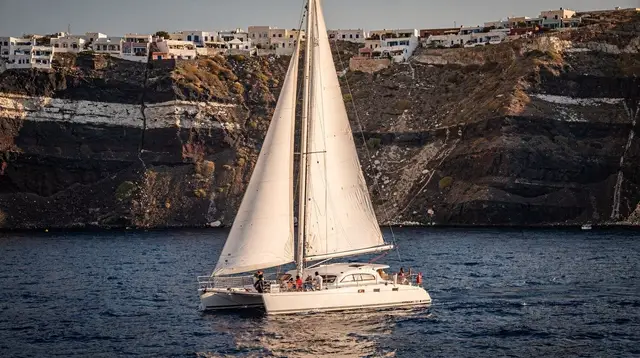
From Imerovigli, take a bus or taxi on to Oia for the afternoon and evening — the remaining stretch of the caldera path is a dirt track with real sun exposure and little shade, better saved for a day with more time, like A Four-Day Santorini Itinerary: Caldera, Kamari and Pyrgos or Five Days in Santorini: Beyond the Caldera Villages. In Oia, wander down toward Ammoudi Bay before the crowds build, then decide how you want to handle sunset. The Byzantine castle ruins fill up ninety minutes to two hours before the sun goes down in high season, so arrive early if you want a spot there, or sidestep the crush entirely — a boat looking back at the cliff, rather than fighting for a place on it, is genuinely the better view.
A guided evening out, whether a guided bus tour that times itself to Oia’s sunset or a more private option like a private sunset tour taking in Oia and Ammoudi Bay, handles the timing and the transport for you. For a full rundown of the alternative viewpoints, see the Oia sunset without the crowds guide.
Day 2: Akrotiri’s buried city and Perissa’s black sand
Head south this morning to Akrotiri, the Minoan town buried by the same eruption that carved out today’s caldera, roughly 1,600 BCE by most dating. What makes Akrotiri worth a dedicated morning is the roof over it — a bioclimatic shelter that means the site is open and comfortable regardless of weather, which makes it the single best plan on a windy or rainy day if your three days don’t line up with sunshine.
No human remains have ever been found here, which is part of what makes it archaeologically unusual: it looks like a town its people had time to leave. A guided visit, such as the guided tour of the city frozen by the volcano, adds the context that’s easy to miss walking through alone. For the full picture of what’s been excavated and what to expect at the entrance, the Akrotiri excavations guide covers it in detail.
From Akrotiri, it’s a short hop to Perissa on the island’s southeast coast, where the Mesa Vouno ridge separates it from Kamari on the other side. This is where the trip’s one real trap sits: Perissa’s sand is volcanic and black, and by midday it holds enough heat to make walking barefoot genuinely uncomfortable, even for a few metres between your sunbed and the water. Bring sandals or reef shoes and use them the whole way down the beach, not just at the entrance.
Perissa itself is long, well organised with sunbeds and tavernas, and easygoing compared with the caldera villages — a deliberate change of pace after two days of clifftop views. If you’re curious how it compares to the beach on the other side of the ridge, Perissa vs Kamari lays out the difference. Head back toward Fira or Oia in the late afternoon for dinner, having covered the two stops — ancient and modern, respectively — that round out the caldera villages from day one.
Day 3: Wine country and a last look at the caldera
Santorini’s vineyards sit mostly inland, on the gentler slopes away from the cliff, and they’re worth a slower final morning. The Assyrtiko grape here is grown without irrigation, trained in low coiled baskets called kouloura that shield the fruit from wind and catch the night’s humidity — it’s the island’s most distinctive piece of agriculture, and one you’ll only really appreciate up close.
A tasting flight of Assyrtiko, the honeyed dessert wine Vinsanto, and the dry, “night-vinified” Nykteri gives a fair sense of the range, and pairing it with a late-afternoon view is an easy way to end the trip: a tour like Santorini: Explore the Island’s Beauty with Sunset Wine Tasting combines both without you needing to plan the route yourself. For background on the grape and how to choose between wineries, see the Santorini wine tasting guide.
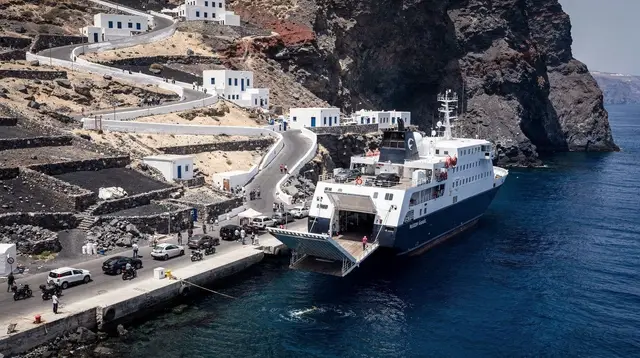
If your flight or ferry isn’t until evening, spend the remaining hours back at the caldera edge — Firostefani or the lanes around Fira are the natural choice on a final afternoon, since Oia’s sunset spot is already checked off from day one. Departing by ferry means routing through Athinios, the island’s only port, at the base of a steep switchback road on the caldera’s west side; departing by air means Santorini’s airport, about six kilometres from Fira. Either way, build in more transfer time than feels necessary — Athinios especially backs up whenever a ferry arrival and departure overlap.
What this itinerary leaves for next time
Three days, spent this way, is a complete first look at Santorini rather than a rushed one — but it does skip real parts of the island on purpose. The active crater at Nea Kameni and the rust-coloured hot springs at Palea Kameni need a boat excursion this route doesn’t have room for; they fit naturally into 2 Days in Santorini: Caldera Villages and the Volcano as an add-on or into A Four-Day Santorini Itinerary: Caldera, Kamari and Pyrgos as a dedicated day.
The inland villages — Pyrgos with its kastro, Megalochori, Emporio’s fortified quarter — are quieter and arguably more atmospheric than anything on the caldera rim, and they’re where Five Days in Santorini: Beyond the Caldera Villages spends its extra time. None of that is a flaw in a three-day trip; it’s simply what a longer one is for.
Three days at a glance
| Day | Focus | Main stops | Pace |
|---|---|---|---|
| 1 | Caldera villages | Fira, Firostefani, Imerovigli, Skaros Rock, Oia | Moderate walking, one late evening |
| 2 | Archaeology and beach | Akrotiri, Perissa | Easy, one bus/taxi transfer each way |
| 3 | Wine and departure | Santorini wineries, Fira or Firostefani | Relaxed, half-day |
FAQ: planning three days in Santorini
Is three days enough for Santorini?
Three days is enough for the classic route this itinerary follows: the caldera villages, Akrotiri, one black-sand beach and a wine stop. It is not enough to add Nea Kameni, the inland villages or a day trip to another island — those need a fourth or fifth day.
Do I need to rent a car for this itinerary?
No. Fira, Oia, Akrotiri, Perissa and the wineries near the caldera are all connected by the KTEL bus network out of Fira, and taxis or a small-group tour cover the rest. A car helps mainly if you want to reach several wineries or inland villages in one afternoon.
Should I base myself in Fira or Oia for three nights?
Fira sits more centrally for buses to Akrotiri and Perissa, while Oia is quieter at night but further from everything else. Many first-time visitors split the difference by staying in Firostefani or Imerovigli, a short walk from Fira with caldera views and less noise.
What should I wear to Perissa beach?
Closed shoes or sandals you can walk in. Perissa’s sand is volcanic and turns black, which means it absorbs heat and becomes genuinely painful to cross barefoot by midday, even when the water is comfortable.
How far ahead should I book the Akrotiri and wine tours?
A few days ahead in high season is safer than walking up, since guided slots at Akrotiri and small-group wine tastings both cap their numbers. Shoulder season allows more flexibility.
What does this three-day itinerary leave out?
It skips Nea Kameni’s active crater and the hot springs at Palea Kameni, which fit into two-days-in-santorini or four-days-in-santorini, and it skips the inland villages like Pyrgos and Megalochori, which five-days-in-santorini covers in full.
Is Santorini safe to visit after the 2025 earthquake swarm?
Yes. The seismic swarm between Santorini and Amorgos ran from late January through March 2025, produced tens of thousands of small quakes and prompted a temporary local state of emergency, but it did not lead to an eruption and has since ended. It is not a reason to change a normal itinerary in 2026.
tours.3 days
Verified deep-linked GetYourGuide tours. Book through these links and we earn a small commission at no cost to you.
GetYourGuide does not provide a product photo for this activity — the image shows the meeting point, photographed by us.