The Koutsoyannopoulos Wine Museum in Vothonas
Is the wine museum at Vothonas a place to book a tasting?
It is a museum first, built into a former underground cellar, tracing the history of Santorini winemaking with tools, dioramas, and a short film. A tasting of a few wines is included at the end, but this is not a working estate with a caldera-view terrace — for that, see Santo Wines or Venetsanos instead.
A cellar, not a cellar door
Most visitors who ask about “the Santorini wine museum” have one specific place in mind: the Koutsoyannopoulos Wine Museum, tucked into the hillside at Vothonas, a quiet inland village a few minutes from Messaria and a short drive from Fira. It is easy to conflate it with the island’s working wineries, because the word “museum” sits right next to the word “wine” on every map pin and every tour listing. It is worth separating the two before you plan a visit, because they answer different questions.
Santo Wines and Venetsanos are producers. You go there to taste this year’s Assyrtiko or last year’s Nykteri, usually on a terrace cut into the caldera cliff, with the volcano and Thirassia laid out below you. The wine is the present tense. The Koutsoyannopoulos museum is built around the past tense: it exists to show you how wine was made here for roughly three centuries before refrigeration, tourism, or the current wave of boutique labels.
If you want a deep dive into the grape and the sweet wine style themselves rather than the buildings, Assyrtiko Explained and the Vinsanto Guide cover that ground; if you want the producers lined up side by side, Santorini Wineries Compared does that job. This page is only about the museum at Vothonas, and about telling you plainly what it is and is not.
What the museum actually is
The museum occupies a real 19th-century underground cellar, known locally as a canava — a cave-like structure cut into the volcanic rock, historically used to keep wine cool and stable without any mechanical refrigeration. That physical fact matters more than it sounds: the whole visit takes place below ground, in tunnels and chambers that stay cool even in the middle of an August afternoon, which is not something you can say about a vineyard terrace at Santorini’s wineries at 2pm in July.
Inside, the route is self-guided and laid out roughly in chronological order. You walk past reconstructed scenes with wax figures showing grape harvesting, foot-treading, barrel-making, and the loading of barrels onto donkeys and then onto boats for export — this was, after all, an island with no roads to speak of for most of its winemaking history, and everything moved by animal and by sea.
Old tools, presses, and cellar equipment are displayed alongside the dioramas, and a short film rounds out the historical account near the end of the route. It is a compact, purpose-built exhibit rather than a converted barn with a few photos on the wall, and it reads that way: lit, signed, and paced for an independent walk-through rather than a guided lecture.
The visit ends with a seated tasting of several wines from the producer’s range, plus a small shop where you can buy bottles on the way out. That tasting is a genuine part of the experience, and it is worth taking your time over — but it happens in a tasting room inside the museum building, not on a terrace looking at the caldera, and it is not preceded by a walk through active vine rows the way a working-winery visit usually is.
What it is not
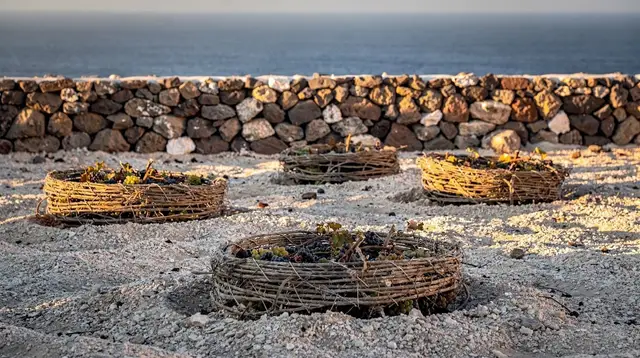
This is the part worth being blunt about, because it is the single most common source of disappointed expectations on this route: the Koutsoyannopoulos museum is not a working winery you visit to taste this vintage’s Assyrtiko while looking at the sea. There is no caldera view from the site — Vothonas sits inland, away from the cliff, and the building itself is largely underground by design. There is no vineyard walk of the kind you get at an estate that grows its own grapes on-site and wants to show you the kouloura basket-woven vines up close. And the focus of a visit here is history and craft, not a comparative tasting of current releases guided by a sommelier talking through vintages.
If what you actually want is a caldera-view terrace, a tasting flight of current wines, and the chance to walk among vines, book Santo Wines or Venetsanos instead, or read Santorini Wineries Compared to choose between the island’s working estates. None of that is a criticism of the museum — it simply is not trying to be that kind of stop, and visitors who arrive expecting it tend to leave a little confused about why there is no view.
a guided visit to the cave wine museum with a tasting included is the most direct way to see the site without working out logistics yourself, and it removes the one real risk of a self-arranged visit: turning up between coach groups with no free slot for the tasting room.
Museum visit versus a working winery, side by side
| Koutsoyannopoulos Wine Museum, Vothonas | Santo Wines / Venetsanos | |
|---|---|---|
| What you’re seeing | A 19th-century cellar turned museum, with dioramas and tools | Active production, current-vintage tasting |
| View | None — underground, inland village | Caldera and Thirassia, from a cliffside terrace |
| Vineyard walk | No | Often, weather and season permitting |
| Focus | History of Santorini winemaking, roughly three centuries | The wine itself, this year’s releases |
| Typical visit length | Around 45 minutes to an hour | Often 1.5 to 2 hours with a guided tasting |
| Weather dependence | None — fully indoors and underground | Terrace seating can be affected by wind or heat |
| Best suited to | Rainy days, midday heat, anyone curious about the history behind the label | Anyone who wants to taste and compare current wines with a view |
Why the location works on the wrong kind of day
Santorini does not get much rain, but when it does — or when the meltemi is blowing hard, or when the midday sun makes an open terrace unpleasant — the list of good options shrinks fast. Most of the island’s signature experiences are outdoor and view-dependent: the caldera villages, the volcano boat trips, the beaches, even most of the working wineries with their terrace seating.
The Koutsoyannopoulos museum is one of the small number of attractions on Santorini that is genuinely indifferent to weather, because it is built into the rock itself. Akrotiri’s excavation site shares that advantage under its bioclimatic roof, and the two make a sensible pair for a day when the forecast looks unpromising — one covers the island’s Bronze Age past, the other its more recent winemaking past, and neither depends on a clear sky.
That same quality makes the museum a reasonable stop during the hottest hours of a summer day, when a walk between Pyrgos and Megalochori or a session on a caldera-view terrace is less appealing than an hour underground at a stable, cool temperature.
Getting there and what to combine it with
Vothonas sits inland, a short drive from Fira and close to Messaria, on roads that also lead toward Pyrgos and Exo Gonia. It has no bus route built specifically for tourism, so a rental car, a taxi, or an organized tour is the practical way to reach it — the same is true of most of the island’s inland villages, since the KTEL bus network radiates from Fira toward the beaches and Oia rather than looping through the interior.
Because the museum sits close to several of the island’s inland winemaking villages, it pairs naturally with a half-day loop rather than standing as a destination on its own. Pyrgos and its kastro are a short drive away, Exo Gonia and Megalochori sit within easy reach, and Santorini’s wine country more broadly spreads across this side of the island.
If you want to build a full day around wine rather than a single stop, Santorini Wine Tasting Guide lays out how to sequence a museum visit against one or two working wineries without doubling back across the island, and the Santorini Wine Itinerary does the same at the scale of a full day or two.
Travelers staying in the caldera villages sometimes assume every wine-related stop is a short walk from Oia or Imerovigli; this one is not, and treating it as a caldera-adjacent stop rather than an inland-village trip is the easiest planning mistake to make here.
Tickets, hours, and what to expect on arrival
Opening hours shift by season, and it is worth checking the current schedule for your travel dates rather than assuming a museum keeps the same hours in January as in August — a number of Santorini attractions reduce hours or close for stretches of the winter, and this one is no exception. The self-guided nature of the route means you are not locked into a fixed tour time the way you are at some working wineries, which makes it easier to slot in around other plans.
In high season, coach groups do pass through between organized excursions, so arriving with a small gap before or after peak midday hours tends to make for a quieter walk through the cellar. Booking ahead removes the guesswork entirely and is the more reliable option if your schedule is tight.
a sunset tasting with island views is the option to look at instead if the caldera view matters more to you than the historical exhibit — it belongs to a different kind of afternoon than the one described on this page.
If wine history is one stop among several
Visitors curious about Santorini’s agricultural history sometimes want to widen the lens beyond wine specifically. a combined tour taking in the tomato museum and a working winery near Megalochori covers a second strand of the island’s food history — Santorini’s small, intensely flavored tomatoes were, for decades, as central to the local economy as wine, and the tomato museum tells that story the way the Koutsoyannopoulos museum tells the wine story.
For a broader taste of the island’s other specialties, a Greek cheese tasting rounds out a food-and-drink day without adding another vineyard stop to it.
For travelers who would rather build their own sequence — museum, one working winery, a village walk, and a late lunch, in whatever order suits their base — a private, fully customizable day is the option that leaves the itinerary in your hands rather than following a fixed group schedule.
Who this stop suits, and who should skip it
This museum earns its place on an itinerary for a specific kind of traveler: someone who wants context before or after tasting the island’s wines, someone visiting on a day when the weather or the heat rules out terrace time, or someone simply drawn to the mechanics of how a place without rivers, irrigation, or flat vineyard rows managed to produce wine at all for three hundred years. Understanding the kouloura vine-training method and the total absence of irrigation, both covered in more depth in Assyrtiko Explained, lands differently once you have seen the tools and the century-old cellar in person.
It is a poor fit for anyone whose main goal is a caldera-view tasting of current releases, or anyone with only one wine-related stop to spare who would get more out of a working estate. In that case, Santo Wines or Venetsanos is the better single choice, and Santorini Wineries Compared will help decide between them.
Questions about the Koutsoyannopoulos Wine Museum
What exactly is the Koutsoyannopoulos Wine Museum?
It is a private museum built inside a 19th-century underground cellar (a canava) at Vothonas, near Messaria. It uses tools, wax figures, dioramas, and a short film to walk visitors through roughly 300 years of Santorini winemaking, from the volcanic vineyard to the export era.
Does the museum include a wine tasting?
Yes, a tasting of several wines is included at the end of the self-guided route through the cellar. It is a seated tasting inside the museum building, not a terrace tasting overlooking the caldera.
How is this different from visiting Santo Wines or Venetsanos?
Santo Wines and Venetsanos are working wineries: you taste current vintages on a terrace or in a tasting room, often with a caldera view, and the focus is the wine itself. The Vothonas museum is a fixed historical exhibit inside a former cellar, with no vineyard walk and no caldera outlook — the tasting is a coda to the history, not the point of the visit.
Is Vothonas near the caldera villages?
No. Vothonas sits inland, close to Messaria and a short drive from Fira, on the opposite side of the island from Oia’s cliffside restaurants. It has no sea view and no caldera view; that is expected here.
Is this a good option on a rainy or windy day?
Yes — it is one of the few Santorini attractions that is entirely indoors and underground, so it is unaffected by rain, wind, or the midday heat. Akrotiri’s excavation site is covered as well, but the wine museum needs no weather-dependent timing at all.
How long does a visit take?
Plan on roughly 45 minutes to an hour for the self-guided route and tasting, less than half the time a full winery visit with a guided walk through the vines usually takes.
Do I need to book ahead?
It is worth booking a slot in high season, since coach groups visit between excursions, but it is far less likely to sell out than a sunset tasting at a caldera-view winery. Confirm opening hours for your travel dates, as these vary by season.
Can I buy wine here, and is it the same as buying at a winery?
The museum has a shop selling bottles from Santorini producers, so you can buy on the way out. It functions as a retail point rather than a producer’s own cellar door, which is the main practical difference from buying directly at Santo Wines or Venetsanos.
Wine Tasting on GetYourGuide
Verified deep-linked GetYourGuide tours. Book through these links and we earn a small commission at no cost to you.
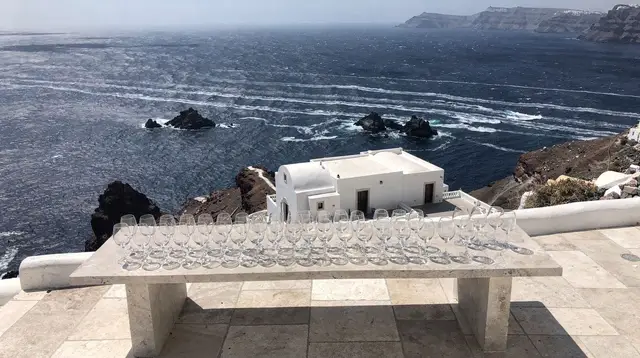
GetYourGuide does not provide a product photo for this activity — the image shows the meeting point, photographed by us.