Assyrtiko Explained: Santorini's Signature White Wine
What is Assyrtiko and what does it taste like?
Assyrtiko is Santorini's signature grape, made into a bone-dry, high-acid white with citrus, green apple and a mineral, often saline finish. It also appears as Nykteri, a fuller, barrel-touched style from grapes harvested at night, but neither is related to Vinsanto, the island's sweet dessert wine.
The grape that explains Santorini’s wine list
Order a glass of white wine almost anywhere on the island and there is a good chance it is Assyrtiko before you even ask. It is the grape behind the Santorini wineries that cluster around Pyrgos, Megalochori and Exo Gonia, and it is the reason locals talk about their wine with a kind of pride usually reserved for the caldera view. Knowing what it actually tastes like, and how it differs from the handful of other grapes grown alongside it, makes a tasting far more useful than simply working through a list of unfamiliar names.
This guide stays close to the grape itself: what Assyrtiko is, why it tastes the way it does, what Nykteri means when it shows up on a label, and how the island’s secondary varieties — Aidani and Athiri in white, Mandilaria and Mavrotragano in red — fit around it. It does not rank wineries or pour glasses of Vinsanto; those questions belong to Santorini’s wineries compared and to our separate guide to Vinsanto. Think of this page as what to know before you sit down at a tasting counter, not which counter to choose.
Why Assyrtiko tastes like nowhere else
Assyrtiko is grown almost everywhere on the island’s wineries, but the conditions it grows in are unusual enough to explain most of what ends up in the glass. The vines are ungrafted, planted directly in volcanic ash and pumice rather than ordinary soil, because the same eruption that shaped the caldera left a substrate phylloxera cannot survive in. There is no irrigation at all: Santorini has no river, no spring and no usable aquifer, and the vines survive on whatever moisture the sea brings in as overnight humidity and dew.
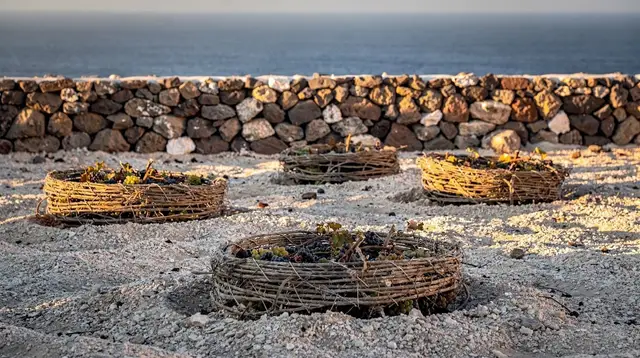
To catch that moisture and protect the grapes from the near-constant wind, growers train the vines low to the ground in a coiled, basket-like shape called kouloura — a woven ring of old wood that looks, from a distance, like a nest sitting on the volcanic soil.
It is the most distinctive thing to look at in the vineyards around Vothonas or Exo Gonia, and it is not decorative: the coil shields the fruit from sun and salt spray while the low canopy traps humidity around the grapes at night. The result is a vine under real stress, ripening slowly through a hot, dry summer, and that stress is what keeps the sugar and the acid in balance instead of letting sugar run away as it would with more water and less heat.
Harvest comes early by European standards, often from late July into August, well before the grapes lose the acidity that defines the finished wine. Put together — ash soil, no water, the kouloura canopy, an early picking date — the process explains why a wine made on one of the hottest, driest islands in the Aegean can still taste this sharp.
Reading a glass of Assyrtiko
The wine itself is dry, pale, and usually unoaked, though a portion of many blends does see some barrel time. The first thing most people notice is the acidity: high, persistent, and more aggressive than in almost any other Greek white. Underneath it sits citrus — lemon and lime more than orange — green apple, sometimes a faint note of honey or beeswax as the wine ages a year or two, and a distinctive mineral, often described as saline or flinty, character that most tasters attribute to the volcanic soil, even if the actual chemistry behind that saltiness is debated among winemakers.
It is not a wine built for sipping alone in the sun, at least not for everyone. The acidity is high enough that Assyrtiko is most enjoyable with food that can meet it: grilled fish, octopus, fava, tomatokeftedes and other fried island specialities, or hard, salty cheeses.
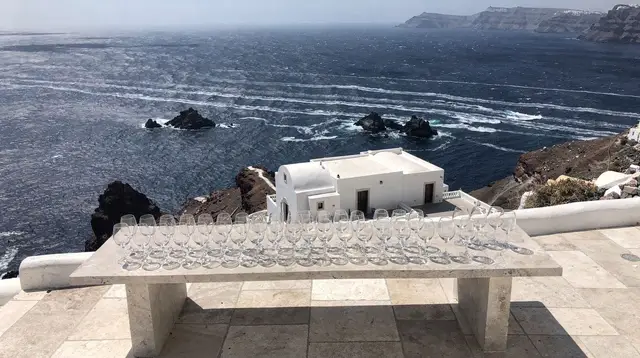
Several tastings around the island now pair a flight of Assyrtiko styles with exactly this kind of small-plate spread rather than serving it on its own — our guide to Santorini’s food and to where to eat by village covers the pairing side in more depth. If you want a guided flight built specifically around comparing styles, a Santorini wine tasting experience walks through several bottlings side by side rather than leaving you to guess from a shelf.
Because the acidity is so central to the wine’s identity, it is worth tasting more than one producer’s version before deciding what you think of Assyrtiko as a style. Some are made in stainless steel only, sharper and more citrus-driven; others spend a few months in old oak, which softens the edges without adding obvious wood flavour. Neither is more “correct” — they are simply different readings of the same grape, and the difference between wineries is exactly what Santorini’s wineries compared sets out to untangle.
Nykteri: the night-harvested style
Nykteri is the name that causes the most confusion on a Santorini wine list, mostly because it sounds like it should be a separate grape. It is not. Nykteri is a style, built primarily from Assyrtiko, often blended with a smaller portion of Aidani or Athiri, in which the grapes are picked at night — the word means roughly “of the night” — so they arrive at the press cool, before the day’s heat can start softening their acidity and dulling the aromatics. Traditionally the wine was then left to age in barrel for several months, sometimes longer, which gives finished Nykteri a fuller body, a slightly deeper colour and a rounder texture than standard, stainless-steel Assyrtiko, while keeping the wine fully dry.
The point of Nykteri is freshness and structure, not sweetness. It sits closer to a barrel-aged white Burgundy in weight than to anything dessert-like, and it is worth ordering specifically if a tasting offers it, since it shows a different side of the same grape rather than a lesser or greater one. What Nykteri is not is Vinsanto: the two names get mixed up by visitors more than almost anything else on the list, and the production methods have nothing in common.
Vinsanto starts from grapes deliberately dried in the sun for one to two weeks before pressing, then ages for years, sometimes decades, to become a thick, sweet, amber wine — the full process, and why it takes so long, is covered on its own in our Vinsanto guide. If a pour tastes sweet, it is not Nykteri.
The supporting cast: Aidani and Athiri
Assyrtiko rarely stands entirely alone on Santorini’s vineyard maps. Aidani and Athiri are the two white grapes most often planted alongside it, and both are used more often as blending partners than as single-varietal bottlings. Aidani tends to bring a floral, slightly more aromatic lift to a blend, softening some of Assyrtiko’s harder acidic edges without erasing them. Athiri plays a similar supporting role, generally lighter and less acidic on its own, which is exactly why it works well cut into a blend rather than bottled solo — a small amount rounds out a wine that would otherwise be almost entirely citrus and stone.
Both grapes show up most visibly inside Nykteri, where the blend softens the barrel-aged wine’s edges, and occasionally in lighter, everyday table whites sold under simpler labels. If a tasting flight includes an “Assyrtiko-Athiri” or “Assyrtiko-Aidani” blend alongside a pure Assyrtiko, it is worth comparing the two directly: the difference is usually smaller than the name suggests, but it is a useful way to feel how much of Assyrtiko’s character survives when it shares the bottle.
The reds: Mandilaria and Mavrotragano
Santorini is known almost entirely for its whites, but two red grapes are grown across the same volcanic soil, and they deserve a mention if only because they are easy to overlook on a tasting menu built around Assyrtiko. Mandilaria is the more widely planted of the two: deeply coloured, tannic, and traditionally used more as a blending grape than a standalone wine, since on its own it can taste rustic and hard-edged. It is often blended with softer grapes, sometimes even brought in from elsewhere in Greece, to round it out.
Mavrotragano is the more interesting story. For decades it was nearly abandoned because it is difficult to grow and produces very little fruit, but a handful of producers have replanted it seriously over the past generation, and it now appears as a single-varietal red from several of the island’s better-known estates. It is fuller-bodied and more structured than Mandilaria, with darker fruit and firmer tannins, and it is the closest thing Santorini has to a serious age-worthy red. Neither grape is the reason most people book a tasting on the island, but ordering a glass of Mavrotragano alongside your Assyrtiko is a reasonable way to see the other half of what grows in this soil.
Where the choice of winery comes in
Everything above describes the grape and the styles it produces; it deliberately stops short of telling you which winery to visit, because that decision depends on things this page is not built to weigh — terrace views over the caldera, group size, whether you want a formal flight or a casual glass, and price. Santorini’s wineries compared lays out those differences directly, while Santo Wines and Venetsanos each get their own closer look, and the Museum of the Vine in Vothonas covers the history side for anyone who wants context before or after tasting.
If you would rather have someone else plan the stops, a guided wine tasting with a local guide takes care of the driving and the order of wineries, which matters more than it sounds — starting with a heavier Nykteri before a crisp stainless-steel Assyrtiko tends to flatten the lighter wine’s acidity.
For an evening version that pairs the tasting with the island’s other headline attraction, an island tour combining sunset views with wine tasting sets the same wines against the caldera light instead of a tasting-room counter. And since the food side of a tasting is not an afterthought given how well Assyrtiko needs salt and fat to balance its acid, a Greek cheese tasting pairs well either as a standalone stop or bolted onto a wine visit.
For travellers building a full day or more around the wine side of the island rather than a single stop, our Santorini wine itinerary sequences villages and wineries in a workable order, and the wine tasting category page lists every bookable option on the island in one place if you would rather compare before deciding. The general Santorini wine tasting guide is the right next stop if you want the practical side — what a tasting costs, how long it runs, whether to book ahead — once you already know Assyrtiko from Nykteri and Nykteri from Vinsanto.
Villages worth knowing for context
None of this requires a wine expert’s itinerary. The vineyards themselves spread across the island’s interior rather than the cliffside villages tourists photograph most, so a short detour through Pyrgos, Megalochori or Emporio puts the kouloura vines in view even outside a formal tasting stop. Seeing the low, coiled vines up close — rather than only the wine they produce — makes the whole explanation above easier to picture: this is not a lush, irrigated vineyard landscape, it is scrub-dry volcanic ground with a vine trained to survive it, and that survival is the entire reason Assyrtiko tastes like it does.
Assyrtiko, Nykteri and the other grapes — the essentials
- Assyrtiko: dry, high-acid, citrus and mineral, Santorini’s defining white grape.
- Nykteri: a style, not a separate grape — Assyrtiko-based, night-harvested, sometimes barrel-aged, still dry.
- Aidani and Athiri: secondary white grapes, mostly used to soften Assyrtiko in blends.
- Mandilaria and Mavrotragano: the island’s reds, the second increasingly bottled on its own.
- Vinsanto: a completely different, sweet, sun-dried wine — not covered here, see the dedicated Vinsanto guide.
Questions about Assyrtiko and Santorini wine
Wine Tasting on GetYourGuide
Verified deep-linked GetYourGuide tours. Book through these links and we earn a small commission at no cost to you.
GetYourGuide does not provide a product photo for this activity — the image shows the meeting point, photographed by us.