Walking Tours in Santorini: Guided Fira on Foot
What does a Fira walking tour include?
A guided walk through Fira's alleys and cave-house architecture, its caldera viewpoints, and often the Museum of Prehistoric Thera. It is a slow, accompanied village visit, not a physical hike — that is the Fira-Oia caldera path, a separate activity.
A different way to see the island’s capital
Santorini’s most photographed views come from a clifftop village, but the village itself — its stepped alleys, cave houses, blue-domed churches, and the working life tucked behind the postcard shots — rewards someone explaining it as much as someone climbing through it. That is what a guided walking tour in Fira is for. It is a slow, accompanied visit built around looking, listening, and understanding what you’re standing on, not a physical challenge.
This matters because Santorini’s content around walking tends to split into two very different things, and they get confused constantly. One is the unguided Fira-Oia caldera path, a genuine hike of roughly 10.5 km along the clifftop between two villages, taking three to five hours with real exposure and no shade.
The other — what this page covers — is a guided walk inside Fira itself, typically an hour and a half to two and a half hours, on paved lanes, ending more or less where it started. Confusing the two leads to the wrong booking: someone expecting a gentle village stroll ends up on a demanding clifftop trek, or someone who actually wanted the full Fira-to-Oia walk books a short village tour and wonders why they never left town.
Why Fira works as a walking-tour subject
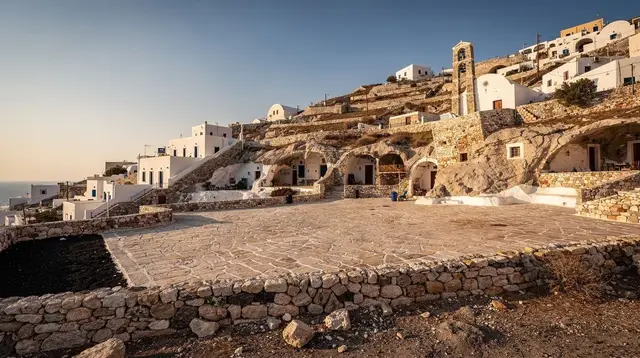
Fira is the administrative capital of the island and its busiest settlement, built along the rim of the Santorini caldera roughly 250 to 300 metres above the water. Its architecture is the reason a guide adds value here rather than just narrating a nice view: the white cave houses (skaftá) were carved directly into volcanic rock and pumice, a building method shaped by earthquake risk, wind, and a near-total absence of timber on a volcanic island.
A guide can point out which structures are original 18th- and 19th-century cave dwellings, which were rebuilt after the major 1956 earthquake, and how the layout of narrow, winding alleys was never accidental — it broke up the wind and confused would-be pirate raids centuries ago.
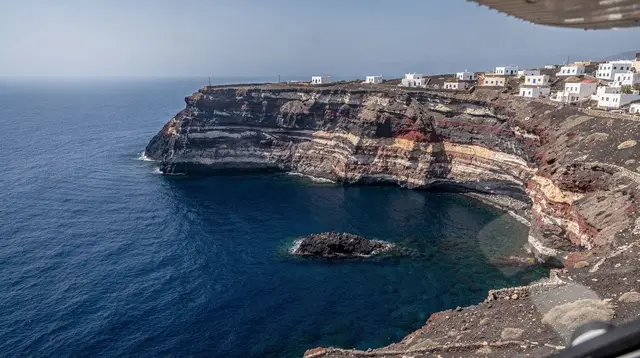
Fira’s other asset is orientation. From its caldera-edge paths you can see the crescent of the main island, the dark cone of Nea Kameni sitting in the water below, and on a clear day the outline of Thirassia across the caldera. A guide who knows the geology can explain what you’re actually looking at — the rim of a collapsed volcanic chamber left by the Bronze Age eruption — in a way that a self-guided wander past the same viewpoints usually doesn’t deliver, because most visitors don’t know to ask.
What a guided walk typically covers
Architecture and back alleys
The core of most Fira walking tours is a route through the village’s residential lanes, away from the main tourist strip of shops and cafés along the caldera edge. This is where cave houses, chapel domes, bougainvillea-covered courtyards, and small neighbourhood squares sit largely unphotographed because they don’t front the view. A guide typically threads a route connecting these with the more familiar caldera-side path, so you see both the postcard Fira and the version residents actually live in.
The caldera viewpoint
Every route includes time at the clifftop path itself, usually near the old port area or close to the top of the cable car and the 588 steps, where the view opens onto the full caldera.
This is often paired with an explanation of how the basin formed — the Late Bronze Age eruption, roughly 1600 BCE, though the exact date is still debated between radiocarbon dating and archaeological chronology — and why the islands you can see (Thirassia, Nea Kameni, Palea Kameni, distant Aspronisi) are all fragments of the same collapsed structure. Some guides bring up the popular link to the Atlantis myth here too — worth hearing as a well-known theory, not as settled history.
The Museum of Prehistoric Thera
Longer and private itineraries often build in a stop at the Museum of Prehistoric Thera, in central Fira, which holds the frescoes and finds recovered from Akrotiri, the Minoan town buried by the eruption and excavated since 1967. Seeing the museum with a guide immediately after walking the caldera edge ties the geology and the archaeology together in a way that visiting either separately doesn’t — you’ve just looked at the crater rim, now you’re looking at what daily life looked like in the town it buried. It’s also a useful fallback on a hot or windy afternoon, since it’s indoors and air-conditioned, unlike anything on the clifftop.
The main formats available
Fira walking tours aren’t one product — they range from short group orientations to private, themed, and cruise-specific formats. Here’s how the common versions differ:
| Format | Typical length | Best for |
|---|---|---|
| Group village walk | 1.5–2 hrs | First orientation, budget-conscious travellers |
| Private walk with local stories | 1.5–3 hrs, flexible | Couples, families, anyone wanting a set pace |
| Foodie walking tour with tastings | 2.5–3.5 hrs | Combining the walk with local food and wine |
| Plate smashing show walking tour | 1.5–2 hrs plus show | Groups wanting entertainment with orientation |
| Sunrise walking tour | Early morning, ~2 hrs | Quiet streets, soft light, before the day-trip crowds |
| Shore excursion, minimal walking | Fits a cruise call window | Cruise passengers on a tight schedule |
A guided village walk built around local stories and photo stops in Fira and Oia is the most flexible of these — you set the pace, skip what doesn’t interest you, and it works whether you have ninety minutes or half a day. For a livelier, more social version, a village walk paired with a traditional Greek plate-smashing show adds a bit of theatre to the orientation, which some groups prefer over a purely narrated route.
Food is another common angle. A guided foodie walk through Fira with tastings along the way uses the same alleys and viewpoints as a standard walking tour but stops at local producers and small eateries rather than only historic points — useful background reading before or after is the site’s food guide and its breakdown of where to eat by village.
If you’re arriving by ship rather than staying on the island, the calculus changes. A shore excursion built around the caldera views with minimal walking is designed specifically around a cruise call’s fixed return time, avoiding the uncertainty of navigating Fira’s crowds and the cable car queue on your own before your ship departs.
Walking tour vs. the Fira-Oia hike
Because both are commonly searched as “walking in Santorini,” it’s worth being explicit about how different they are:
| Fira walking tour | Fira-Oia caldera hike | |
|---|---|---|
| Guided | Yes | No — self-guided |
| Distance | Under 2 km, loops within the village | ~10.5 km, one direction |
| Duration | 1.5–2.5 hrs | 3–5 hrs |
| Terrain | Paved lanes, some steps | Paved near Fira, then dirt path, real elevation change |
| Physical effort | Low | Moderate to demanding, no shade |
| Ends where | Back in Fira, generally | In Oia — plan the return by bus or taxi |
| Good for | Orientation, culture, architecture | A genuine hike between two villages |
If what you actually want is the clifftop trek all the way to Oia, that’s covered separately in the Fira-Oia caldera hike guide — it is not something a standard Fira walking tour will get you, and booking one expecting the other is the most common mismatch on this subject. Anyone drawn to a longer, harder walk with more elevation and fewer people should instead look at the hike up Profitis Ilias and the Mesa Vouno ridge, which is a different route again, well away from Fira.
Sunrise, daytime, and sunset options
Timing changes the experience more than most people expect. A private sunrise tour from Fira that continues to Oia takes advantage of empty streets and soft early light — genuinely a different village to walk through compared with midday, when cruise-ship crowds and day-trippers fill the same lanes. Mid-morning to early afternoon is the busiest window in Fira, particularly on days with multiple ships in port, so a walking tour scheduled then will spend more time navigating people than admiring architecture.
Late afternoon works reasonably well too, especially if the tour is timed to finish near sunset — though be aware that Fira’s own sunset viewpoints get busy as well, just less dramatically than Oia’s Kastro. If seeing the sunset properly matters more to you than the walking itself, that’s really a separate decision covered in the site’s sunset guide, and a walking tour that happens to end around dusk is a bonus, not a substitute for choosing the right sunset spot deliberately.
Who a Fira walking tour actually suits
This format is aimed at travellers who want context and orientation without physical exertion: first-timers trying to get their bearings quickly, older travellers or anyone with mobility limits who still wants to see the village properly, families who don’t want a multi-hour trek, and cruise passengers working with a fixed number of hours ashore. If you’re reading this while planning your very first visit, it pairs naturally with the broader first-time in Santorini guide and the practical basics in Santorini in one day.
It suits less well anyone specifically looking for exercise, solitude, or a rural/coastal walk — those needs are better met by the caldera hike to Oia, the Profitis Ilias ascent, or a rented e-bike route rather than a village tour. It’s also not the way to see Fira’s old town on your own schedule if you’d genuinely rather wander without commentary — that’s a perfectly valid alternative, just a different product from a guided tour.
Practical notes
Footwear matters even on a short village walk: Fira’s lanes are a mix of smooth pavers, uneven cobbles, and shallow steps, so trainers or walking sandals beat anything with a slick sole. Midday heat between June and September makes water worth carrying even for a two-hour walk, and shade is limited once you’re past the covered lanes near the main square. Group tours typically run with somewhere between eight and twenty people; if that feels too large, a private option keeps things closer to your own pace and lets you linger at whichever viewpoint or alley catches your attention.
Combining formats works better than trying to do everything separately. A guided walk covering architecture and the caldera edge, followed independently by a stop at Santo Wines or another winery for the afternoon, or paired the next day with a proper hike out to Oia, gives a fuller picture of the island than either a single tour or a single hike would alone. For a wider comparison of where to base yourself for this kind of mixed itinerary, see Oia vs. Fira: where to stay, and for getting between the old port and the village itself, the trade-offs are laid out in cable car vs. steps vs. donkey.
Finally, a broader option worth knowing about: a minibus tour from Fira covering island highlights and Oia’s sunset isn’t a walking tour in the strict sense, but it’s a common alternative for travellers who want to see more of the island — villages beyond Fira, the sunset at Oia — without committing to either a long guided walk or the unguided caldera hike. It’s worth comparing against a pure Fira walking tour if your priority is covering ground rather than understanding one village in depth.
Fira walking tours: your questions answered
Is a Fira walking tour the same as the Fira-Oia hike?
No. A Fira walking tour is a short, guided visit inside the village — alleys, viewpoints, sometimes the museum — lasting one to two hours at an easy pace. The Fira-Oia caldera path is an unguided, roughly 10.5 km walk of three to five hours along the clifftop to a different village. They solve different needs and are not interchangeable.
How long does a guided walking tour of Fira take?
Most run 1.5 to 2.5 hours, sometimes longer when the Museum of Prehistoric Thera or a food stop is included. A private walk can be shortened or extended around what the group wants to see.
Do I need to be fit for a Fira walking tour?
No. These are village walks on paved lanes and stepped alleys at a relaxed pace, built around looking and listening rather than covering distance. They suit most fitness levels, including travellers who would rather not attempt the Fira-Oia hike.
What is the plate smashing show walking tour?
It pairs a guided walk through Fira with a Greek tradition of smashing plates for celebration, usually alongside food or drink. It is one of the more theatrical formats and works well for groups wanting entertainment as well as orientation.
Are guided walking tours worth it if I’m only in Fira for a cruise stop?
Often yes. A shore excursion built around minimal walking covers the essentials — the caldera edge, the old town, sometimes the cable car — in the window a cruise call allows, without the uncertainty of finding your own way back to the port on a tight schedule.
Can a guided walking tour include the Museum of Prehistoric Thera?
Some do, particularly longer or private itineraries. The museum holds the Akrotiri frescoes and sits inside Fira, so it fits naturally into a village walk rather than requiring a separate trip.
Is a private walking tour better than a group one?
A private walk lets you set the pace, skip what doesn’t interest you, and ask questions freely, which suits couples, families, or anyone with limited time. A group tour is usually cheaper and still gives a structured overview — the trade-off is schedule and flexibility, not quality of content.
Walking Tours on GetYourGuide
Verified deep-linked GetYourGuide tours. Book through these links and we earn a small commission at no cost to you.
GetYourGuide does not provide a product photo for this activity — the image shows the meeting point, photographed by us.