Megalochori Village Guide
What is Megalochori, Santorini?
Megalochori is a small inland village in southern Santorini, built around a walled central square known locally as the Kastro. It sits close to the Venetsanos winery and the Athinios ferry port, and is known for its whitewashed alleys, cave houses, and a far quieter pace than Fira or Oia.
A Village That Never Needed the Caldera
Most first-time visitors to Santorini see three names before they land: Fira, Oia, and maybe Akrotiri for the ruins. Megalochori rarely makes that shortlist, and that omission is the whole reason to go. It sits inland, away from the caldera rim, with no cliffside view to sell and no queue for a photo spot. What it has instead is a small walled square, a scatter of wine estates on its edges, and streets that were built for people living there, not for people photographing them.
This guide treats Megalochori as a place in its own right — its layout, its history, how it compares to Pyrgos and Emporio, and how to fit it into a day that also touches the coast or a ferry departure. It does not cover wine tasting in any depth: for that, see the dedicated wine tasting guide and the wineries compared page, since Megalochori’s best-known neighbor, Venetsanos, deserves its own coverage rather than a paragraph here.
Where Megalochori Sits
Megalochori lies in the southern interior of Santorini, a few kilometers south of Fira and close to the cliff above Ormos Athinios, the island’s only ferry port. It is not on the caldera rim like Imerovigli or Oia, and it is not on the coast like Kamari or Perissa. It occupies the in-between zone that most itineraries drive through rather than stop in — which is precisely the zone where Pyrgos, Exo Gonia, Vothonas, and Megalochori itself all sit, forming a loose cluster of inland villages that share a similar character: whitewashed, quiet, and largely residential.
The village’s proximity to Athinios matters practically. Anyone driving up from the ferry, or heading down to catch one, passes within a few minutes of Megalochori. That makes it one of the easiest villages on the island to combine with a ferry arrival or departure, without adding meaningful driving time.
The Kastro and the Shape of the Village
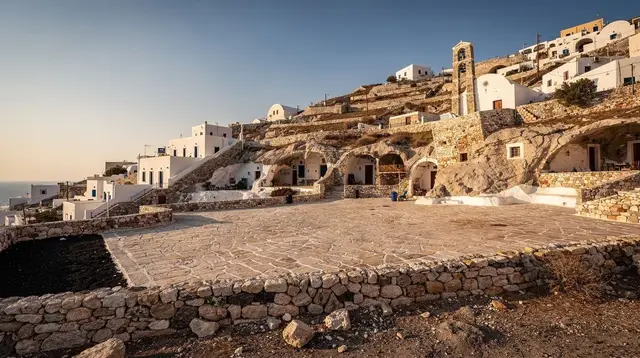
At the heart of Megalochori is a small, tightly packed cluster of buildings known locally as the Kastro. The name suggests a fortress, and in a sense it once functioned like one: the outer walls of the houses were built to face outward and connect into a defensible perimeter, a common Cycladic response to the threat of pirate raids that shaped village planning across the islands for centuries. Inside that perimeter, the alleys narrow to barely a shoulder’s width, turning at odd angles between churches, courtyards, and private homes.
This is worth being precise about, because visitors sometimes expect a kastro on the scale of the one in Emporio, which is the most intact and legible fortified settlement on Santorini, with a clear circuit of outer walls still traceable on foot. Megalochori’s Kastro is smaller and less obviously fortress-like today; much of its defensive logic is now folded into ordinary house walls rather than standing as a visible monument. It rewards a slow walk more than a dramatic photograph.
Beyond the Kastro, the wider village spreads out in the low, whitewashed cubic style found across the island, along with several examples of skaftá — homes carved directly into the volcanic rock, keeping interiors cool through the summer without needing much in the way of walls at all. A handful of small churches with blue or muted domes punctuate the streets, and several old wine-storage buildings, or kanaves, sit at the edges of the village, a reminder that this has been wine country for longer than it has been a tourist stop.
Megalochori, Pyrgos, and Emporio Compared
These three inland villages are often mentioned in the same breath, and it helps to know what actually separates them before choosing where to spend limited time.
| Village | Character | Elevation and views | Best known for |
|---|---|---|---|
| Megalochori | Quiet, domestic, low-key | Low-lying, no wide panorama | Kastro square, proximity to Venetsanos and Athinios |
| Pyrgos | Historic, layered, atmospheric | Highest hilltop settlement on the island, near Profitis Ilias | Island-wide views, medieval street plan |
| Emporio | Traditional, more visited than Megalochori | Flat, inland | The most intact fortified kastro on Santorini |
If the goal is a sweeping view over most of the island, Pyrgos wins outright — its position below Profitis Ilias, the island’s highest point at 567 meters, gives it a vantage point Megalochori simply does not have. If the goal is to see a genuinely fortified settlement with walls still readable as walls, Emporio is the stronger stop. Megalochori’s case is different: it is the villages Kastro is smaller, its streets less dramatic, but it is also the one least altered by tour traffic, and its wine-country setting gives it a different flavor from either of the other two.
Wine Country at the Edges, Not the Center of This Page
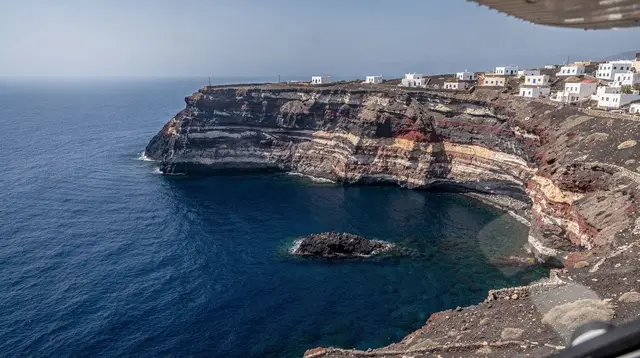
It is impossible to describe Megalochori honestly without mentioning wine — the village grew up among vineyards, and several notable estates sit within walking or short driving distance, including Venetsanos, housed in one of the oldest surviving winery buildings on Santorini, perched on the cliff above Athinios specifically so that grapes and barrels could once be lowered straight down to boats at the port below.
That said, this page is about the village, not the glass. Assyrtiko, Vinsanto, the kouloura basket-vine training method, and the estates themselves are covered properly in the wine tasting guide and the wineries compared page, along with the wineries destination page. If a full tasting is the goal for the day, start there rather than here, and treat Megalochori itself as the walk before or after the glass.
For travelers who want the village and a winery stop combined into a single planned outing rather than assembling it themselves, a guided option covers that ground directly.
a half-day tour pairing Pyrgos and a winery visit with tastingsWhat There Is Actually To Do Here
Megalochori is not built around a checklist of sights, and it should not be visited like one. The village rewards slow movement: wandering into the Kastro without a fixed route, sitting at one of the handful of small tavernas on the square, and letting the afternoon light change how the whitewashed walls look between 4pm and dusk.
A short list of what to look for:
- The Kastro square itself, with its knot of alleys and small churches
- The old kanaves, wine-storage buildings, scattered at the village edges
- A handful of skaftá cave houses, some now converted into small guesthouses
- The church of Panagia Episkopi nearby, one of the older religious sites in the area
- Views down toward Athinios port and the sea beyond, from the village’s southern edge
There is no beach here and no caldera panorama — those belong to other parts of the island covered in the Santorini villages guide and the beaches guide. Megalochori’s appeal is specifically the absence of both.
Getting There
Megalochori sits close enough to the main north-south road that a rental car or scooter reaches it from almost anywhere on the island within half an hour. From Fira it is a short, direct drive of roughly 10-15 minutes. From Oia, allow closer to 25-30 minutes given the length of the island. Details on renting and driving conditions are covered in the driving in Santorini guide and the car and scooter rental guide.
Public buses run from Fira on a limited schedule and are not the most practical option for a village visit timed around light and quiet — a taxi or private transfer is more reliable, particularly since taxis on the island are genuinely scarce and benefit from advance booking rather than being hailed on the spot.
Because Megalochori sits so close to Athinios, it also works naturally into a ferry-day plan — a stop on the way down to catch a boat, or a first taste of the island on the way up from one. The Athinios port guide covers the practical side of that connection, including the steep switchback road up from the port itself.
Combining Megalochori With a Wider Day
On its own, Megalochori is a stop of an hour or two, not a half-day destination. It works best folded into a loop through the island’s quieter interior — pairing it with Exo Gonia, Vothonas, and Pyrgos makes for an afternoon that touches four distinct village characters without repeating any of them, finishing at Pyrgos for the view over the island as the light softens.
For visitors who prefer not to self-drive this route, a guided village day removes the navigation and adds context along the way.
a private tour through Santorini’s traditional villages with lunch includedTravelers building a longer, more flexible plan around several inland stops — including a winery, a village, and a chance to adjust the pace on the day — are often better served by a custom itinerary built around their own priorities rather than a fixed route.
a customizable best-of tour with local guide and hotel pickupWhen to Go
Megalochori has no single “best” season the way a beach or a sunset spot does, since its appeal is the absence of crowds rather than a specific view that changes with the light. That said, a few practical notes apply:
- In July and August, visiting in the late afternoon avoids both the heat and the busier midday hours on the connecting roads.
- Shoulder months — late April through May, and October — bring the same quiet village with cooler walking conditions.
- In winter, several small tavernas and guesthouses in and around the village close, following the same pattern seen across most of Santorini’s interior from November to March.
None of this changes dramatically year to year, but it is worth checking current opening hours for any specific taverna or winery before building a whole afternoon around it.
Practical Notes
A short table for planning purposes:
| Detail | Note |
|---|---|
| Distance from Fira | Roughly 10-15 minutes by car |
| Distance from Oia | Roughly 25-30 minutes by car |
| Distance from Athinios port | A few minutes by car |
| Typical visit length | 1-2 hours |
| Public transport | Limited KTEL bus service; taxi or private transfer more reliable |
| Nearby winery | Venetsanos, on the cliff above Athinios |
Cash is worth carrying for small tavernas in the village, as is standard across Santorini’s interior settlements, even though cards are increasingly accepted in more tourist-facing spots.
Frequently Asked Questions About Megalochori
Is Megalochori worth visiting in Santorini?
Yes, if the goal is to see a genuine Santorini village without a cruise-ship crowd. It has no caldera view and no single headline attraction, which is exactly why it stays calm even during the busiest weeks of summer.
How do I get to Megalochori from Fira or Oia?
By car or scooter, it takes roughly 10-15 minutes from Fira and about 25-30 minutes from Oia. KTEL buses reach the area on a limited schedule, so most visitors drive, take a taxi, or stop here as part of a private tour.
Is Megalochori the same as Pyrgos?
No. Both are inland villages built around a Kastro, but Pyrgos sits higher, on the island’s tallest hilltop settlement below Profitis Ilias, with wide views over much of Santorini. Megalochori sits lower and flatter, closer to the coast at Athinios, with a more enclosed, domestic feel.
Does Megalochori have a fortified kastro like Emporio?
Not to the same degree. Megalochori’s central square is called the Kastro and originated as a defensive cluster of outward-facing house walls, but it never reached the scale of fortification preserved in Emporio, which remains the most intact defensive settlement on the island.
Can I visit a winery from Megalochori?
Yes. Venetsanos, one of the island’s oldest surviving winery buildings, sits just outside the village on the cliff above Athinios port. This guide covers the village itself; tasting details and other estates are handled separately in the wine tasting guide.
Is Megalochori close to the ferry port?
Yes, it is one of the closest villages to Athinios, Santorini’s only ferry port, which makes it a practical stop on the way to or from a ferry rather than a special detour.
What time of day is best to walk around Megalochori?
Late afternoon into early evening, once the midday heat eases and before dinner. The village’s stone alleys offer little shade, and there is no reason to rush through at midday.
Can I combine Megalochori with other inland villages in one trip?
Yes, and this is the most efficient way to see it. Pairing it with Exo Gonia, Vothonas, and Pyrgos in a single loop covers four distinct village characters in one afternoon, ending at Pyrgos for the island’s widest inland view as the light softens.
a private tour combining traditional villages with the Akrotiri excavationsVillages and Culture on GetYourGuide
Verified deep-linked GetYourGuide tours. Book through these links and we earn a small commission at no cost to you.
GetYourGuide does not provide a product photo for this activity — the image shows the meeting point, photographed by us.