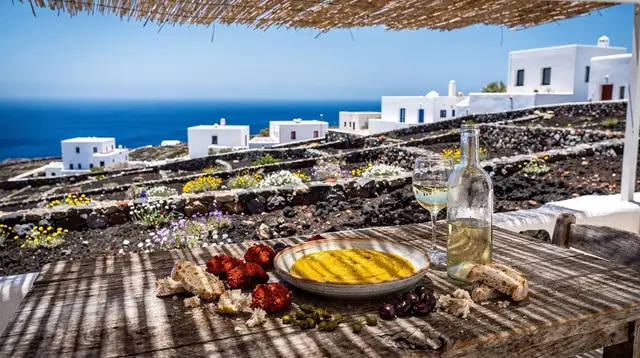
Fava and Tomatokeftedes: Santorini's Two Signature Dishes
What are fava and tomatokeftedes in Santorini?
Fava is a smooth puree made from Santorini's own split yellow pea, grown in the island's volcanic soil, not the fava bean used elsewhere in the Mediterranean. Tomatokeftedes are fried fritters made from the island's small, intensely flavoured cherry tomatoes, onion and herbs, a dish specific to Santorini rather than a generic Greek starter.
Two dishes turn up on almost every taverna table in Santorini, and neither is what a first-time visitor usually expects. For anyone arriving by ferry through Athinios port, one of the first things on the table once they’ve settled in usually isn’t feta or a gyro. One is a pale yellow puree that looks like hummus and isn’t. The other is a small fried fritter that looks like it should be common across Greece and mostly isn’t. Knowing what fava and tomatokeftedes actually are before you sit down means you order with intent instead of guessing from a menu photo.
A pulse, not a bean
The name is the first trap. Fava sounds like it should be made from fava beans, the broad bean eaten across the Mediterranean under names like ful or broad bean puree. Santorini’s fava has nothing to do with that plant. It’s made from a split yellow pea, a legume that has been grown on the island for generations specifically because almost nothing else will grow here.
Santorini has no rivers, no springs and no usable groundwater. What agriculture exists survives on volcanic ash soil, the dry heat driven in by the meltemi wind, and the moisture that condenses out of the night air, without irrigation. The same conditions that force vines into the low, basket-woven kouloura shape you’ll see across the island’s wineries also shaped which crops the island could keep growing over centuries: crops that don’t need watering. The Santorini split pea is one of them, alongside the small cherry tomatoes behind tomatokeftedes.
Because of that specific origin, Santorini fava holds a Protected Designation of Origin, PDO Fava Santorinis. That matters more than it sounds like it should, because the word “fava” is used loosely across Greece for various pea and legume purees. A fava puree made from a generic split pea grown on the mainland is a different product from the one grown in this particular volcanic soil, even if both end up smooth and yellow on a plate.
If you want to taste the source crop rather than just the finished dish, some of the island’s wine estates and farm visits, including the kind covered in a farm-to-table tour that stops at a working local farm, will point out the fields where it’s grown. Some of the wider combo tours that pair a caldera cruise with a village or wine stop pass through similar terrain, even when food isn’t the tour’s main focus.
How Santorini turns it into fava
The dried peas are boiled slowly, usually with onion, until they break down into a mash, then pureed with olive oil until smooth. That base on its own is mild and slightly sweet, closer to a lentil or split-pea soup that’s been reduced to a spread than to anything resembling hummus in flavour, even though the texture invites the comparison.
What arrives at the table is rarely just the puree. It’s almost always finished with something on top: a drizzle of good olive oil, lemon juice, sometimes capers, and very often a spoonful of caramelised onion, which adds the sweetness and acidity the base ingredient doesn’t have on its own. The toppings vary by kitchen, but the puree itself, made from that one specific local pea, is the constant. This page won’t walk through how to make it at home; if that’s what you’re after, the island’s cooking classes cover the technique directly, with a hot pan in front of you rather than a description on a screen.
Tomatokeftedes: the fritters that only really happen here
Tomatokeftedes translates plainly as tomato fritters, and the shape is exactly what it sounds like: small, roughly patty-shaped, deep fried, golden outside and soft inside. What makes them a Santorini dish specifically, rather than a generic Greek starter, is the tomato itself.
Santorini grows a small, intensely flavoured cherry tomato that, like the split pea, survives on almost no water. Concentrated by the dry growing conditions, these tomatoes carry far more flavour per gram than a standard supermarket tomato, which is why a fritter built around them tastes markedly different from a tomato fritter made anywhere else, and why they taste best in the hot, dry stretch of summer that lines up with the island’s best time to visit. The batter mixes the crushed tomato with grated or finely chopped onion, mint, sometimes a little oregano, and just enough flour to hold everything together before it’s dropped into hot oil.
It’s worth being precise about what tomatokeftedes are not. They aren’t fried green tomatoes, a different dish built around unripe, sliced, breaded fruit. They aren’t the courgette fritters, kolokythokeftedes, that share a similar shape and cooking method but a completely different base ingredient. And while fritters made from tomatoes exist elsewhere in Greece under the broader name domatokeftedes, the version tied to Santorini’s specific tomato variety, grown in this soil, is what locals mean when they say tomatokeftedes without qualification. Presenting them as an everyday dish you’ll find on any Greek island’s menu understates what’s actually specific about them here.
Where these two dishes sit in a meal
Both fava and tomatokeftedes are mezze, small shared plates meant to open a meal rather than anchor it. They’re ordered at the start, alongside two or three other small dishes, and eaten with bread rather than as a course on their own. It would be unusual, and a little out of step with how the island eats, to order either as a main.
They’re also commonly ordered together, since they complement each other well: one smooth and cool, the other crisp and hot, both mild enough to sit next to sharper dishes like grilled octopus or a Greek salad without competing. A glass of dry, mineral Assyrtiko is the standard pairing for both, since its acidity cuts through the olive oil in the fava and the fried batter of the fritters in a way a softer white wouldn’t.
If wine pairing specifically is what you’re after beyond these two dishes, the island’s broader wine tasting guide and its rundown of wineries go into more depth than makes sense here.
For a preview before you’ve even landed, some Athens-based experiences bring a version of this table to you: a tasting session built around Santorini’s food and wine while you’re still in Athens is a reasonable way to know what you’re aiming for once you arrive. Once you’re on the island itself, fava and tomatokeftedes also show up on the kind of evening menus served aboard a sunset dinner cruise around the caldera, usually early in the meal, before the main courses come out. For anyone watching the sunset from dry land rather than a boat deck, both dishes turn up just as often at tavernas near the island’s sunset spots beyond Oia. Cruise passengers deciding what to prioritise before docking will find the same trade-off, food-focused evening against everything else on offer, laid out in the guide to best shore excursions in Santorini.
Why you’ll find both on almost every menu
The short answer is that the island had very little choice in what to grow, and it made the most of what survived. With no irrigation and thin volcanic soil, Santorini’s agriculture narrowed over centuries to a handful of crops tough enough to live on dew and winter rain alone: the Assyrtiko vine, the split pea behind fava, the small cherry tomato behind tomatokeftedes, and a scattering of capers and white aubergine. Those crops became the backbone of the local table simply because they were what was there.
That’s also why both dishes read as specifically Santorinian rather than as generic Greek starters you’d find with identical ingredients on any island. The pea and the tomato aren’t interchangeable with versions grown somewhere wetter; the flavour concentration that makes both dishes distinctive comes directly from the growing conditions described in this island’s broader food guide, which covers the wider table beyond these two dishes specifically.
Villages inland, away from the caldera view, tend to be where you’ll find the more traditional versions, since that’s historically where the farming happened: places like Pyrgos, Megalochori and Vothonas sit closer to the fields than the clifftop towns do, though both dishes have long since spread to every part of the island, including Oia and the excavation-adjacent tavernas near Akrotiri. Getting to that inland cluster is straightforward enough for a day trip by rental car or a rented ATV or quad. The island’s KTEL bus network also connects them, for anyone who’d rather not drive. Near Akrotiri specifically, a plate of tomatokeftedes afterward is a common way to end a visit to the Akrotiri excavations.
What to expect when you order
Portions are small by design, meant for sharing rather than as an individual starter, so ordering one of each for a table of two or three is normal rather than excessive. Prices for both dishes are modest by the island’s standards, since the ingredients are simple even if the sourcing is specific; expect fava to run slightly cheaper than tomatokeftedes, which involve more preparation and frying. Most tavernas serving them are informal, ground-level spaces, though anyone checking on step-free access beforehand can consult the island’s accessibility guide before choosing where to sit down. The dishes themselves rarely run out, but a seat at the busiest tavernas serving them can, which is one reason it’s worth checking the island’s rundown of what to book ahead rather than assuming a table will be free.
Quality varies more with the topping and the frying than with anything hidden. A well-made fava should taste like the pea first, not just olive oil and lemon; a well-made tomatokeftedes should taste distinctly of tomato through the fried exterior, not like a bland fritter with tomato paste stirred in. Neither dish needs elaborate plating to be good, and an overly styled version with unusual garnishes is sometimes a sign of a kitchen leaning on presentation rather than the ingredient itself.
Two dishes, one table
| Fava | Tomatokeftedes | |
|---|---|---|
| What it is | A smooth pea puree | Fried tomato fritters |
| Main ingredient | Santorini split yellow pea | Santorini cherry tomato |
| Texture | Silky to slightly grainy | Crisp outside, soft inside |
| Served | Cold or room temperature | Hot, straight from the pan |
| Common toppings | Olive oil, lemon, caramelised onion | Usually none, eaten plain or with tzatziki |
| Vegan | Usually | Usually, worth confirming the batter |
| Typical course | Mezze, start of the meal | Mezze, start of the meal |
Both dishes are simple enough that they rarely need much explanation on a menu, which is exactly why it helps to already know what’s behind the names. If you want the fuller picture of how a meal here is built around dishes like these, the island’s food guide covers the wider table, its village-by-village eating guide covers where to find strong versions of each, and its food tours and Greek night guide covers structured ways to try several dishes, including these two, in one sitting.
For villages worth building a walk around while you’re thinking about where to eat next, the villages guide and an itinerary built around the island’s wine and food are natural next stops, as is a broader look at how a single day here tends to unfold.
Fava and tomatokeftedes: common questions
Is Santorini’s fava made from fava beans?
No. Despite the name, Santorini fava is made from a local split yellow pea, sometimes labelled the Santorini split pea, not from the broad bean known elsewhere as the fava bean. The two are different legumes, and a true Santorini fava will list this local pea, not fava beans, as its main ingredient.
What does fava actually taste like?
It’s earthy and slightly sweet, closer to a smooth pea or lentil puree than to hummus, with a texture that ranges from silky to slightly grainy depending on how long it’s been cooked. On its own it’s mild, which is why it’s almost always finished with olive oil, lemon, and something sharp on top.
Are tomatokeftedes the same as fried green tomatoes?
No. Tomatokeftedes are made from ripe, often overripe, cherry tomatoes mixed into a batter with onion, herbs and flour, then fried as small fritters. Fried green tomatoes are a different, unrelated dish built around unripe fruit sliced and breaded whole.
Will I find these dishes outside Santorini?
Fritters made from tomatoes appear in various forms around Greece under names like domatokeftedes, but the version built specifically around Santorini’s small volcanic-soil cherry tomatoes is tied to the island. Fava as a dish exists elsewhere in Greece too, but Santorini’s is a protected, single-origin product grown only here, so a fava labelled Santorini elsewhere in the country is not the same crop.
Are fava and tomatokeftedes vegan?
Fava usually is, since the base is just the pea, water, onion and olive oil, though it’s worth asking if a kitchen has added anything else to the topping. Tomatokeftedes are typically vegan too, but the batter can occasionally include a small amount of cheese, so it’s a fair question to ask rather than an assumption to make.
What’s traditionally served alongside them?
Both are mezze, meant to be shared at the start of a meal rather than eaten as a main course. They’re commonly ordered together, alongside other small plates, and both pair naturally with a glass of the island’s dry Assyrtiko, which cuts through the richness of the olive oil and the fried batter.
Can I buy fava to take home?
Yes, dried Santorini fava is sold in shops and at some wineries and farm shops across the island, and it travels well since it’s a dried pulse rather than a prepared dish. Look for packaging that names the pea and the PDO Fava Santorinis designation rather than a generic fava label, since that’s the guarantee it’s the real local crop.
Food and drink tours on GetYourGuide
Verified deep-linked GetYourGuide tours. Book through these links and we earn a small commission at no cost to you.
GetYourGuide does not provide a product photo for this activity — the image shows the meeting point, photographed by us.