Accessibility in Santorini: What Limited-Mobility Travelers Should Know
Is Santorini accessible for wheelchairs, strollers or limited mobility?
Not easily. The caldera villages sit atop a 250-300m cliff, the old port is reached by 588 steps, a small cable car, or donkeys, and taxis are scarce (about 30 for the whole island). Flatter beach towns like Kamari and Perissa, and boat-based sightseeing, work far better than Fira or Oia for reduced mobility.
Why Santorini is harder than it looks in photos
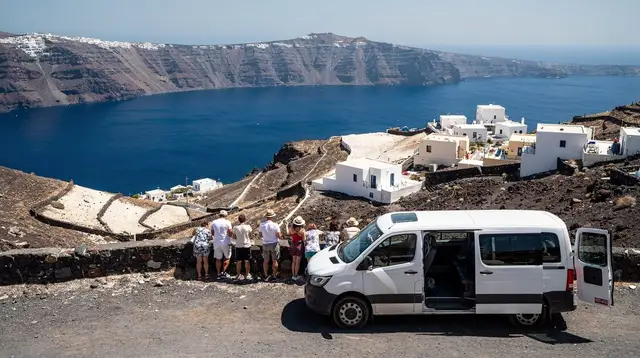
Every postcard of Santorini shows the same thing: white cubes stacked along a curving cliff edge, with the sea far below. That image is exactly the problem. The villages people come to see — Fira, Firostefani, Imerovigli and Oia — are built along the rim of a caldera wall that drops 250 to 300 meters to the water.
There is no flat approach. There is no beach at the bottom of these particular villages. The whole point of the view is that you are standing on top of a cliff, and getting up there, or moving between terraces once you’re there, is not a minor inconvenience for someone with a mobility limitation — it’s the defining fact of the island’s geography.
This page is not about which of the three ways down to the old port is “best” — that comparison, with wait times and prices, lives on its own page. This one is about the bigger picture: whether Santorini, as a whole, is a realistic destination for a traveler using a wheelchair, walking with difficulty, pushing a stroller, or simply dragging heavy luggage — and how to plan around its constraints if it is.
The caldera villages: beautiful, and built on stairs
Fira, Oia and Imerovigli were laid out centuries before anyone thought about ramps or lifts. Houses are carved into the cliff and stacked on top of one another, connected by narrow lanes, tunnels and short staircases that step down between terraces. Even a short walk from a hotel to a restaurant two streets away can involve a dozen uneven stone steps, a slab path polished smooth by decades of foot traffic, or a section of loose gravel.
A few practical consequences follow from this:
- Wheeled luggage is a liability. Suitcases with small wheels catch on cobblestones and steps constantly. Soft bags carried by hand, or with backpack straps, cope far better.
- Strollers get folded often. Parents doing Santorini with kids should expect to carry a folded stroller up and down short flights of steps multiple times a day, not roll it continuously.
- “Sea view” does not mean “ground floor.” Cave-style rooms are frequently reached by their own private staircase from the lane above, which is part of their charm and part of the problem. Ask specifically about steps to the room, not just to the property, before booking — see where to stay in Santorini for how the villages differ in this respect, and Oia versus Fira for a closer look at the two most visited ones.
None of this makes the caldera villages impossible to visit. It means visiting them takes more planning, more time between stops, and more tolerance for asking a taxi or a hotel porter for help than a typical seaside town would.
The old port: three routes, one shared problem
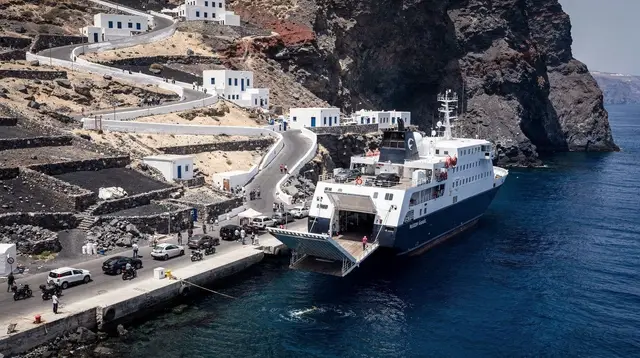
Below Fira, the old harbor of Skala receives excursion boats, tenders and the launches from cruise ships anchored offshore. Getting between the harbor and the town 220 meters above is where Santorini’s terrain becomes unavoidable, because there are exactly three ways to do it: the cable car, the 588-step staircase, or a donkey.
Each option has a real limitation worth knowing before you rely on it:
| Route | What it demands | The catch for limited mobility |
|---|---|---|
| Cable car | A short wait in line, a few minutes standing in a small cabin | Capacity is limited to a set number of cabins per hour; when cruise ships are in port, demand can outstrip that capacity for long stretches |
| 588 steps | Sustained climbing or descending on uneven stone, no seating along the way | Not realistic for most mobility limitations, and hard even for fit travelers in midday heat |
| Donkey | Being led on an animal up a narrow switchback path | Animal welfare weight limits apply, and the ride itself is not a supported, stable seat |
The trap worth naming directly: the cable car is often presented as the accessible option, but it is not a guaranteed one. It has a fixed number of cabins and a fixed capacity per trip, and on days when one or more cruise ships are anchored off the island, passengers being shuttled up from tenders are given priority, which can leave everyone else — including anyone who has no other way up — waiting far longer than expected.
If your itinerary depends on the cable car at a specific time, build in slack, or better, avoid routing through the old port altogether and choose an excursion that boards from a different point, such as one of the caldera cruises that leave from other jetties around the island.
The practical takeaway: anyone with significant mobility constraints should treat the old port as an area to avoid entirely rather than a puzzle to solve. If a cruise excursion or boat trip disembarks there, ask the operator in advance what the alternative is, and lean on private transfers rather than the walk up.
Taxis: the island’s real bottleneck
Santorini’s public transport and taxi network was built for an island a fraction of its current visitor numbers. There are only around thirty taxis in total serving the entire island — Santorini’s airport, the ferry port at Athinios, every village, and every beach, all sharing the same small fleet.
For most visitors this means occasional waits. For a traveler who cannot manage stairs, a crowded bus, or a long walk to a taxi rank, it means something closer to a planning requirement: book a private transfer in advance, every time, rather than assuming a taxi will be available on arrival. This applies to:
- Arrival at the airport or the port, where taxi queues can run well past thirty minutes in high season
- Any evening trip to watch the sunset, when demand for cars spikes across the whole island at once
- Moving between villages, since the local buses are inexpensive but crowded, make frequent stops, and are not designed with wheelchair access in mind
A pre-booked private transfer costs more than a shared taxi or bus, but it removes the single biggest source of unpredictability on the island for anyone with reduced mobility.
Where the terrain works in your favor
It’s worth saying plainly: not all of Santorini is built like Oia. Several areas are considerably easier to navigate, and a trip planned around them can look very different from one centered on the cliff-edge villages.
- Kamari and Perissa sit on the flatter southeastern coast, each with a long paved beachfront promenade lined with cafés and hotels at street level. This is the closest thing Santorini has to a conventional, level seaside town.
- Perivolos, next to Perissa, shares the same flat layout and is generally quieter.
- Akrotiri, the excavated Bronze Age settlement, is entirely under a flat, covered roof with level, wide walkways between the ruins — genuinely one of the more manageable major sights on the island, and a good option on a day when walking elsewhere feels like too much.
- Villages a little inland, such as Karterados or parts of Messaria, tend to have wider, flatter streets than the caldera-edge towns, simply because they were never built to cling to a cliff.
A trip that bases itself in Kamari or Perissa rather than Fira or Oia, uses private transfers for anything time-sensitive, and treats the caldera villages as short, well-planned outings rather than a place to wander freely, is a realistic version of Santorini for someone managing a mobility limitation.
Seeing the caldera without climbing it
One of the more useful workarounds on this island is that its single best-known view — the caldera itself — can be experienced entirely from the water, without a single step. A boat looks up at the cliffs rather than fighting for a foothold on top of them, and boarding usually involves nothing harder than a short step down from a jetty or tender, worth checking with the operator in advance if that step itself is a concern.
a full-day catamaran cruise around the caldera, with swim stops and lunch on board, replaces an entire day of clifftop walking with a day spent seated on deck. For the sunset specifically — normally a scrum of people standing for hours along Oia’s castle walls — a sunset cruise on the water gives the same light on the cliffs from a stable seat instead. Travelers prioritizing comfort and privacy over group logistics sometimes go further still and book a private villa experience with a dedicated setting rather than joining a shared group tour at all.
None of these remove every obstacle — getting to the departure jetty may still involve some walking or a short transfer — but they remove the specific obstacle that trips up most limited-mobility visitors: the long, stepped, uphill-downhill walk along the caldera rim.
Planning a trip around these constraints
A few decisions made before arrival do more good than anything improvised on the ground:
- Choose accommodation by access, not just by view. Ask directly: how many steps from the road to the reception, and from the reception to the room? A caldera-view room is often reached by its own staircase even within an otherwise accessible property.
- Base yourself partly, or entirely, in a flatter town. Kamari or Perissa as a base, with day trips into Fira or Oia rather than nightly walks through them, reduces daily strain considerably.
- Pre-book every transfer. Given how scarce taxis are, spontaneity is the enemy here. This applies doubly to airport and port arrivals — see getting to Santorini for the fuller picture of how people arrive and move around.
- Treat the old port as optional. If an itinerary routes through Skala and the 588 steps or the cable car, ask whether an alternative departure point exists.
- Build in recovery time. Santorini’s terrain is genuinely more tiring than a flat destination, even for travelers without a diagnosed mobility limitation. Fewer stops per day, planned with slack, work better than an ambitious list.
- For families, the same logic applies to strollers as to wheelchairs: a kids’ itinerary built around beach mornings in Kamari or Perissa and short, well-timed visits to the caldera villages holds up better than one built around long walks through Oia’s lanes.
The honest verdict
Santorini was not designed with accessibility in mind, and no amount of trip planning changes the underlying geography: a cliff is a cliff. But the island is large enough, and varied enough, that a visit doesn’t have to mean fighting the cliff head-on. Flatter beach towns, a covered archaeological site, boat-based sightseeing and pre-booked private transfers cover a meaningful share of what makes the island worth visiting, without depending on stairs, a small-capacity cable car, or a scarce taxi arriving exactly on schedule. The villages on the postcards remain the hardest part of the island to move through — worth a well-planned visit, not a place to wing it.
Accessibility and mobility in Santorini — frequently asked questions
Is Santorini wheelchair accessible?
Partially. Main roads and some hotel and restaurant terraces are reachable by car or taxi, but the pedestrian lanes inside Fira, Oia and Imerovigli are narrow, stepped and cobbled, and were never built with wheelchairs in mind. Purpose-built accessible facilities exist but are the exception, not the rule.
Can I use a stroller in Fira and Oia?
You can, but expect to carry it often. The caldera-edge paths mix cobblestones, uneven stone slabs and short flights of steps between terraces, so a lightweight, foldable stroller works better than a large travel system.
How do I get from the old port of Fira up to town without walking?
Three options exist: the cable car, the 588-step staircase, or a donkey. Each has real limits for reduced mobility, and none is guaranteed to be available the moment you need it — see our dedicated comparison of the three for wait times and costs.
Are taxis easy to find on Santorini?
No. The island has only around thirty taxis in total, shared between the airport, the port and every village. Waits of thirty minutes or more are common in high season, so pre-booking a private transfer matters much more here than on a typical island.
Which parts of Santorini are easier for someone with limited mobility?
The beach towns of Kamari and Perissa sit on flatter ground with paved seafront promenades, unlike the cliff-edge villages. Akrotiri’s excavation site is under a flat, covered roof and is one of the more manageable indoor attractions on the island.
Is the cable car in Fira a reliable accessibility solution?
Only partly. It is the fastest way up from the old port, but its cabins are small and it is often reserved first for cruise-ship passengers when several ships are in port, which can mean long queues exactly when you need it most.
Should someone who uses a wheelchair skip Santorini altogether?
Not necessarily, but expectations need adjusting. A trip built around a caldera-view hotel with lift access, private transfers, boat excursions instead of clifftop walking, and a beach town base can work; a trip built around wandering Oia’s lanes independently will not.
Are boat trips and cruises a good workaround for limited mobility?
Often yes. Seeing the caldera from the water avoids stairs and crowds entirely, though boarding still usually means a step down from a jetty or tender, so it is worth asking the operator about boarding conditions before booking.
Trip-planning essentials on GetYourGuide
Verified deep-linked GetYourGuide tours. Book through these links and we earn a small commission at no cost to you.
GetYourGuide does not provide a product photo for this activity — the image shows the meeting point, photographed by us.