Nea Kameni Volcano Guide
Is the Nea Kameni entry fee included in a caldera cruise?
Usually not. Nea Kameni charges a landing fee of around 5 euros, paid in cash on the island itself, and most catamaran and boat operators leave it out of the advertised cruise price. There is no lava to see either way — the last eruption was in 1950.
The Volcano in the Middle of the Caldera
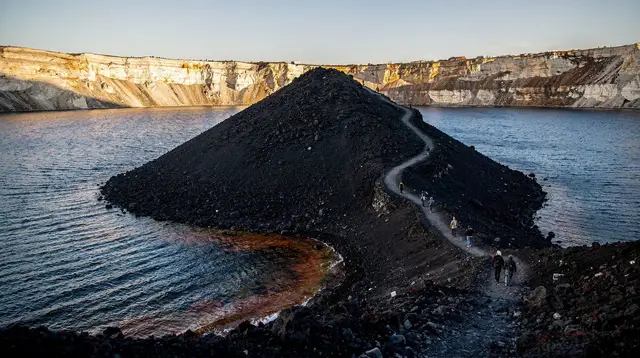
Every boat that circles the Santorini caldera eventually points its bow at a low, black, treeless hump sitting almost dead centre of the water. That is Nea Kameni, the youngest land in the Cyclades and the only part of the Santorini volcanic system that visitors actually walk on. It has no village, no beach, no shade, and no permanent residents — just a cone of dark rock, a scatter of steaming vents, and a path worn into the cinder by decades of cruise groups climbing to the rim.
Nea Kameni is not a side note on a caldera cruise; for many operators it is the reason the cruise exists. But the islet comes with two things that trip up first-time visitors almost every time: a small entry fee that most cruise brochures don’t mention, and an expectation — set by photos and imagination rather than fact — that there will be lava to see. Neither is a secret exactly, but neither is advertised loudly either. This guide sets out exactly what you will find when you land, what it costs, and how it fits alongside the neighbouring islets of Palea Kameni and Thirassia.
What Nea Kameni Actually Is
Nea Kameni — “New Burnt Island” — is the active centre of the Santorini volcanic system, formed by a sequence of eruptions long after the massive Bronze Age eruption that carved out the wider caldera around 1600 BCE. Together with its quieter neighbour Palea Kameni, it sits inside the flooded caldera formed by that ancient event, more or less equidistant from the caldera villages of Oia and Fira on one side and Thirassia on the other.
The islet last erupted in 1950. Before that, activity came in bursts across the twentieth century — 1925 to 1928, 1939 to 1941 — and further back to events in 1707 and earlier centuries. What you see today is the legacy of that activity rather than anything currently flowing: cooled lava fields, cinder cones, and fumaroles where warm, sulphurous gas still seeps from cracks in the rock. If you want the fuller geological story of how the caldera itself came to exist, that is covered separately in how the Santorini caldera was formed; this page stays focused on Nea Kameni as a place you visit, not as a geology lesson.
The Walk to the Crater
Boats don’t dock at a pier on Nea Kameni in the way they might elsewhere — passengers land at a small jetty and walk from there. The path itself is unmarked by anything scenic in the conventional sense: no trees, no flowers, just dark volcanic gravel and cinder underfoot, rising gradually toward the main crater rim.
The walk up takes roughly 30 minutes at a relaxed pace, and slightly less coming back down. It’s not technically difficult, but it is not flat, shaded, or forgiving of bad footwear — the surface is loose in places, and the black rock absorbs heat aggressively under a summer sun. Most cruise itineraries build in 30 to 45 minutes on the island, which is enough for the walk up, a few minutes at the top, and the walk back, but not much more. If your group tends to move slowly, or you want time to linger and take photographs at the summit, it’s worth checking with your operator how long the Nea Kameni stop actually runs before you book.
At the top, the reward is the crater itself: a wide, barren depression of reddish and black rock, with visible fumaroles venting warm air that carries a faint sulphur smell. On a clear day the view back across the water to the cliffside villages of the caldera is one of the better vantage points on any cruise itinerary, precisely because you are looking at the caldera rim from inside it rather than from above.
The Fee Nobody Puts on the Brochure
This is the detail that causes the most friction on the day: landing on Nea Kameni costs money, and it is usually not included in the price you paid for your cruise.
The entry fee is on the order of 5 euros per person, and it is collected in cash, on the island, rather than as a line item added to your ticket in advance. Most catamaran, sailing, and semi-private cruise operators build their advertised price around the boat itself — the crew, the route, sometimes drinks, a barbecue, or a swim stop — and simply leave the Nea Kameni landing charge as a separate, unbundled cost that passengers pay directly once they’re ashore.
Nothing about this is dishonest exactly, but it is easy to miss if you’re reading a cruise listing quickly, and it is the single most common source of an unpleasant surprise once people are already on board with no cash on them. Two practical takeaways:
- Bring cash in small denominations. There are no card machines on a volcanic islet with no shops, and no ATM to bail you out.
- Ask before you book, not after you land. A quick message to the operator — “is the Nea Kameni landing fee included?” — settles the question before it becomes a group scramble for coins at the jetty.
If you’re comparing multiple cruise options and want a side-by-side of what each one does and doesn’t include, Santorini volcano tours compared and catamaran vs sailing boat go into more detail than fits here.
Setting Expectations: There Is No Lava
It’s worth saying plainly, because the assumption comes up often: there is no lava visible anywhere on Nea Kameni, at any time of year. The islet’s last eruption was in 1950, and nothing about its current state resembles the glowing, flowing imagery that “active volcano” tends to conjure. What you will see is cooled black and reddish rock, some visibly more recent than the surrounding terrain if you know what to look for, and fumaroles releasing warm gas rather than heat you can feel from a distance.
That doesn’t make the visit unremarkable — walking across ground that erupted within living memory, in the middle of a bay formed by one of the most consequential eruptions in the ancient Mediterranean, is its own kind of striking. It just isn’t a fireworks display, and operators who imply otherwise in their marketing are overselling it.
How Cruises Combine Nea Kameni With the Rest of the Caldera
Nea Kameni almost never appears alone on an itinerary. It’s typically one stop among several on a half-day or full-day boat trip that also includes a swim stop, sometimes a call at Thirassia, and often a run past — or a sunset view of — Oia. The table below sketches how the main formats compare, in general terms rather than fixed prices, since operators and seasons vary.
| Cruise format | Typical length | Includes Nea Kameni landing fee? | Best suited to |
|---|---|---|---|
| Day-time catamaran with swim stops and lunch | Around 5–6 hours | Usually not included | Groups wanting a full day on the water, swimming plus the volcano |
| Sunset catamaran with swim stops and dinner | Around 5–6 hours, ending near sunset | Usually not included | Couples and groups prioritising the Oia sunset from the water |
| 3-hour caldera catamaran with drinks | Around 3 hours | Varies by operator | Shorter visits, cruise-ship passengers on a tight window |
| Semi-private or small group cruise | Varies | Varies by operator | Travellers wanting fewer passengers per boat |
Whichever format you choose, confirm the Nea Kameni fee status in writing before departure — it is the one line item that consistently causes confusion on the day.
a full day-time catamaran cruise around the volcanic islets with swim stops and a barbecue lunch on board a sunset catamaran cruise that pairs the Nea Kameni stop with swim breaks and dinner as the caldera lights upCruise-Ship Passengers and Short Windows
If you’re arriving on a cruise ship docked offshore rather than staying on the island, your time is tighter than most independent visitors’, and Nea Kameni competes for a shrinking window against Fira, Oia, and lunch. A shorter, focused option — like a three-hour caldera catamaran run — can fit the volcano stop into a single-day port call without eating the whole afternoon. For a broader look at making the most of a short call, see one day in Santorini from a cruise ship and the wider Santorini cruise port guide.
a three-hour caldera catamaran cruise with drinks, built for a tighter scheduleNea Kameni vs Palea Kameni: Don’t Confuse the Two
Nea Kameni and Palea Kameni sit close together in the caldera and are often visited back to back on the same cruise, but they offer entirely different experiences and this guide covers only the first of them.
- Nea Kameni: you land, you walk, you climb to a crater rim, you pay a small cash entry fee, and you do not swim here.
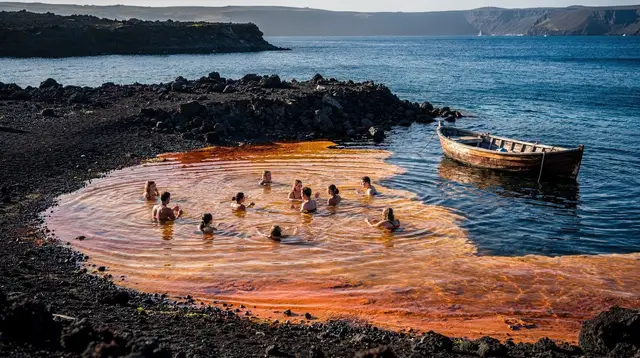
- Palea Kameni: you do not land at all — boats anchor offshore and passengers swim from the boat to the islet’s warm, iron-tinted hot springs.
If the springs, the swimming, and the rust-coloured water are what you’re after, that experience is covered in full in the Palea Kameni hot springs guide, including the fact that the “hot” springs are closer to lukewarm and will stain light-coloured swimwear. Most itineraries that include Nea Kameni also stop at Palea Kameni, so budgeting time — and a swimsuit — for both makes sense even if this page is only about the volcano climb.
a catamaran cruise around the volcanic island that combines both the Nea Kameni crater and the Palea Kameni swim stopA Note on the 2025 Seismic Swarm
In early 2025, an extended seismic swarm affected the sea area between Santorini and Amorgos, beginning on 27 January and lasting roughly forty days, with more than 28,000 recorded tremors at its peak. It prompted a local state of emergency, school closures, and the temporary departure of thousands of residents. It’s reasonable for anyone booking a volcano visit to wonder whether that has any bearing on a trip to Nea Kameni.
It does not, in practical terms. No eruption occurred during the swarm, current research attributes the activity to a deep magma intrusion rather than an imminent eruption, and the swarm itself ended months before this page was written. Cruise operators have continued landing on Nea Kameni on the same basis as before. For the fuller picture on how the swarm is understood today and what it does and doesn’t mean for a visit, see Santorini safety and the 2025 earthquakes.
Planning the Rest of Your Volcano Day
A stop on Nea Kameni rarely stands alone, and it’s worth thinking about it as part of a wider caldera itinerary rather than a single errand. Pair it with a look at the caldera cruise guide for a broader sense of what a half-day or full-day boat trip typically covers, and what to bring on a caldera cruise for a packing list that accounts for the volcano’s heat, dust, and lack of shade. If your schedule allows for a longer boat day, some itineraries extend as far as Thirassia or wrap around toward Ammoudi Bay beneath Oia.
a full one-day guided tour of Santorini that includes a visit to the volcano alongside the island’s main sights
Nea Kameni Entry Fee and Visit FAQ
How much does it cost to visit Nea Kameni?
Expect an entry fee on the order of 5 euros per person, collected in cash once you land on the island. It is a local landing charge, not a ticket you buy in advance, and the exact amount can shift from season to season.
Is the Nea Kameni entry fee included in my cruise ticket?
Very often it is not. Most catamaran, sailing, and semi-private cruises quote a price that covers the boat, the crew, and sometimes drinks or a meal, but leave the Nea Kameni landing fee as a separate cash payment on the island. Ask your operator directly before you board.
Will I see lava or an active eruption at Nea Kameni?
No. There is no visible lava anywhere on Nea Kameni. The last eruption on the islet was in 1950, and the crater today is a field of dark volcanic rock and vents of warm, sulphur-smelling air, not flowing lava.
How long does the walk to the crater take?
The main path from the landing point to the highest rim of the crater takes roughly 30 minutes at an easy pace, on loose volcanic cinder and gravel. Most cruise stops allow 30 to 45 minutes on the island, which is enough time for the walk and a short pause at the top.
What should I wear to visit Nea Kameni?
Closed shoes with a solid sole are the one non-negotiable item — the path is loose cinder and can be sharp underfoot. Sun protection, water, and a hat matter too, since the islet has no shade and the black rock holds heat.
Is Nea Kameni safe after the 2025 earthquake swarm?
Yes. The seismic swarm that affected the Santorini area in early 2025 did not produce an eruption, and it ended after roughly forty days. Nea Kameni has continued to receive cruise landings on the same basis as before, with no special restrictions tied to the swarm.
Can I visit Nea Kameni without a cruise?
Not really. There is no scheduled ferry service to Nea Kameni for independent travellers; the islet is reached only as a stop on a boat tour, whether a small caldera cruise, a catamaran sunset trip, or a larger day tour of the island.
Is Nea Kameni the same as Palea Kameni?
No. Nea Kameni is the islet you climb, with the active crater and no swimming. Palea Kameni sits nearby and is where boats stop for the warm hot springs, reached by swimming from the boat rather than by landing.
Volcano and Hot Springs on GetYourGuide
Verified deep-linked GetYourGuide tours. Book through these links and we earn a small commission at no cost to you.
GetYourGuide does not provide a product photo for this activity — the image shows the meeting point, photographed by us.