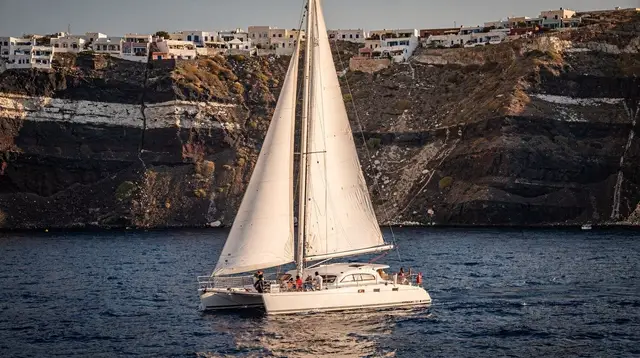
A long, mountainous island east of the caldera
Amorgos sits at the far eastern edge of the Cyclades, closer in feel to nowhere else in the group. Where Santorini is a ring of low villages around a flooded caldera, Amorgos is a single long spine of mountain running roughly forty kilometres, dropping into the sea on both sides in cliffs rather than beaches. It has none of Santorini’s volcanic geology and none of its crowds. What it has instead is a whitewashed monastery built into a sheer cliff face, a scattering of hill villages connected by old stone paths, and a reputation among divers and hikers that has little to do with sunsets.
For anyone reading this from The Santorini Caldera or from one of the villages along the Fira-Oia caldera path, the honest first question is whether Amorgos belongs on the same trip at all. It is further from Santorini than Ios, Folegandros or Sikinos, and the ferry connection reflects that distance. This page treats Amorgos on its own terms, as an island to reach deliberately rather than to squeeze into a single afternoon.
Getting there from Athinios
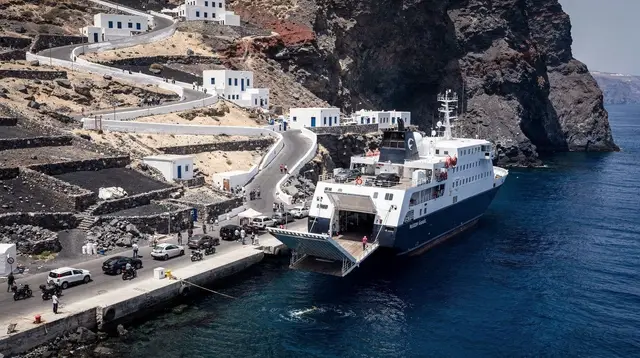
Every ferry out of Santorini leaves from Ormos Athinios, the single port at the foot of the caldera cliff. There is no direct fast-ferry route that skips straight to Amorgos in under two hours: depending on the company and the season, a crossing takes roughly two to four hours, and some routes call at one or two other islands — often Naxos or a smaller stop — before continuing on to Amorgos’s own ports. Schedules and durations shift by year and by carrier, so treat any single figure as an order of magnitude, not a promise, and check the current timetable before booking anything around it.
Amorgos has two ports, and which one your ferry uses matters for planning:
| Port | Side of the island | Nearest village |
|---|---|---|
| Katapola | South | Chora, on the ridge above |
| Aegiali | North | Tholaria and Langada |
Some ferries call at both in a single run, others only one. If you are day-tripping from a neighbouring island rather than from Santorini directly, this is worth confirming before you buy a ticket — arriving at Aegiali when your return leg departs from Katapola means a bus or taxi across the island in between.
For the wider context of how Amorgos fits into a longer Cyclades run, see island hopping from Santorini and Cyclades island-hopping routes; the mechanics of tickets and seasonal frequency are covered in the Santorini ferry guide.
Katapola, Aegiali and Chora
Katapola is a working harbour town wrapped around a deep, sheltered bay, with a handful of tavernas along the water and none of the polish of a resort. It’s a practical base rather than a scenic one, and most visitors use it as the jumping-off point to walk or drive up to Chora.
Chora, Amorgos’s capital, sits on the ridge above Katapola rather than on the water — a cluster of whitewashed houses, a row of ruined windmills along the crest, and views down to both coasts on a clear day. It has a similar layout logic to Santorini’s own clifftop villages, without the caldera and without the volume of visitors.
Aegiali, on the north coast, is the other side of the island in every sense: a sandy bay, a smaller and more relaxed harbour village, and the starting point for several of the hiking routes that connect the northern villages of Tholaria, Langada and Potamos. Travellers who want a beach base tend to prefer Aegiali; travellers who want to be near Chora and the monastery tend to land at Katapola.
The Monastery of Hozoviotissa
Amorgos’s single most photographed sight is the Monastery of Hozoviotissa, a narrow white building built directly into a cliff face on the island’s east coast, roughly 300 metres above the sea. It dates to the 11th century and is still an active monastery, home to a small number of monks. The approach is on foot, up a stepped path from the road below, and the building itself is only a few metres wide — it reads more like an extension of the rock than a freestanding structure.
Visiting hours are limited and modest dress is required (covered shoulders and knees for everyone); check current opening times locally rather than assuming it is open on arrival, since hours vary by season and can change with little notice. The monastery is also the reason many photographers and hikers put Amorgos on their list in the first place — a self-guided photography session across the island’s cliffs and villages typically routes past it.
Hiking between the villages
Amorgos is one of the better Cyclades islands for walking, precisely because it has stayed underdeveloped. Old stone paths — the same ones that connected villages before roads existed — still link Chora, Potamos, and the string of settlements above Aegiali (Tholaria, Langada, Stroumbos). None of the routes are flat: this is a mountain island, and paths climb and drop between ridgelines with genuine exposure to sun and wind, so water, sturdy shoes and an early start matter here as much as they do on the Fira to Oia caldera hike back on Santorini.
A guided option removes the guesswork over navigation and timing: the guided hiking day trip through the Aegiali Bay villages covers Tholaria, Langada and the coastal paths between them with a local guide setting the pace. For travellers who would rather cover ground by road than on foot, a full-day road trip around Amorgos reaches Chora, both ports and several viewpoints in a single day without the climbing.
Diving and the legacy of Le Grand Bleu
Amorgos has a name in diving circles that predates most of its tourism. Luc Besson’s 1988 film Le Grand Bleu (The Big Blue), about free-diving rivals, was filmed largely around Amorgos’s coastline, and the association has stuck: the island still draws divers and freedivers specifically, rather than as an afterthought to a beach holiday.
Two structured options run from the island’s dive centre for different levels: a basic diver course for those starting from scratch, and a freediver course for those specifically drawn by the island’s free-diving reputation. Visibility and water conditions here are broadly similar to what you’d find diving out of Santorini — see the scuba diving Santorini guide for a comparison — but the coastline and dive sites themselves are entirely different, shaped by rock rather than by volcanic ash.
Wine, food and a slower pace
Amorgos doesn’t have Santorini’s PDO vineyards or its Assyrtiko reputation — the island’s volcanic soil and rain-shadow climate are specific to Thira and don’t transfer across the water. What Amorgos does have is small-scale Cycladic wine production and a food culture built around what the island itself produces: local cheeses, honey, and simple taverna cooking rather than the wine-tourism infrastructure of the caldera villages.
A half-day Cycladic wine tasting with local snacks is the closest equivalent Amorgos offers to a Santorini winery visit, pairing regional wines with mezze rather than a formal cellar tour. It’s a lower-key experience than Santo Wines or Venetsanos back on Santorini, and it’s worth going in with that expectation rather than comparing the two directly.
The 2025 seismic swarm, in plain terms
Because Amorgos sits at the eastern end of the same stretch of sea as Santorini, it’s worth addressing directly: in early 2025, an earthquake swarm was recorded in the sea between Santorini and Amorgos. It began on 27 January 2025, lasted around forty days, and produced more than 28,000 recorded tremors, some as strong as magnitude 5.2 — enough to trigger a local state of emergency on Santorini, school closures, and a temporary departure of several thousand residents and workers. Subsequent research has attributed the swarm to magma moving upward through a dyke from a deep reservoir, not to volcanic unrest breaking the surface.
No eruption occurred, on Santorini or anywhere near Amorgos, and the swarm ended. It is not an ongoing event, and nothing about current conditions suggests one is imminent on either island. It’s mentioned here because Amorgos was the geographic reference point used at the time to describe where the swarm was centred, and because any page about visiting Amorgos that ignores it would be leaving out something readers are likely to have heard about. For a fuller account of what happened and what it means for visitors now, see Santorini safety and the 2025 earthquakes.
How Amorgos compares to other nearby islands
Santorini sits within reach of several smaller Cyclades islands, and each one covers different ground on this site. Ios is closer and busier, with a stronger nightlife reputation. Folegandros and Sikinos are quieter and architecturally similar to each other. Anafi is the smallest and least developed of the group. The Koufonisia islands, further north, are flat and beach-focused in a way Amorgos is not. Amorgos stands apart from all of them by its scale — it’s a genuinely mountainous island rather than a low, beach-ringed one — and by its specific draw for hikers and divers rather than beachgoers.
For travellers building a longer route through the group rather than a single add-on to Santorini, the ten-day Cyclades island-hopping itinerary gives Amorgos the multi-day slot it needs rather than trying to compress it into a day trip. Broader activity listings for the island, including tours not covered above, sit on the things to do in Amorgos page.
How long to actually stay
Given the ferry time from Athinios, a single day on Amorgos means spending as much time travelling as sightseeing — workable if you’re already island-hopping through the region and have a boat that suits your schedule, but not a satisfying way to see the monastery, do any real walking, and get back. Two nights lets you split time between Katapola/Chora and Aegiali without rushing either side of the island; three gives room for a hiking day, a dive or wine tasting, and one unstructured day. Compare this against the shorter, more established options covered in day trips from Santorini before deciding whether Amorgos fits your itinerary as written or needs its own extra night.
Amorgos questions answered
How do you get to Amorgos from Santorini?
By ferry from Athinios, Santorini’s only ferry port. Crossings take roughly two to four hours depending on the operator and how many other islands the route calls at along the way. There is no airport on Amorgos serving direct flights from Santorini.
Is Amorgos a good day trip from Santorini?
Not really. The ferry crossing alone can take up to four hours each way, which leaves little time on the island itself. Amorgos suits a two- or three-night stay far better than a single-day visit.
What is Amorgos famous for?
Two things mainly: the Monastery of Hozoviotissa, built into a cliff face on the east coast, and its association with the 1988 film Le Grand Bleu, which gave the island a lasting reputation among divers and freedivers.
Is Amorgos affected by the 2025 earthquakes near Santorini?
An earthquake swarm in early 2025 was centred in the sea between Santorini and Amorgos and lasted about forty days. It produced no eruption, has since ended, and current research points to magma movement deep underground rather than surface volcanic activity. It is not an ongoing risk to visitors.
Which port should I arrive at, Katapola or Aegiali?
It depends on your ferry and your plans. Katapola sits below Chora and is the better choice if the monastery and the capital are your priority. Aegiali, on the north coast, is closer to the hiking villages of Tholaria and Langada and has the island’s better sandy beach.
Is Amorgos good for diving?
Yes — it’s one of the more established diving destinations in the Cyclades, partly on the back of its Le Grand Bleu reputation. Both beginner and freediving courses run out of the island’s dive centre.
Do you need a car on Amorgos?
A car or scooter makes the island far easier to cover, since the two ports and the hill villages are spread along a single, winding road. A guided road trip is a practical alternative for visitors who would rather not drive unfamiliar mountain roads themselves.