Where Folegandros Fits on the Map From Santorini
Folegandros is one stop further into the southern Cyclades than Ios, reached from Santorini on the same ferry network that runs out of Athinios, the island’s only port. There is no single, reliable crossing time to quote here — sailings vary by company, by boat, and by whether a route calls at Ios on the way. That variability is worth knowing before you book, because it shapes how you should plan the rest of the trip: as an overnight extension rather than a rushed there-and-back.
This page treats Folegandros on its own terms, as a destination to add onto a Santorini stay. It doesn’t cover the general mechanics of hopping between islands — for that, see the island-hopping guide and the broader Cyclades routes overview — and it doesn’t retread Ios, Amorgos, Sikinos, Anafi or Koufonisia, each of which has its own page in this guide. What follows is what actually changes once you step off the boat in Folegandros: a cliff-top capital instead of a caldera, quiet squares instead of sunset crowds, and a noticeably slower rhythm.
Getting There From Athinios
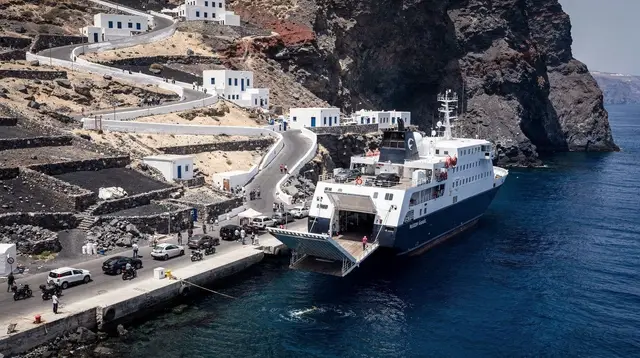
Every ferry to Folegandros departs from Athinios, the working port at the base of Santorini’s western cliff — there is no other option, since Santorini has just the one ferry harbour. From there, routes toward the southern Cyclades typically continue past Ios before reaching Folegandros, which is part of why the crossing runs longer and less predictably than the short Santorini–Ios leg.
Because durations shift with the operator, the vessel class, and the exact stop pattern, resist the temptation to look for a fixed number of hours anywhere on this site — there isn’t a reliable one to give. What you can plan around instead:
- Book through a ferry search tool or agent that shows the actual sailing time for your date, not a generic figure.
- Expect a longer day of travel than the Santorini–Ios hop, and build in slack rather than a tight connection.
- Check whether your route is a direct sailing or one that calls at Ios first, since that changes both time and price.
For the mechanics of the port itself — where to wait, how boarding works, and what the road down from Fira looks like — see the Athinios port guide and the wider Santorini ferry guide. If you’re still deciding how to reach Santorini in the first place, getting to Santorini covers flights and ferries from the mainland.
Chora: A Capital Without a Caldera
Where Santorini’s villages line the rim of a volcanic crater, Folegandros’s capital, Chora, sits on its own cliff edge with a different kind of drama: a tight cluster of whitewashed houses built around a fortified medieval quarter called the Kastro, where the outer walls of the houses themselves once formed part of the island’s defences against pirate raids. Walking into the Kastro from one of Chora’s three connected squares feels like stepping through a gate that has barely changed shape in centuries.
Chora is entirely car-free, and its scale rewards slow walking rather than a checklist. A path climbs from the edge of town up to the whitewashed church of Panagia, perched above the village on a hill; the walk up takes a modest effort and is best done in the cooler hours, with the reward being a clear view back down over Chora’s rooftops and the sea beyond. In the evening, the squares fill gradually with locals and visitors sharing the same handful of tables — there is no equivalent here to the sunset crush that defines a place like Oia back on Santorini.
Getting Around on Foot: What the Lanes Are Actually Like
Chora’s lanes are stepped, cobbled and largely level once you’re inside the squares, but reaching them from the port or walking out toward Ano Meria involves slopes and stairs that a wheelchair or a stroller won’t manage without help. Folegandros has none of Santorini’s cable car or paved caldera-rim paths, so if you’re weighing how manageable a Cycladic island is for a limited-mobility traveller, the accessibility guide to Santorini sets a useful baseline — Folegandros sits noticeably further from that baseline than Fira or Oia do. For anyone who’d rather cover the coastline without walking every path, an ATV or quad rental is a common workaround on islands like this one, though the same caution about traffic and uneven terrain that applies on Santorini applies here too.
Ano Meria and the Rest of the Island
Beyond Chora, most of Folegandros’s land and its older way of life sit in and around Ano Meria, a loose scatter of farmsteads and small settlements running along the island’s spine. It’s a useful counterpoint to Chora: fewer visitors, working terraces, small tavernas attached to family farms, and a slower sense of what the island looked like before tourism arrived. A local bus generally connects Chora and Ano Meria, and a rental car or scooter opens up the rest of the coastline at your own pace — useful context if you’re also weighing driving in Santorini or renting a car or scooter for the island-hopping leg of a trip.
Beaches: Mostly Earned, Not Handed to You
Folegandros doesn’t have the long, easy sand of Santorini’s south coast. Its beaches tend to sit below cliffs or at the end of a footpath, which keeps them quieter but means most require a short walk or a boat to reach — closer in spirit to Santorini’s boat-only coves than to a beach you drive straight up to. Bring water and proper shoes for any path, and treat a beach day here as part of the walk, not separate from it.
This is exactly where a boat trip earns its keep instead of adding it as an afterthought. A half-day out on the water reaches coves that the paths don’t, and lets you compare several bays in the time it would take to walk to just one. Options for exactly that:
a four-hour private boat charter on a compact speedboat, sized for a couple or small group wanting to set their own stops along the coast, or, for a larger party, the same four-hour format on a bigger 8-metre boat. Both work well as a half-day plan bracketed by a slow lunch in Chora on either side.
Wine, Slowly
Folegandros keeps a small, low-key wine tradition rather than Santorini’s dense cluster of tasting rooms — a scattering of family plots rather than a wine route. A tasting at Domaine Paliomilos is the way to see it: a working vineyard setting rather than a polished visitor centre, with pours built around what the island’s soil and climate actually produce. It pairs naturally with a slower, one-stop afternoon rather than a multi-winery day like the ones built around Santorini’s Assyrtiko estates.
On and Under the Water
Snorkelling and swimming stops matter more here than any single landmark, since so much of the coast is only reachable from the sea. A boat that combines a couple of swim stops with a look at the coastline covers more ground than walking alone, and removes the guesswork of which cove is worth the hike:
a private boat trip that pairs snorkelling stops with an onboard wine tasting works as a full-day plan for two or a small group, while a smaller-budget or larger-party option is a guided snorkelling cruise led by dive professionals, useful if you’d rather have someone point out where to get in the water than navigate it yourself.
Booking the Crossing and the Boat Trips Ahead of Time
Because Folegandros ferries don’t run on a short, frequent shuttle the way the Santorini–Ios hop does, seats on the sailing you actually want can sell out during July and August — the same booking-ahead logic covered in what to book ahead in Santorini applies just as much to this onward leg. The boat trips described above are also worth reserving a few days out rather than on arrival, since Folegandros has far fewer boats working its coast than Santorini’s caldera fleet, and a sold-out afternoon slot rarely has a same-day replacement.
A Rough Day-by-Day
| Time | What it looks like |
|---|---|
| Day 1 | Arrive from Athinios, settle into Chora, walk the Kastro at dusk, dinner on one of the three squares |
| Day 2 | Morning walk to Panagia church, afternoon boat trip along the coast with a swim stop |
| Day 3 (optional) | Bus or scooter out to Ano Meria, a farm taverna lunch, ferry onward or back toward Santorini |
What a Day Actually Costs
| Category | Budget | Comfortable |
|---|---|---|
| Room in Chora | €50–90/night | €120–200+/night |
| Meals | €25–35/day | €50–70/day |
| Local transport (bus/scooter) | €5–15/day | €30–40/day (car hire) |
| One boat trip (per person, shared) | — | €60–110 |
Treat these as planning ranges, not fixed prices — they shift with season and how far in advance you book, the same caution that applies to any Santorini budget guide figure.
When to Go
Folegandros follows the same broad Cyclades rhythm as Santorini: late spring and early autumn give warm weather and open tavernas without the peak crowds, midsummer is busiest and priciest, and many small businesses scale back or close outside roughly April to October. If you’re timing a Santorini trip around its own shoulder season or working from the general best time to visit Santorini guidance, the same window works well for pairing the two islands.
Fitting It Into a Longer Trip
Folegandros works best as a deliberate add-on rather than a rushed side trip. If you’re already building a longer route through the southern and central Cyclades, it slots naturally alongside a broader plan like the ten-day Cyclades island-hopping itinerary, or as one stop on a route that also touches Naxos, Paros, Milos or Sifnos.
For a shorter trip that stays anchored in Santorini with just an overnight detour, treat Folegandros as the “quiet night” in an otherwise busier schedule — see the general day trips from Santorini guide for how that balance tends to work across the nearby islands.
If your main comparison is between the Cyclades hub islands and something smaller and slower, Folegandros is the clearest example of the latter: no caldera, no cable car, and a capital you can walk end to end in a few minutes — which is, for a lot of travellers coming from Santorini, exactly the point.
Folegandros From Santorini: Common Questions
How do I get from Santorini to Folegandros?
Ferries leave from Athinios, Santorini’s only ferry port, on routes that continue past Ios toward Folegandros, Sikinos and beyond. Several companies run the connection with different boats and stop patterns, so the sailing you land on depends entirely on which ferry you book.
Is there a fixed ferry duration from Santorini to Folegandros?
No. Unlike the short Santorini–Ios hop, the crossing to Folegandros doesn’t have one reliable, quotable duration — it depends on the vessel, the operator and whether the route calls at Ios first. Always check the sailing time shown at booking rather than a number quoted elsewhere.
Is Folegandros worth visiting after Santorini?
For travellers who want a contrast rather than more of the same, yes. Folegandros has no caldera and no cable car crowds — instead it offers a cliff-top capital, quiet squares and beaches reached on foot or by small boat, which reads as a deliberate change of pace rather than a lesser version of Santorini.
How many days do I need in Folegandros?
Two nights lets you see Chora properly, walk to the Panagia church and reach one beach. Three nights adds Ano Meria and a boat trip along the coast without rushing any of it.
What is Folegandros known for?
Its cliff-edge capital, Chora, built around a fortified medieval Kastro quarter with houses forming part of the defensive wall itself, plus a scattering of coves that are mostly reached by footpath or boat rather than by road.
Is Folegandros walkable without a car?
Chora itself is entirely car-free and easy on foot. Reaching outlying beaches and Ano Meria usually means a local bus, a taxi boat, or a rental car or scooter, since the island’s paths and roads cover real distance between villages.
When is the best time to visit Folegandros?
Late spring and September into October give warm, swimmable weather without the peak-season crush. Midsummer is busier and pricier, and many facilities scale back or close outside roughly April to October, similar to the pattern across the smaller Cyclades.
Can I visit Folegandros as a day trip from Santorini?
It’s possible on paper, but with no fixed, short crossing time in either direction it makes for a long day with little time on the island itself. An overnight stay is the more comfortable way to actually see Chora, Ano Meria and a beach without watching the clock.