An island of coastline, not a single view
Santorini is a caldera you look into. Milos is a coastline you go around. That difference shapes everything about visiting it, especially as a trip out from Santorini: there is no single cliff-edge village that sums the island up, no one photograph that stands in for the whole place the way Santorini has its own well-known best photo spots that most visitors head straight for. Milos is a volcanic island shaped like a horseshoe around a wide natural bay, its rim broken into headlands, coves and sea caves that are easiest to appreciate from the water rather than from any one clifftop.
The island’s capital, Plaka, sits on a hill above the bay — a cluster of whitewashed houses, a Venetian kastro at the summit, and views down over the port town of Adamas where the ferries arrive. Plaka is small and walkable, closer in feel to a quiet Cycladic hill village than to Fira or Oia: no caldera crowds, no sunset scramble for a rail spot, just narrow lanes, a handful of tavernas, and a view that takes in most of the bay at once. Its steep, stepped streets are still worth checking against mobility needs beforehand, in the same way the accessibility in Santorini guide is worth reading before assuming Fira or Oia will be manageable.
This page covers Milos island and Plaka as a whole. It does not go into detail on Kleftiko, the coves and sea caves visited by boat from the south coast, or Sarakiniko, the white lunar rock formation that has its own separate identity on the island — both have their own pages, since most visitors experience them as specific boat or day-trip stops rather than as part of a general look at Milos. It is the same logic that gives Santorini’s own excavated Minoan city, Akrotiri, a dedicated page rather than a paragraph inside a general island guide.
It also leaves Pollonia and the small islands of Kimolos and Polyaigos to their own pages, since that northern cluster works best as its own short itinerary rather than a stop bolted onto a Milos day trip.
Getting from Santorini to Milos
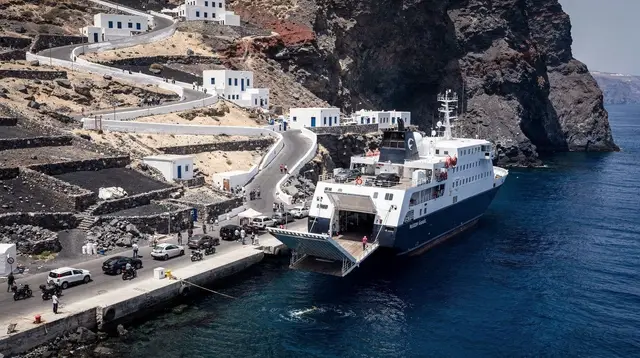
There is no bridge and no direct flight between the two islands — the connection is a high-speed ferry, and the only sensible way to give a duration is a range rather than a fixed number. Depending on the operator, the boat, and how many islands it calls at on the way, the crossing from Athinios to Milos runs to roughly the same order of magnitude as the routes to Naxos, Paros or Sifnos: a few hours, not a quick hop like the run to Ios. Anyone booking should check the specific sailing rather than assume a fixed time, since the same route can vary noticeably between a direct fast ferry and one that stops at two or three islands first.
For the mechanics of buying tickets, finding the right pier at Athinios, and what a departure morning actually looks like, the Athinios port guide and the broader Santorini ferry guide cover it in full. If Milos is one stop among several, the Cyclades island-hopping routes guide lays out how it connects with the rest of the western and central Cyclades network.
The practical point worth repeating: because the sailing itself takes several hours each way, a same-day return from Santorini means a very long day built mostly around the ferry rather than around Milos. The Santorini to Milos day trip guide goes through what that day actually looks like hour by hour, and where it tends to go wrong for people who underestimate the crossing. Cruise passengers weighing the same math against a fixed port call should look at the best shore excursions in Santorini guide before assuming Milos fits inside a single stop.
Plaka and the villages of Milos
Plaka is the obvious base for a short visit, and often the only village a day-trip itinerary has time for. It sits above Adamas on a ridge, close enough to walk down to for the ferry but high enough to catch the evening light over the bay. The kastro at the top — a small Venetian fortress built into the hillside — is the customary sunset point on the island, in the same spirit as the sunset spots beyond Oia that travellers seek out around Santorini’s own caldera, though with a fraction of the crowd. It is a genuinely different kind of sunset experience: fewer people, a lower vantage, and a view over water and headlands rather than into a volcanic caldera.
Below Plaka, Adamas is the working port — ferry tickets, car and scooter rental, most of the accommodation, and the boats that leave each morning for the coastal tours. Travellers who rented an ATV or quad to get around Santorini, as covered in the ATV and quad rental guide, will find Adamas offers the same kind of scooter and car rental on a smaller scale. It is not a destination in its own right so much as the logistics base for everything else on the island. Between the two, smaller settlements like Trypiti and Plakes fill in the hillside with the same whitewashed, low-key character, without the tour-bus traffic that the capital sees at midday.
None of this replaces a beach day. Milos’s beaches sit around the coastline rather than near the hill villages, and reaching the better-known ones — many of which are only practical by boat — is really the subject of the excursions covered below, not something to squeeze in on foot from Plaka.
Seeing the coastline: boat tours and how they work
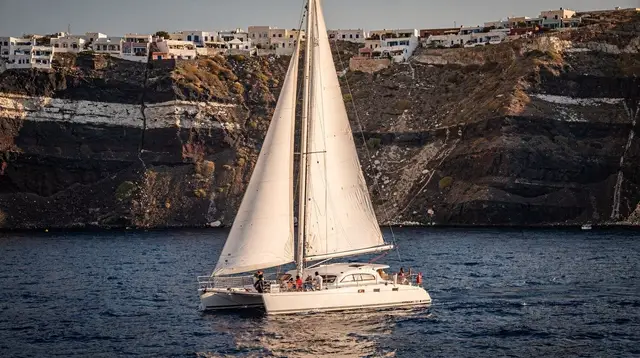
Because Milos’s coastline is its main attraction, and because so much of it is inaccessible or awkward by road, boat tours are less an optional add-on here than the default way to see the island properly. It’s a similar dynamic to the packaged combo tours compared on Santorini, where a single boat covers ground that would take several separate trips on land. A typical circuit leaves Adamas in the morning, works around a run of coves, cliffs and sea caves — Kleftiko among them for tours that go that far south — with stops for swimming, and returns by mid-afternoon or at sunset.
For visitors staying on Milos for a day or two, a circuit like a small-boat cruise around Milos and the neighbouring islet of Polyaigos covers a wide stretch of coastline in one outing, including corners of the island that are essentially unreachable on foot. Travellers with more time, or who want the whole coast at a slower pace, sometimes choose a full-day cruise on a traditional wooden boat that works its way along the coastline with several swim stops rather than a faster, shorter route.
Evenings on Milos have their own version of the caldera-sunset habit, built around the water instead of a clifftop. A sunset sailing that combines a swimming stop with a visit to the island’s ancient theatre is a fairly direct answer to what to do with a Milos evening that isn’t just dinner in Plaka. That ancient theatre sits in the same historical bracket as Santorini’s own Ancient Thira, the Doric city on Mesa Vouno, though on a smaller and far less-visited scale.
Travellers arriving specifically for Kleftiko rather than a general coastal tour have a dedicated option too: a half-day catamaran run built around that stretch of coast and timed to finish around sunset, which the Kleftiko destination page covers in more depth, including what the coves actually look like and why they photograph the way they do.
The table below is a rough way to compare the shape of the main tour types, not a price guarantee — operators and seasons change both length and cost.
| Tour type | Typical length | What it covers |
|---|---|---|
| Milos & Polyaigos boat circuit | Full day | Milos coastline plus the neighbouring islet, several swim stops |
| Traditional boat, full-day cruise | Full day | Slower pace along the coastline, multiple coves |
| Sunset sail with swim and theatre | Half day, evening | Swim stop combined with the island’s ancient theatre |
| Kleftiko half-day catamaran | Half day | Focused run to Kleftiko’s coves, timed to sunset |
Where Milos sits in a Cyclades trip
Milos belongs to the group of western Cyclades that sit on the same ferry network as Sifnos, Kimolos and Polyaigos — a cluster with its own slower, less crowded character compared with the central Cyclades routes through Naxos, Paros and Mykonos. Anyone stretching a Santorini trip into a longer island-hopping route will usually meet Milos as part of that western branch rather than tacking it onto a central-Cyclades itinerary.
For a single extra stop after Santorini, a one-week pairing built specifically around the two islands is covered in the Santorini and Milos one-week itinerary. For a broader comparison of what Milos offers against Santorini’s other common island pairing, the Santorini versus Milos guide sets out the differences in beaches, pace and crowd levels directly.
And for the wider question of whether a day trip anywhere is worth it against staying put, the day trips from Santorini guide and the how many days in Santorini guide both work through the trade-off in more general terms.
Travellers weighing several possible add-on islands rather than Milos specifically should start with the island hopping from Santorini guide, which lays out the realistic options — Milos among them — against how much time is actually available.
Staying longer than a single day opens up options a rushed visit skips entirely. A private or small-group cruise that adds a wine-tasting stop, such as a private boat cruise around the island paired with a wine tasting, only really makes sense with an overnight on Milos, since it runs at a pace that a same-day return from Santorini can’t accommodate. Milos’s local wines are a different story from the volcanic Assyrtiko that defines Santorini’s own vineyards, which makes the tasting a genuine point of comparison rather than more of the same. The same is true of exploring the fuller range of things to do on Milos, which covers activities beyond the coastal boat circuits summarised here.
The honest trade-off
The core decision for anyone reading this from Santorini is simple to state and easy to get wrong: Milos rewards time, and a same-day trip from Santorini doesn’t give it much. The ferry crossing alone — several hours each way, on the same order as the routes to Naxos or Paros — eats a large share of a single day, leaving a compressed window for Plaka, a boat tour, or both, rarely all three comfortably.
That isn’t a reason to skip Milos. It’s a reason to be realistic about what a single day buys: a boat tour along part of the coastline, a walk through Plaka, and a return ferry, with little slack if anything runs late. An overnight — even just one — turns the same trip into an actual visit, with a full day for the coastline and an evening in Plaka that isn’t shadowed by a departure time. Either way, the honest planning point is the same one that applies to any of Santorini’s neighbouring islands: check the specific ferry schedule before committing to a day trip, because the crossing time is the variable that decides whether the day works. That planning gets easier inside the window covered by the best time to visit Santorini guide, when ferries and boat tours are both running at full frequency.
Milos from Santorini: frequently asked questions
How do you get from Santorini to Milos?
By high-speed ferry from Athinios port, roughly 2 to 4 hours depending on the boat and the route it takes through the Cyclades. There are no direct flights between the two islands, so the ferry is the only practical option.
Is Milos worth visiting as a day trip from Santorini?
It can be, but expect most of the day to pass on the ferry or a boat tour rather than on land. A single overnight turns the same trip into a far less rushed visit and lets you actually reach the island’s beaches.
What is Milos known for?
Milos is known for its volcanic coastline of coves, sea caves and coloured cliffs, its whitewashed hilltop capital Plaka, and boat excursions that circle the island rather than a single beach or headland.
Do I need a car on Milos?
A car or scooter helps, since the island’s beaches and villages are spread along a coastline with limited bus coverage. Many visitors see the coast mainly by boat instead, which covers more ground than driving would.
Does this guide cover Kleftiko and Sarakiniko?
No. Those have their own destination pages, since they are usually visited as specific stops rather than as the whole island. This guide covers Milos and Plaka, with links out to Kleftiko, Sarakiniko and the smaller islands nearby.
What’s the best time of year to visit Milos?
Late May to early October, when ferry connections from Santorini run most frequently and boat tours operate daily. Outside that window, both thin out considerably, and some tours stop altogether.
Can you combine Milos with other Cyclades islands from Santorini?
Yes. Milos sits on the same western-Cyclades ferry routes as Sifnos, Kimolos and Polyaigos, so a longer island-hopping trip can add one or more of them rather than treating Milos as an isolated stop.