A coastline you can only see from the water
Kleftiko is not a beach, a village, or a place you can look up directions to. It is a stretch of the southwest coast of Milos where wind and sea have carved a run of white volcanic rock into arches, chimneys, and half-submerged caves, dropping straight into water so clear the boats seem to float on air rather than sea. There is no settlement here, no road along the cliffs, and no path down from above — the whole point of Kleftiko is that it only reveals itself once you are on a boat looking back at the coast rather than standing on it.
That isolation is also its history. The name comes from the Greek word for “stolen,” and local accounts tie it to the klefts — the irregulars and, in some versions, outright pirates — who are said to have used the caves as a hideout for ships and plunder through the Ottoman centuries, screened from view by the maze of rock. Whether every story is precisely true or not, the geography explains why the legend stuck: this is a coastline built for hiding.
If you’re reading this from Santorini, the honest framing matters. Kleftiko is not a stop you fold into a day already built around Fira or Oia — it’s a destination in its own right, on a different island, reached by a sequence of a ferry crossing and then a separate boat tour. Most of a Kleftiko day is spent travelling to it and being on the water once you arrive, and that’s worth knowing before you book anything.
Where Kleftiko sits, and what it isn’t
Kleftiko occupies the far southwest tip of Milos, well outside walking or driving range of Adamas, the port town where every boat tour departs. There’s no lookout point on land, no signposted viewpoint, and nothing to photograph unless you’re on the water — this is the single detail worth repeating to anyone planning around it, because it’s the one that trips people up.
It’s also frequently confused with Sarakiniko, Milos’ other famous rock landscape, and the two could hardly be more different in practice. Sarakiniko sits on the island’s north coast, is made of smooth white volcanic rock rather than caves and arches, and you reach it by a short drive or taxi and then walk straight onto it — no boat required. Kleftiko has the caves, the boat-only access, and the swimming; Sarakiniko has the flat lunar terrain and the free, walk-up view. Confusing the two on a short island-hopping trip can mean showing up somewhere with the wrong shoes, the wrong expectations, or worse, discovering there’s no way to reach the cliffs you’d pictured.
| Kleftiko | Sarakiniko | |
|---|---|---|
| Coast | Southwest Milos | North Milos |
| Landscape | Sea caves, rock arches, coves | Smooth white rock terraces |
| Access | Boat only | Drive or walk-up |
| Cost to visit | Boat tour ticket | Free |
| Main activity | Swimming and snorkelling into caves | Walking, sunbathing, cliff-jumping |
Getting there from Santorini
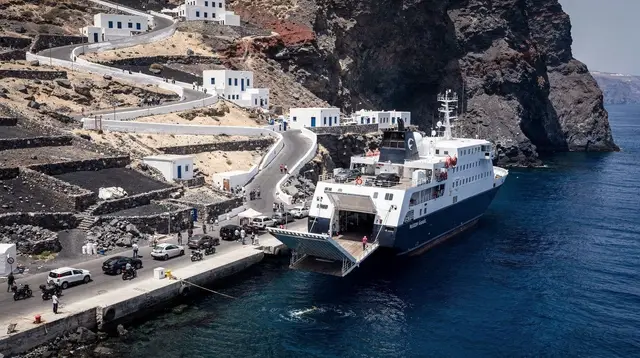
There’s no direct route from Santorini straight to Kleftiko — you go to Milos first, then join a boat there. High-speed ferries connect Santorini and Milos in a few hours depending on the route and the vessel; conventional ferries take noticeably longer. Schedules run more frequently in high season (June to September) and thin out considerably in the shoulder months and winter, so this is a trip to plan around, not to improvise on the day.
Because the ferry crossing itself eats a meaningful chunk of the day, a same-day round trip from Santorini to Kleftiko and back is tight rather than comfortable. Most travellers who want to see Kleftiko properly either treat it as one stop on a longer island-hopping route through the Cyclades that includes an overnight on Milos, or fold it into a multi-island itinerary pairing Santorini and Milos rather than a single rushed day.
If you’re weighing whether Milos deserves that kind of time against a more caldera-focused stay, our Santorini versus Milos comparison lays out the trade-off in more detail, and our dedicated Santorini-to-Milos day trip guide walks through the ferry logistics step by step.
Once you’re on Milos, every Kleftiko boat departs from Adamas, the main port, where operators line the harbourfront with boards advertising the day’s routes.
Boat options: what you’re actually choosing between
Boats to Kleftiko range from large shared cruise boats that circle much of Milos’ south coast in a day, to speedboats that reach the caves faster and add nearby stops, to fully private charters for a small group. The right pick depends on how much you want to see beyond Kleftiko itself, and how much you value setting your own pace over the water.
| Tour style | Typical length | Good for | What to expect |
|---|---|---|---|
| Half-day morning cruise | ~3–4 hours | First-timers, time-limited days | Kleftiko plus the Sykia sea cave, shared boat |
| Speedboat tour | ~4–6 hours | Travellers who also want Polyaigos | Faster crossings, smaller group, more stops |
| Private boat charter | Flexible, half or full day | Small groups, families, photographers | Set your own route and swim stops |
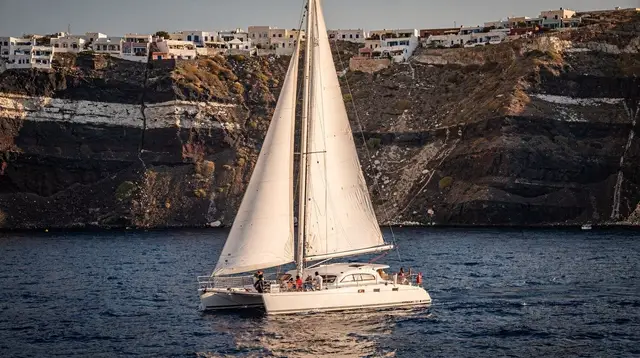
| Afternoon catamaran with sunset | ~4–5 hours | A calmer pace, sunset on the water | Later departure, drinks often included |
| Private cruise with wine tasting | Flexible | Couples, special occasions | Onboard tasting alongside the coastline |
For a straightforward first look at Kleftiko without committing to a full-day charter, the half-day morning cruise to Kleftiko and the Sykia cave covers the essentials in a single shared-boat outing. If you’d rather set your own pace, linger longer in the caves you like, and skip a crowded shared deck, a private boat tour to the Kleftiko caves and Sykia gives you that control, usually for a small group or a family.
Travellers who want to see more of the coastline in one outing — including a run out to the uninhabited islet of Polyaigos — tend to book the speedboat tour combining Kleftiko and Polyaigos, which trades a slower shared cruise for a faster, more compact route.
If you’d rather compare the trade-offs between a shared boat and a private one before you book, our guide to private guides versus group tours applies just as well to boat charters as it does to land tours, and renting a boat without a licence or arranging a private yacht charter are worth a read if you’re the kind of traveller who’d rather skipper your own route than join someone else’s schedule — though note that self-skippered boats are far less common around Milos’ more exposed southwest coast than in Santorini’s sheltered caldera, and most visitors to Kleftiko go out with a licensed local operator for exactly that reason.
What you’ll actually see and do
Once the boat rounds into Kleftiko, the itinerary is less a checklist than a slow drift between stops: the boat noses toward one archway or cave mouth, drops anchor or idles nearby, and passengers slip into the water to swim through openings that are only passable from the sea. Several of the caves are large enough to swim well inside them, with light filtering down through gaps in the rock overhead; others are narrow slots you glide through rather than caves you enter. Snorkelling gear is usually included, and the water here is markedly clear even by Cycladic standards, so even a shallow float over the rocks below rewards the effort.
Boats typically make two or three stops within Kleftiko itself before moving on, depending on the tour and the day’s sea conditions — some coves are calmer than others, and skippers will favour whichever openings are swimmable that day rather than force a fixed route. Longer tours often continue past Kleftiko to other pockets of Milos’ quieter coastline, or across to Polyaigos, an uninhabited islet between Milos and Kimolos known for its own untouched coves, or toward Kimolos itself for those with a full day and a longer charter.
For most visitors, the appeal is simple: no crowds fighting for a viewpoint, no ticket queue, just rock, cave, and water, seen from a boat deck with nothing to do but swim, photograph, and drift.
Combining Kleftiko with the rest of Milos
Because getting to Kleftiko already means being on Milos for at least a day, it’s worth building the rest of that day — or that stay — around the island rather than treating Kleftiko as an isolated errand. The fishing village of Pollonia makes a quieter base than busy Adamas and sits closer to the ferry crossing to Kimolos, if you want to add a second island to the trip. Travellers looking for more organised things to do around the port and beyond can check the things to do in Milos hub and the Kleftiko-specific activity listings for what else is bookable from Adamas.
Some multi-stop cruises pair a Kleftiko run with a wine or sunset element back on land — the afternoon catamaran cruise to Kleftiko with sunset is built exactly around that later, calmer timing, ending with the light over the water rather than a midday sun. If your day allows for it, an evening back in Adamas or the nearby village of Plaka rounds things out well after a morning spent swimming through sea caves.
When to go, and what can go wrong
Kleftiko is a fair-weather destination in the most literal sense: the caves and coves are only comfortably swimmable when the sea is calm, and the approach itself is more exposed than Santorini’s sheltered caldera. The meltemi, the strong seasonal wind that builds through July and August, is the main risk to a planned trip — it tends to strengthen through the afternoon, which is one reason morning departures are generally the safer bet in high summer. On a genuinely windy day, operators will shorten the route, skip the more exposed caves, or cancel the trip outright, usually decided on the morning itself rather than announced in advance.
The practical upshot: don’t schedule a Kleftiko boat trip as the single fixed point of a tightly planned Cyclades itinerary. Build in a spare day if you can, especially in July and August, and treat a confirmed booking as provisional until the operator confirms on the day.
Late May through September is the realistic window for swimming comfortably; outside that, sea temperatures and reduced ferry and boat schedules make Kleftiko a much harder trip to plan.
Kleftiko for special occasions
Because it trades crowds for isolation, Kleftiko has become a fairly popular choice for couples wanting an alternative to Santorini’s more photographed sunset spots. A slower, more intimate option is the private cruise with wine tasting along Milos’ coastline, which pairs the swim stops with an onboard tasting rather than a packed shared-boat schedule — a reasonable pick if the day is less about ticking off a landmark and more about the slow version of it.
Planning notes before you book
A few things worth confirming before paying for any Kleftiko boat tour: whether snorkelling gear is included or should be brought, whether food and drink are provided or should be packed, and what the operator’s weather-cancellation policy actually says — refund terms vary considerably between operators, and Milos’ southwest coast is more wind-exposed than the calmer routes many travellers are used to from Santorini’s caldera cruises. Cash is still useful to have on hand at the port for any last-minute extras, even where cards are accepted for the booking itself.
Frequently asked questions about visiting Kleftiko
Can you get to Kleftiko by car or on foot?
No. Kleftiko is a cluster of sea caves and rock stacks on the uninhabited southwest coast of Milos, with cliffs dropping straight into the water and no road or marked trail nearby. Every visit happens from the sea, on a boat tour or private charter out of Adamas.
How do you visit Kleftiko from Santorini?
You take a ferry from Santorini to Milos, then join a boat tour to Kleftiko from Adamas, Milos’ main port. Ferry schedules and boat departure times don’t always line up conveniently for a single-day round trip, so many visitors either stay a night on Milos or book the trip as part of a longer island-hopping route.
What is Kleftiko famous for?
Kleftiko is known for its white volcanic rock arches, sea caves, and hidden coves carved by wind and water, set in exceptionally clear turquoise water. The name comes from the Greek word for stolen, a reference to pirates who are said to have used the caves as a hideout for their ships and loot.
How long does a boat trip to Kleftiko take?
A half-day morning cruise to Kleftiko and the nearby Sykia cave typically runs 3 to 4 hours from Adamas. Full-day and private boat options add stops such as Polyaigos or other coves along Milos’ south coast and can run 6 to 8 hours.
Is Kleftiko the same as Sarakiniko?
No, and this is the most common mix-up. Sarakiniko is a white, moon-like rock landscape on Milos’ north coast that you can drive or walk to directly. Kleftiko is on the southwest coast, has sea caves and rock arches rather than flat white terrain, and is reachable only by boat.
What should I bring on a Kleftiko boat tour?
A swimsuit worn under your clothes, a reef-safe sunscreen, a hat, a light cover-up for the boat ride, and water shoes if you plan to walk on any rocky patches. Most boats provide snorkelling gear, but bring your own mask if you prefer a good fit.
Does weather ever cancel Kleftiko boat trips?
Yes. The meltemi wind, strongest from July into August, can make the crossing rough enough that operators shorten routes or cancel outright, usually on the day itself rather than in advance. Booking a morning departure improves your odds, since the wind in the Cyclades often builds through the afternoon.
Can you swim inside the sea caves at Kleftiko?
Yes, swimming and snorkelling into several of the caves and under the rock arches is the main draw of a Kleftiko stop, and most tours anchor specifically to allow time in the water. Conditions vary by cave and by swell, so follow your skipper’s guidance on which openings are safe that day.