Santorini vs Milos: Which Volcanic Island Fits Your Trip
Should I visit Santorini or Milos?
Santorini gives you an inhabited caldera, wineries and the famous Oia sunset, with the crowds that come with them. Milos gives you quieter volcanic coastline — Kleftiko, Sarakiniko — reached by boat, with far fewer people and no comparable village life. Many travellers combine both by ferry from Athinios.
Both islands are volcanic. Both sit in the Cyclades. Both photograph well. Beyond that, Santorini and Milos are asking for different kinds of attention, and knowing which one you actually want saves a lot of second-guessing once you’re on a ferry to Athinios with a return ticket you can’t easily change.
Two different volcanoes, two different results
Santorini’s volcanism produced a caldera — a collapsed crater roughly 12 km by 7 km, its inner wall rising 250 to 300 metres from the sea, with villages built along the rim. Fira, Firostefani, Imerovigli and Oia all sit above that drop, looking down into water that fills the crater left by the Bronze Age eruption around 1600 BCE (the exact date is still debated between radiocarbon and archaeological dating, so treat it as approximate). The active vent, Nea Kameni, sits in the middle of that same caldera, and boats land visitors there to walk up to the crater rim.
Milos’s volcanism shows up differently. Instead of one dramatic collapsed basin, the island’s coastline is carved into white pumice cliffs, sea caves, and rock formations shaped by acidic volcanic water and centuries of erosion. Kleftiko, on the southwest coast, is the best-known result — a cluster of sea arches and caves once used by pirates, reachable only by boat. Sarakiniko, on the north coast, looks almost lunar: smooth white rock meeting startlingly blue water, with no sand at all. Neither of these is a caldera in the Santorini sense — Milos has no equivalent inhabited crater rim, and no single village perched over open water the way Oia is.
If you came here for the geology, they answer different questions. Santorini shows you what a caldera looks like from inside it, populated by 3,000 years of settlement on top. Milos shows you what volcanic rock does to a coastline once left alone.
Getting between them
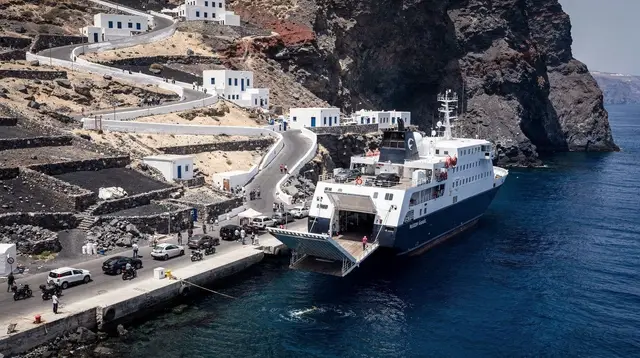
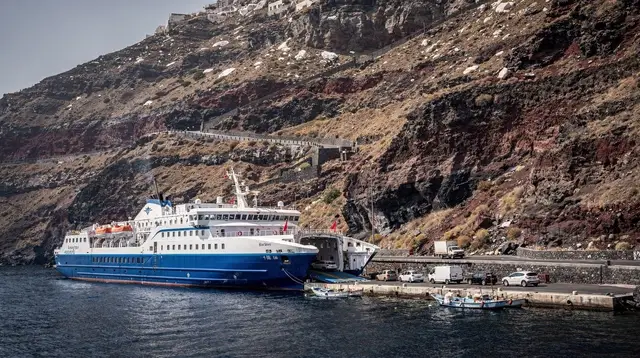
Athinios is Santorini’s only ferry port, and it’s also where boats leave for Milos. Several ferry companies run the route with a mix of high-speed catamarans and slower conventional ferries, and the crossing time varies by company, boat type and season — check current schedules before booking rather than assuming a fixed duration, since operators change frequency outside high summer. The Santorini ferry guide covers how to book and what to expect at the port itself, which sits at the base of a steep switchback road below the caldera villages.
If you’re weighing a full route rather than a single hop, the island hopping from Santorini guide and the broader Cyclades island hopping routes page lay out how Milos fits alongside Ios, Folegandros and Sifnos as western-Cyclades options reachable from the same port.
What each island actually gives you
| Santorini | Milos | |
|---|---|---|
| Signature sight | Caldera villages, Oia sunset | Kleftiko, Sarakiniko |
| Volcanic feature | Inhabited caldera rim, active islet (Nea Kameni) | Eroded pumice coastline, sea caves |
| Beaches | Black and red volcanic sand, hot underfoot | White and varied — pumice, sand, pebble |
| Best seen by | Walking the caldera rim, boat for sunset | Small boat for Kleftiko, on foot for Sarakiniko |
| Crowd level | Very high in Oia and Fira, June–September | Markedly lower, even in August |
| Wine | Assyrtiko, Vinsanto, PDO Santorini wineries | No comparable wine industry |
| Village life | Fira, Oia, Pyrgos — dense, historic | Plaka, Adamas — smaller, quieter |
| Typical stay | 3–5 nights | 3–4 nights, often paired with Santorini |
Crowds are the real dividing line
This is where most people actually make the decision, whether they say so or not. Santorini’s caldera villages absorb an enormous amount of daily cruise-ship traffic — Santorini and Mykonos jointly apply a cruise passenger levy of €20 per person in peak season specifically because of the volume, and a daily cap of 8,000 cruise visitors is in effect on the island. On a heavy cruise day, Fira and Oia are dense with people from roughly mid-morning to late afternoon, and the Kastro at Oia fills up one and a half to two hours before sunset in high season.
Milos doesn’t have this problem at anything like the same scale. It receives far fewer cruise calls, and its main draws — Kleftiko, Sarakiniko, the fishing village of Pollonia — are spread along the coastline rather than funnelled into one clifftop path. If crowd avoidance is your actual priority rather than a secondary preference, that alone may settle the question in Milos’s favour.
Beaches: black sand versus white rock
Santorini’s beaches are volcanic black or red sand — dramatic to look at, genuinely hot to walk on at midday, which is why footwear matters on every beach visit here. Perissa and Perivolos offer the longest stretch of black sand with the most infrastructure; Kamari is pebbled and sits under the Mesa Vouno cliff; Vlychada trades sand for wind-sculpted cliffs. Red Beach has had repeated cliff collapses — in 2018, 2023 and December 2025 — and access remains partially restricted; check conditions before planning to walk in, and treat a boat view as the reliable option.
Milos works differently: it’s often cited as having some of the most varied coastline of any Cycladic island, mixing white pumice shoreline, sheltered coves and small sandy bays around Pollonia and elsewhere, without the uniform black-sand heat of Santorini’s beaches. Neither island wins outright — it depends whether you want drama concentrated in a few dramatic spots (Santorini) or variety spread widely (Milos).
Boats matter on both islands, differently
On Santorini, a boat mostly buys you distance from the crowd and a different angle on the caldera. A day cruise circles the caldera, typically stopping at Nea Kameni to walk up to the crater (the landing fee, around €5, is usually paid in cash on-site and often isn’t included in the cruise price) and at Palea Kameni to swim to the hot springs — expect tepid, iron-tinted water that will stain light swimwear.
this Santorini day cruise around the caldera covers both islets along with a swim stop, and works as a half-day option if you’re staying inland.
On Milos, a boat is closer to essential rather than optional, because Kleftiko simply has no land access. Small-boat excursions from Adamas run out to the sea caves and arches, often combined with a swim stop and a look at nearby coastal formations. If you’re comparing the two islands specifically for what a boat trip shows you, Milos rewards it more directly — the caves are the whole point, not a bonus.
For Santorini’s sunset specifically, going out on the water solves the Oia crowding problem outright:
a sunset cruise along the caldera puts you in front of the cliffs instead of competing for a spot on top of them, and the timing shifts a lot through the year — around 20:50 in late June, closer to 17:15 in late December — so any cruise operator worth using will adjust departure times seasonally rather than quote you a fixed hour.
Wine, villages and things Milos doesn’t have
Santorini has an entire secondary economy built on Assyrtiko: vines trained low in basket-woven kouloura coils to survive the meltemi wind and capture night dew, since there’s no irrigation and no year-round water source beyond desalination. Wineries around Pyrgos and Megalochori run tastings, and the Santorini wine tasting guide covers which ones are worth the detour. Milos has no equivalent — it’s not a wine island, and comparing the two on this axis isn’t really fair to either.
Village life tips the other way in scale rather than kind: Santorini’s Oia, Fira and hilltop Pyrgos carry centuries of dense settlement wedged onto a caldera rim. Milos’s main town, Plaka, and its port village, Adamas, are smaller and quieter — pleasant, but not built around the kind of clifftop drama that makes Santorini’s villages a destination in themselves.
Diving is worth a specific mention, since both islands are decent options and get compared for it: Santorini’s underwater volcanic terrain suits divers looking for swim-throughs and volcanic rock formations close to the caldera.
a guided diving tour around Santorini’s volcanic reefs is a reasonable way to see that side of the island if beaches alone aren’t the goal.
Cost and practicalities
Milos runs noticeably cheaper across the board — accommodation, tavernas and boat trips all sit below Santorini’s prices, largely because demand and cruise-ship volume are so much lower. Santorini’s cruise levy (€20 per passenger June–September, €12 in April, May and October, €4 November–March) is charged to the cruise line rather than paid at a gate, but it reflects the general price pressure that high demand puts on everything else on the island — accommodation especially.
Both islands use the euro, both accept cards widely, and both still require cash for small tavernas, taxis and — on Santorini specifically — the Nea Kameni landing fee. Neither island has a train or comparable public transport network beyond buses, so a rental car, scooter or pre-booked transfer matters on both, though Milos’s smaller road network makes a scooter a genuinely practical option in a way it can feel riskier on Santorini’s steeper caldera roads.
What about the 2025 earthquake activity?
Worth addressing directly rather than skating past it. A seismic swarm began on 27 January 2025 in the sea between Santorini and Amorgos, lasted roughly forty days, and produced more than 28,000 recorded tremors, some up to magnitude 5.2 — enough to prompt a local state of emergency, school closures and the temporary departure of several thousand residents. There was no eruption. Published research since has attributed the swarm to a magma dyke intrusion rising from a deep reservoir, and the swarm itself is over.
It’s a real event worth knowing about, not a reason to avoid the island or a sign that an eruption is imminent — see the Santorini safety and the 2025 earthquakes guide for the fuller picture. Milos sits in the same general seismic zone but wasn’t the swarm’s focal point, and doesn’t carry the same volcano-safety questions travellers ask about Santorini’s Nea Kameni vent.
So which one, if you can only pick one
If what you actually want is the postcard — whitewashed villages stacked on a caldera, a wine list built on one grape, and a sunset that’s genuinely worth the fuss even with the crowd — that’s Santorini, and no other Cycladic island duplicates it. If what draws you is water, rock and quiet — swimming into sea caves, walking across white lunar stone, spending an afternoon without jostling for a viewpoint — that’s Milos, and it does that better than Santorini does.
If you don’t have to pick, the honest answer is to do both. The ferry link from Athinios makes it straightforward, and the two islands don’t compete for the same kind of day — one gives you villages and wine, the other gives you coastline and quiet, and a week split between them uses both well. The Santorini and Milos one week itinerary lays out a workable split, and the Santorini to Milos day trip guide covers the shorter version if a full transfer isn’t in your plans.
Santorini vs Milos, common questions
Is Milos as beautiful as Santorini?
It’s beautiful in a different register. Santorini’s beauty is architectural — whitewashed villages stacked on a caldera rim. Milos’s beauty is geological — white pumice cliffs, sea caves and lunar rock at Sarakiniko and Kleftiko. Neither replaces the other.
How do I get from Santorini to Milos?
By ferry from Athinios port. Several companies run the route with high-speed and conventional boats, and the crossing time varies by company and season, so check current schedules rather than assuming a fixed duration.
Is Milos less crowded than Santorini?
Yes, noticeably. Milos sees a fraction of Santorini’s cruise-ship traffic, and its highlights — Kleftiko, Sarakiniko, Sifnos-facing beaches — are spread around the coastline rather than concentrated on one clifftop path like Oia.
Does Milos have a sunset like Oia’s?
Milos has good sunsets, especially over Sarakiniko’s white rock or from Plaka’s kastro, but it has no single sunset landmark that draws crowds the way Oia’s Kastro does. That is arguably its appeal.
Can I see Kleftiko without a boat?
No. Kleftiko is a set of sea arches and caves accessible only by boat, either on a small-boat excursion from Adamas or as part of a longer island cruise. There is no walking path in.
Which island is better for beaches?
Milos, if you want variety and white sand — it’s often cited as having some of the most varied coastline in the Cyclades. Santorini’s beaches are volcanic black or red sand, dramatic but hot underfoot and narrower in choice.
Is Milos cheaper than Santorini?
Generally yes. Accommodation, food and boat trips tend to cost less on Milos, mainly because demand and cruise-ship volume are far lower than on Santorini.
Should I do both islands in one trip?
It works well if you have the time. A common pattern is several nights in Santorini for the caldera and wineries, then a ferry to Milos for a slower, coastline-focused finish.
Popular Santorini experiences on GetYourGuide
Verified deep-linked GetYourGuide tours. Book through these links and we earn a small commission at no cost to you.
GetYourGuide does not provide a product photo for this activity — the image shows the meeting point, photographed by us.