A Moonscape You Walk Into, Not Sail To
Every year, a handful of travellers step off a boat at Milos expecting to find Sarakiniko waiting for them offshore, the way Kleftiko does. It doesn’t work that way. Sarakiniko sits on the north coast of Milos, a short drive from the port town of Adamas, and you reach it by road — on foot, by rental car, by taxi, or on the back of an organised tour bus. Kleftiko, the sea-cave landscape everyone photographs on the same island, is on the opposite, south-western coast and can only be seen from the water. They are often confused because both are white and both are relentlessly photogenic, but they are not the same place, not the same coast, and not the same kind of visit.
What makes Sarakiniko worth the detour is the rock itself: pale, almost bone-white volcanic stone, sculpted by wind and sea into smooth folds, hollows and low domes that fall away into a blue-green cove. There is no sand, no beach umbrellas, no shade — just rock, sky and water, which is exactly why photographers keep coming back. This page covers Sarakiniko on its own terms: what it actually looks like, how to get there from Santorini, when to go, and how much time it deserves. It does not attempt to cover Milos town or Adamas in depth, and it leaves the port village of Pollonia, further along the same north coast, for its own page.
Getting to Sarakiniko From Santorini
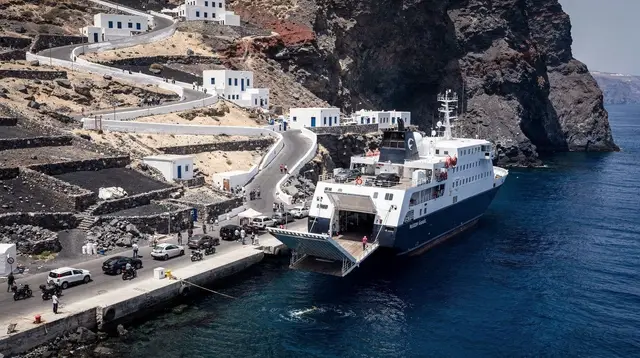
There is no direct route between Santorini and Sarakiniko — you go via Milos. Ferries leave from Athinios, Santorini’s only ferry port, and the crossing to Milos takes roughly three to four hours depending on the operator and the type of vessel, with timetables that shift by season and are worth checking close to your travel date rather than assuming a fixed schedule. Milos is one of the stops covered on our Santorini ferry guide, alongside the other islands reachable in a single hop.
Once you land in Adamas, Sarakiniko is a short drive along the coast road heading north, in the direction of Pollonia. Most visitors arrive by rental car or taxi; local buses run less frequently and are not built around tourist schedules, so they are the least practical option if you are working with a single day. Because the ferry crossing already takes a meaningful chunk of the day, we’ve written a dedicated page on what a Santorini-to-Milos day trip actually looks like in practice, including how much time that leaves you on Milos itself.
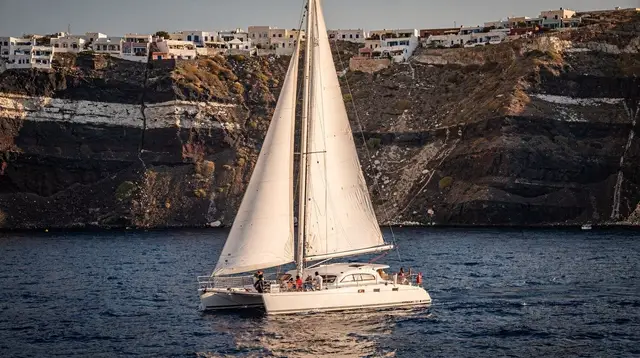
If you would rather not deal with car rental or bus timings at all, several organised excursions run a loop that includes Sarakiniko along with other north-coast sights, either by land or by boat from the water side. a half-day cruise along Sarakiniko and the other landmarks of northern Milos covers the coastline from the sea, which gives you a very different view of the same rock formations than standing on top of them.
Why the Rock Looks Like This
Milos sits on the same volcanic arc as Santorini, but its geology reads differently on the surface. Sarakiniko’s white stone is compacted volcanic ash and pumice, laid down by eruptions long before Santorini’s own caldera took shape, then worn smooth over millennia by wind, rain and the sea. The result is a landscape with almost no sharp edges: rounded ridges, shallow basins that fill with rainwater after a storm, low arches, and a scatter of sea caves cut into the base of the cliffs where the water has worked hardest. There is no soil to speak of, so nothing grows — no scrub, no trees, nothing green breaking up the white. That absence of vegetation is part of what gives Sarakiniko its nickname among visitors: the moonscape.
The contrast with the water is what carries most photographs. Against the white rock, the sea reads as a saturated blue-green in bright sun, and the line between the two is sharp enough that it looks almost drawn rather than natural. Later in the day, as the light lowers, the same rock takes on warmer tones — pale gold rather than white — which is one reason serious photographers plan around the edges of the day rather than the middle.
What to Do at Sarakiniko
There isn’t a long list of activities here, and that’s rather the point. Sarakiniko rewards slow movement more than a checklist:
- Walk the formations. Paths worn into the rock by decades of visitors lead along the ridges and down toward the water; sturdy, closed shoes are far more useful than sandals, since the surface can be uneven and, in places, sharp.
- Swim in the coves. Small inlets cut into the rock hold calm, clear water that’s good for a swim, though depths change quickly close to the rock and there are no lifeguards.
- Cliff jumping. This is one of the things Sarakiniko is known for among younger travellers — locals and visitors jumping from low ledges into the deeper pockets of water. It is unsupervised and entirely at your own judgement; check the depth and the state of the sea before you commit, and skip it if the water looks disturbed.
- Photograph the light. Early morning and the last hour before sunset are when the rock’s texture shows best and the crowds thin out; midday sun flattens the contrast that makes Sarakiniko distinctive in photos.
There are no shops, no tavernas and no shaded seating on site, so bring water, sun protection and anything else you’ll want, and plan to eat back in Adamas or another village rather than at Sarakiniko itself.
Sarakiniko or Kleftiko — Not the Same Stop
Because both places show up in the same searches and the same photo feeds, it’s worth being blunt about the difference before you plan around one or the other.
| Sarakiniko | Kleftiko | |
|---|---|---|
| Coast | North Milos | South-west Milos |
| How you get there | By road — car, taxi, tour bus, on foot from parking | By boat only |
| Terrain | Smooth white rock you walk on and swim from | Sea arches, caves and rock stacks seen from the water |
| Typical visit | 2-3 hours, self-paced | Half a day, as part of a boat tour |
| Known for | Photography, cliff jumping, a moonscape look | Sea caves, snorkelling, a former pirate hideout |
If your itinerary has room for both, a number of boat tours combine them, since Kleftiko is unreachable any other way and several routes pass close to Sarakiniko’s coastline on the way out or back. a small-group yacht day combining Kleftiko, Sarakiniko and Polyaigos is one way to see both landscapes without renting a car and driving between coasts yourself, and it adds Polyaigos — the uninhabited island south-east of Milos — into the same day.
Photography Notes
Sarakiniko is one of the most photographed corners of the Cyclades for a reason that has nothing to do with luck: the light does the work, if you show up at the right time. A few practical points that matter more here than at most beaches:
- There is zero shade. By late morning in summer, both the rock and the light are harsh; bring a hat and expect washed-out contrast in your photos if you shoot at noon.
- Sunrise beats sunset for solitude. Sunset draws tour groups arriving from Adamas; sunrise at Sarakiniko is genuinely quiet, and the low, warm light suits the white rock well.
- Wide shots read better than close-ups. The scale of the formations, and the way they meet the water, is the actual subject — a few steps back usually beats a tight crop.
- Bring grippy footwear, not flip-flops, if you want to move around the rock ledges for a better angle without worrying about your footing.
For visitors who want the sunrise timing handled for them, a sunrise visit to Sarakiniko followed by a traditional breakfast in Plaka pairs the quiet, early light with a slower morning afterward, rather than rushing straight back to the ferry.
Safety and Practical Notes
Sarakiniko looks gentle in photographs, but a few things are worth knowing before you go:
- Wet rock is slippery. After rain, or near the waterline where spray keeps the surface damp, footing can be unpredictable — move carefully near any edge.
- No lifeguards, no facilities. There is no supervision for swimming or cliff jumping, and nowhere on site to buy water or food; bring what you need.
- Depth varies sharply. The coves look uniform but the seabed drops and rises unevenly close to the rock; check before jumping or diving in from height.
- Wind changes conditions fast. Milos, like the rest of the Cyclades, gets the meltemi in summer; a calm cove can turn choppy within an hour, which matters more if you’re swimming or if your visit is by boat.
- Midday heat on bare rock is intense with no shade to retreat to — plan your visit for the cooler parts of the day if you’re sensitive to heat.
None of this makes Sarakiniko dangerous by ordinary standards, but it is an unsupervised natural site, not a managed beach, and it rewards a bit of caution.
Fitting Sarakiniko Into a Day From Santorini
Because the ferry crossing between Santorini and Milos takes several hours each way, a same-day round trip is tight rather than leisurely. A realistic version of the day looks like this: an early ferry from Athinios, arrival in Adamas by mid-morning, a short drive or taxi to Sarakiniko for two to three hours, then either a quick look at Adamas itself or straight back to catch the return sailing. There usually isn’t time left in a single day to also add Kleftiko, Pollonia or inland Milos without cutting Sarakiniko short — pick one focus for a day trip, and save the rest for a future visit that includes a night or two on Milos.
If a full loop around northern Milos without renting a car sounds easier, a private boat tour linking Sarakiniko, Kimolos and Polyaigos covers several north-side landmarks in one outing, departing from Adamas and giving you the water-level view of Sarakiniko as a bonus rather than the only way to see it.
For travellers weighing whether Milos is worth the crossing at all against other options, our day trips from Santorini guide and our broader island-hopping from Santorini guide both cover how Milos compares to closer islands in terms of time and payoff, and the Cyclades island-hopping routes guide is useful if you’re building a longer multi-island trip rather than a single day trip.
Beyond Sarakiniko, Without Going Into It Here
Sarakiniko sits on the same stretch of coast as a few other places we cover in their own detail elsewhere on the site. Milos itself — the port town, the beaches, the wider island — has its own page, as does Pollonia, the fishing-village-turned-resort further along the north coast toward Kimolos.
Kimolos, reachable by a short ferry hop from Pollonia, and Polyaigos, the uninhabited island south-east of Milos, both appear on some of the boat tours listed above if you want to extend beyond a single stop. And if Kleftiko is the real draw for you rather than Sarakiniko, its own destination page and the boat-only access it requires are covered separately, along with the things to do around Kleftiko for tour options.
For a longer stay that gives Milos its due rather than squeezing it into a single day, our Santorini and Milos in one week itinerary lays out a pace that includes Sarakiniko, Kleftiko and time to actually relax on Milos rather than racing the ferry clock both ways.
Questions About Visiting Sarakiniko
Is Sarakiniko the same place as Kleftiko?
No. Sarakiniko is on the north coast of Milos and is reached by road; Kleftiko is on the south-west coast and can only be visited by boat. Both are white rock formations on the same island, which is why they’re often confused, but they involve different transport, different terrain and different kinds of visit.
Do you need a boat to see Sarakiniko?
No. Sarakiniko is accessible by car, taxi or organised tour from Adamas, and much of it can be walked. Some boat tours do pass along the coastline near Sarakiniko on the way to or from Kleftiko, but a boat is not required to visit it.
How do you get to Sarakiniko from Santorini?
By ferry from Athinios to Milos, a crossing of roughly three to four hours depending on the operator and season, followed by a short drive or taxi ride from Adamas to Sarakiniko on the north coast.
Is there a beach at Sarakiniko?
Not in the usual sense. There’s no sand — the site is white volcanic rock with small coves for swimming rather than a stretch of beach. Bring proper shoes rather than expecting soft ground underfoot.
Can you swim at Sarakiniko?
Yes, in the small coves cut into the rock, though there are no lifeguards and the seabed depth changes quickly close to shore. Check conditions before swimming or jumping in.
What’s the best time of day to visit for photos?
Early morning or the last hour before sunset, when the light is softer and the crowds are thinner. Midday sun flattens the contrast between the white rock and the water that makes Sarakiniko distinctive.
Can Sarakiniko be visited as a day trip from Santorini?
Yes, but the ferry crossing takes up a large part of the day in each direction, so plan on Sarakiniko being the main focus of that day rather than one stop among several.
Is Sarakiniko crowded?
It can get busy around midday with tour groups arriving from Adamas, especially in July and August. Early morning and early evening are noticeably quieter.