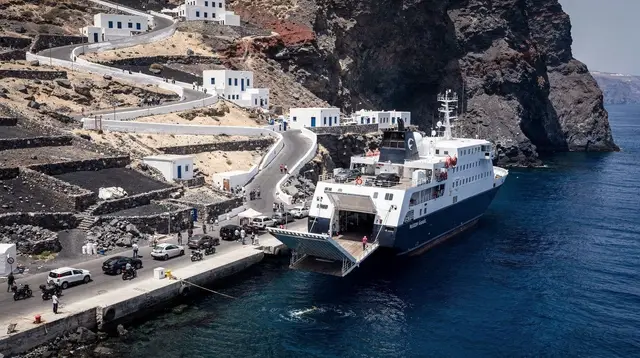
The Quiet Island North of Milos, Not Santorini
Kimolos sits just north of Milos, across a strait so narrow that on a clear day you can see the kastro of Chorio from the Milos shoreline. It belongs to the same volcanic arc as Santorini and Milos, but it has none of their visitor numbers: a small, whitewashed island of a few square kilometres, one proper village, and a coastline of quiet coves that most people who have heard of the Cyclades have still never heard of. If you are reading this page, you have almost certainly already committed to time on Milos, and you are wondering whether Kimolos deserves a slice of it.
It’s worth saying plainly, before anything else, what this page is not about. It is not about Milos itself — the island’s own beaches, geology, and boat tours are covered on its own page and in the things to do on Milos guide. And it is not about Polyaigos, the uninhabited islet further north that you will see from Kimolos’s shoreline without being able to land on it freely; several of the boat trips that pass Kimolos also skirt Polyaigos’s coast, but that is a different island with different rules, not a place you casually walk onto.
Why Kimolos Is Not a Santorini Day Trip
This is the point worth getting right before you build a schedule around it: there is no direct boat, ferry, or excursion connecting Santorini to Kimolos. Every practical route runs through Milos first. That means a Kimolos day trip planned from Santorini is really two trips stacked on top of each other — a ferry crossing from Santorini to Milos that already takes a couple of hours each way, followed by a second, shorter crossing from Milos’s Pollonia port over to Kimolos.
Stacked into a single day, that adds up to a lot of time on the water and comparatively little time on solid ground. It’s the kind of itinerary that reads well on paper and feels rushed in practice, with two schedules that both have to line up and very little slack if either one runs late. If you’re weighing up whether island-hopping from Santorini makes sense at all, the island hopping from Santorini guide and the broader Cyclades island-hopping routes overview both lay out which combinations are realistic and which ones only look realistic on a map.
The version of this trip that actually works is different: spend your Cyclades time based on Milos, as covered in the Santorini to Milos day trip guide and the wider Santorini vs Milos comparison, and treat Kimolos as one extra day layered onto that stay rather than a bolt-on from Santorini itself.
Getting There: Santorini, Milos, Pollonia, Kimolos
Here is the honest shape of the journey, leg by leg, with approximate rather than fixed timings — ferry schedules in the Cyclades shift by season and operator, so treat these as planning ranges, not guarantees.
| Leg | How | Approximate time |
|---|---|---|
| Santorini → Milos | High-speed ferry from Athinios | Around 2 hours |
| Milos (Adamas) → Pollonia | Local bus or taxi across the island | Around 30-40 minutes |
| Pollonia → Kimolos (Psathi) | Small local ferry or boat excursion | Around 20-30 minutes |
Two things follow from that table. First, doing all three legs in both directions on the same day as a Santorini departure is a very long day of transit, most of it spent getting somewhere rather than being there. Second, once you are already staying in Pollonia or elsewhere on Milos, the Kimolos crossing itself is genuinely short — short enough that it becomes a reasonable half-day or full-day add-on rather than an expedition.
An alternative to the scheduled local ferry is to book a boat excursion that already includes Kimolos in its route. A few operators run half- and full-day sailing trips that swing past Kimolos’s coastline, its sea caves, and the strait toward Polyaigos, which removes the need to coordinate a separate ferry timetable. A private boat cruise from Pollonia covering west Milos and Kimolos is built exactly around this gap — it starts where the ferry would, and folds the crossing into a longer day on the water instead of a there-and-back errand.
Chorio and the Kastro: What There Is to See
Kimolos has one real settlement of any size, and it does most of the island’s visual work. Chorio, the main village, sits a short walk up from the port at Psathi and is built around a kastro — not a single fortress but a compact block of houses whose outer walls form a defensive perimeter, a design shared with several other Cycladic villages built against the threat of pirate raids. Inside it, the lanes narrow to little more than an arm’s width, lined with whitewashed walls, blue-shuttered windows, and small chapels tucked into corners. It rewards slow walking rather than a checklist of sights: there isn’t a single monument to aim for so much as an accumulated texture of the place.
From the higher points around the kastro, the view opens out over the strait toward Polyaigos and, on a clear day, back across to the ridgelines of Milos. It’s a smaller, quieter version of the caldera-village views that draw people to Oia and Imerovigli back on Santorini — without the crowds, and without a sunset industry built around it.
Beaches Worth the Crossing
Kimolos’s beaches are the other reason people make the trip, and they lean toward the same volcanic character found across the region — pale sand, mineral-tinted rock, and water that stays notably clear even close to shore. Alyki, near an old salt flat on the southern coast, is the most visited and the easiest to reach, with a handful of tavernas nearby. Further along the coast, smaller coves like Mavrospilia and Klima see far fewer visitors and have little to no infrastructure, which is either the appeal or the drawback depending on what you’re after.
Kimolos is also known locally for the Skiadi rock, a mushroom-shaped volcanic formation carved by wind erosion, and for a scatter of low-key thermal springs near Prassa on the northern coast — features that echo, at a much smaller scale, the volcanic geology that also produced Nea Kameni and Palea Kameni back near Santorini. None of these spots come with the facilities of a resort beach, and reaching the more remote ones usually means a rented scooter, a taxi, or a boat rather than a walk from the port.
A Day on Kimolos: How to Spend It
If you have a full day rather than a rushed half-day, a workable shape looks like this: arrive at Psathi in the morning, walk or take a short taxi ride up to Chorio and spend an hour or two in the kastro, then head to Alyki or one of the quieter beaches for the middle of the day, and time your return crossing to Pollonia for the late afternoon so you’re not racing a last boat.
If your time is tighter, or you’d rather not manage two separate schedules yourself, a boat trip that already loops past Kimolos removes most of the coordination. The Kimolos and Polyaigos sailing cruise built around the Blue Lagoon covers the coastline and swimming stops in a single organised day rather than a self-arranged ferry-and-taxi sequence.
Travellers based further out, on Sifnos, have their own version of this same idea in the eight-hour Milos, Polyaigos and Kimolos coastline route, which strings all three together into one longer sailing day rather than three separate island stops.
Food and the Local Character
Kimolos keeps a handful of tavernas around Chorio and the port, most of them simple and locally run rather than styled for a tourist crowd. The island is known within the region for manoura, a firm local cheese matured wrapped in grape must, a specialty that rarely travels far beyond Kimolos and neighbouring Milos. Meals here tend to be unhurried by necessity as much as by choice — there is no competing rush of restaurants, and evenings on the island are genuinely quiet once the day’s crossings have stopped.
When to Go
Kimolos follows the same broad seasonal rhythm as the rest of the western Cyclades: late May through September is when crossings from Pollonia run most reliably and most frequently, which matters more here than on bigger islands, since a single missed or cancelled sailing can undo a day’s plan. Outside that window, and especially in winter, boat frequency drops sharply and a Kimolos side trip becomes a much less certain proposition. If your Santorini and Milos stay falls in the shoulder months of April, May, or October, it’s worth checking current crossing frequency before building a Kimolos day into the plan rather than assuming it will run as often as it does in July.
Kimolos Compared: Should You Actually Go
The honest answer depends entirely on where you’re coming from. As a bolt-on to a Santorini-only trip, Kimolos asks for a lot of transit — a ferry to Milos, a crossing to Pollonia, a crossing to Kimolos, and all of it again in reverse — for what ends up being a few hours on the island itself. As an extra day tacked onto a Milos stay, the equation flips: the crossing is short, the island is close, and the contrast with Milos’s own busier beaches and boat tours is part of the appeal.
If you’re still deciding how to split your time across the region, the Santorini vs Milos comparison and the one-week Santorini and Milos itinerary are both better starting points than trying to force Kimolos into a Santorini-based schedule. And if Sifnos is also part of your route, the speedboat tour to Kimolos and north Milos departing from Sifnos is worth comparing against the Milos-based options, since it approaches the same stretch of coastline from a different direction entirely.
Planning the Rest of Your Cyclades Trip
Kimolos rarely works as a stand-alone destination — it’s a detail added to a longer route through the western Cyclades. For the wider picture of how the islands connect, the things to do on Kimolos page rounds up bookable activities specific to the island, while island hopping and day trips as categories cover the same questions across the whole region.
If you’re building a longer route that also takes in Sifnos or further islands, the ten-day Cyclades island-hopping itinerary and the general Santorini ferry guide are the two most useful references for keeping the logistics realistic rather than optimistic.
Kimolos Day Trips, Explained
Can you visit Kimolos directly from Santorini?
No. There is no ferry or excursion boat linking Santorini to Kimolos directly. Every route runs through Milos first, then a separate short crossing from Pollonia to Kimolos’s port at Psathi.
How do you actually get from Milos to Kimolos?
Take a bus or taxi across Milos to the village of Pollonia, on the island’s northeast tip, then board the small local ferry or a boat excursion for the short crossing to Kimolos. The sea gap is narrow, but it is still a separate leg with its own schedule.
Is Kimolos worth adding to a Santorini trip?
Only if you are already spending several days on Milos. Squeezed into a single day from Santorini, the return ferry to Milos alone takes up most of the day, leaving little time for a further crossing to Kimolos and back.
What is there to do on Kimolos in a few hours?
Walk the whitewashed lanes of Chorio and its kastro, look out over the strait toward Polyaigos, and reach one of the nearby beaches by foot, bike, or a short taxi ride if the boat schedule allows the time.
Do boats between Pollonia and Kimolos run year-round?
Crossings are most frequent from late spring through September. Outside that window, schedules thin out considerably, so a Kimolos side trip is realistically a warm-season plan.
Should you stay overnight on Kimolos instead of day-tripping?
An overnight stay is the better way to see the island properly, since it removes the pressure of matching two boat schedules in one day, but most visitors treat Kimolos as an extension of a Milos base rather than a separate stop.
Is Kimolos crowded like Santorini or Mykonos?
No — Kimolos sees a small fraction of the visitor numbers of Santorini, Milos, or Mykonos. That relative quiet is the main reason travellers make the extra crossing.