A Cycladic island shaped by clay and footpaths
Sifnos sits in the western Cyclades, one stop past Milos on the ferry lines that fan out from Athinios, and it is a different kind of island from the caldera you are leaving behind. There is no cliff of pumice, no crowd waiting for a single view. Instead there are whitewashed villages linked by an unusually complete network of walking paths, a pottery tradition that has supplied Greece with cooking vessels for centuries, and a reputation — deserved — as the island that shaped modern Greek cuisine. It belongs on this site as one of the western Cyclades, grouped with Milos, Kimolos and Polyaigos as places you reach by leaving Santorini for a day, or several.
This page covers Sifnos on its own terms: its villages, its trails, its beaches, and how it fits into a longer island-hopping trip from Santorini. It does not cover Milos itself, nor Kleftiko and Sarakiniko, which sit on Milos’s own coastline and belong to a separate hop — see the Santorini to Milos day trip guide for that leg instead.
Getting to Sifnos from Santorini
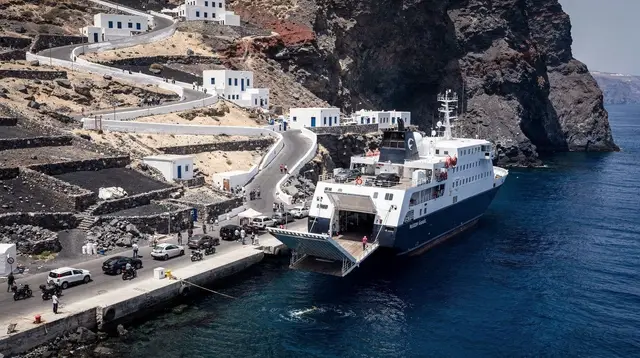
There is no shortcut here worth pretending exists. Sifnos is reached from Santorini by high-speed ferry, sailing from Athinios, and the crossing takes somewhere in the region of two to three hours depending on the boat, the operator and whether the route calls at Milos or another island on the way. Some schedules run more directly than others, and timings shift by season, so treat any single figure you see quoted online as provisional rather than fixed — check the current ferry guide and the operator’s own timetable close to your travel date rather than booking around an old number.
What matters for planning is the shape of the day, not the minute count. A same-day return from Santorini to Sifnos means several hours on the water bookending a short visit — workable if the goal is simply to see the island and eat well once, but not enough time to walk the hiking trails or see more than Apollonia and one beach. If Sifnos is the reason for the trip rather than a curiosity, an overnight stay changes the experience completely.
| Route from Santorini | Typical crossing | Suits |
|---|---|---|
| Direct high-speed ferry | Around 2-3 hours | An overnight stay, or a long single day |
| Ferry via Milos | Longer, with a stop | Combining Sifnos with a Milos call |
| Small-group day tour | Full day, guided | Travellers who want logistics handled for them |
Travellers combining several islands in one trip often route through Milos or Folegandros on the same ferry line — see Cyclades island-hopping routes for how the connections generally link up across a week or ten days.
Apollonia and Artemonas: the Chora
The island’s capital, Apollonia, is not one compact square but a run of neighbourhoods that blur into each other along a ridge, built up in white cubic houses, blue-domed churches and narrow lanes closed to cars. Its main pedestrian street, known locally as the steno, is where the evening walk happens: bakeries, jewellery workshops, tavernas with tables spilling into the alley, and the small Folklore Museum housed in a converted mansion.
Artemonas, a fifteen-minute walk north along the ridge, feels calmer and slightly grander — bigger neoclassical houses, more churches per square metre than seems reasonable for a village this size, and views down toward the coast that are worth the uphill walk on a clear evening. The two villages are often treated as one destination, and most visitors base themselves in or near this ridge regardless of which end they sleep in.
Kastro: the medieval capital on the cliff
Before Apollonia took over, Kastro was the island’s capital for centuries, and it looks the part. Built directly on a rock above the sea, its houses form a defensive ring — the outer walls of the village are the walls of the fortress, a Venetian-Byzantine building technique that leaves almost no gap between a front door and open sea. Inside, the lanes are narrow enough to touch both sides at once, and small chapels appear in courtyards with no warning. It is one of the few Cycladic villages where the settlement’s entire logic — defence against pirate raids, cistern by cistern — is still legible just by walking through it, and it rewards an unhurried visit far more than a checklist stop.
Kamares and the other harbours
Kamares is the island’s main port, set in a deep, sheltered bay backed by a small beach that gets surprisingly good swimming for a working harbour. It is the arrival and departure point for most visitors and has enough tavernas and rooms to make an overnight stay there workable, though most travellers move up to Apollonia once they’ve landed. Smaller harbours dot the rest of the coast: Vathi in the south, a lagoon-like bay with a scatter of tavernas at the waterline, and Cheronissos in the far north, a genuine fishing and pottery village where boats still outnumber tourists on most days.
The hiking network between villages
Sifnos has one of the better-maintained trail networks in the Cyclades, connecting almost every village on the island with stone-paved and dirt paths that predate the road network by centuries — these were how people and mules actually moved between settlements. Waymarked routes link Apollonia and Artemonas to Kastro, to the monastery at Vrysi, and down toward the southern coast near Vathi and Chrysopigi, with distances that suit a morning or an afternoon rather than a full-day trek. Spring, from April into June, is the best window: wildflowers, cooler air, and the terraced hillsides at their greenest. By August, the same paths are exposed and hot in the middle of the day.
For visitors basing a Cyclades trip primarily around boats and beaches, this walking network is the clearest reason to treat Sifnos as more than a stopover — it is genuinely built for it in a way most of the islands on this list are not.
a private historical car tour that links Kastro, Apollonia and the island’s older villages in a single half-day is a practical way to see the ground the trails cover if walking every stretch isn’t the plan, especially on a shorter visit.
Pottery, and the island that taught Greece to cook
Sifnos has been a centre of pottery production since antiquity, thanks to local clay deposits, and the craft is still visible rather than just remembered — working ceramic studios operate in Kamares, Vathi and especially Cheronissos, where several generations of the same families have thrown pots for cooking, storage and glazing. The most distinctive local vessel is the flat-bottomed clay pot still used to cook the island’s best-known dish.
That dish is revithada, a chickpea stew traditionally sealed in one of these clay pots and left in a wood-fired oven overnight, ready by the next midday — a slow-cooking method built around villages that once shared a single communal oven. Sifnos also has a stronger claim than most islands to having shaped Greek cuisine at a national level: Nikolaos Tselementes, the cookbook author whose name became a byword for a cookery manual in Greek the way “Mrs Beeton” did in English, was born on the island. Food here is treated as a subject worth the same attention as the ruins and the view elsewhere in the Cyclades, and it shows in how many restaurants in Apollonia and Artemonas still cook slowly rather than fast.
Beaches: Platys Gialos, Vathi and Chrysopigi
Sifnos’s beaches are gentler than the volcanic sand you’ll have already seen on Santorini — pale sand and shallow, calm water rather than black grit that burns underfoot. Platys Gialos, on the south coast, is the longest and most developed, backed by a run of tavernas and small hotels, and it’s the easiest beach to reach without a car. Vathi, further west, sits in a near-enclosed bay that keeps the water flat even when wind picks up elsewhere on the island — a useful thing to know given how often the meltemi disrupts boat plans across the Cyclades in summer. Chrysopigi, at the island’s southeastern tip, is smaller and framed by the monastery described below, making it as much a place to look at as to swim from.
Panagia Chrysopigi and the island’s patron saint
The monastery of Panagia Chrysopigi stands on a small rocky outcrop connected to the mainland by a narrow causeway, right at the sea’s edge — one of the most photographed single buildings on the island, and deservedly so, since the setting does the work rather than the architecture. The Virgin of Chrysopigi is the island’s patron, and her feast day in early summer draws islanders back from Athens for the celebration. Visiting outside the festival is quiet: a short walk out to the chapel, a look at the water on both sides, and a beach immediately below for afterwards.
Sifnos as part of a longer island-hopping trip
Most travellers reach Sifnos as one stop within a broader route through the western Cyclades rather than a single round trip from Santorini. Ferries connecting Sifnos to Milos, Kimolos and Serifos make it straightforward to build a week that includes two or three islands without backtracking, and several of the boat excursions based on Sifnos extend that reach further still.
a speedboat day trip from Sifnos out to Kimolos and the northern coast of Milos covers ground this page doesn’t — Milos’s own beaches, including Kleftiko, sit outside its scope, but a boat based in Sifnos is one legitimate way to see them without changing base.
For travellers who’d rather stay closer to Sifnos itself, a private speedboat trip to the uninhabited island of Poliegos reaches one of the least-visited stretches of coastline in the whole archipelago, and a combined tour taking in both Kimolos and Poliegos with stops for swimming covers both in a single day for anyone based on Sifnos for more than a night or two.
Those planning the wider hop from Santorini rather than a Sifnos base specifically should also look at a full-day catamaran cruise as a way to see several coastlines from the water without committing to an overnight anywhere — a reasonable middle option between a rushed day trip and a multi-island stay. For the wider logic of stringing islands together from Santorini, the ten-day Cyclades island-hopping itinerary and the general day trips from Santorini guide both set out how Sifnos usually fits alongside Amorgos, Kimolos and Polyaigos on the same broader route.
Best time to visit and what to budget
Sifnos follows the same seasonal rhythm as the rest of the Cyclades, but its appeal skews slightly earlier and later in the year than a beach-first island would. Late April through June brings walkable trails, blooming terraces and ferries that are running but not yet packed. July and August are hot, busier, and more exposed to the meltemi, which can disrupt smaller boat excursions with little notice. September is arguably the island’s best month: warm sea, thinner crowds, and the trails cooling back down to walkable again.
| Item | Typical cost |
|---|---|
| Ferry, Santorini to Sifnos (one way) | Comparable to other mid-distance Cyclades routes |
| Simple taverna meal | €12-20 per person |
| A boat excursion from Sifnos | €50-90 per person |
| A double room, mid-range, high season | €90-160 per night |
These are order-of-magnitude figures rather than fixed prices, and they move with the season and with fuel and ferry pricing that changes year to year — treat the table as a planning aid, not a quote. For the general seasonal picture across the wider trip, Santorini’s month-by-month weather guide is a useful companion, since it shapes when ferries run reliably in both directions.
Frequently asked questions about visiting Sifnos from Santorini
How do I get from Santorini to Sifnos?
By high-speed ferry from Athinios, Santorini’s only ferry port. The crossing is generally in the region of two to three hours, sometimes longer if the route calls at another island first — check the current timetable close to your travel date rather than relying on a fixed schedule, since operators and frequencies change by season.
Is Sifnos worth visiting as a day trip from Santorini?
It’s possible, but the ferry crossing itself takes up a large share of the day in both directions, leaving only a few hours ashore. That’s enough to see Apollonia and have a meal, but not enough for the hiking trails or more than one village. An overnight stay suits Sifnos better than most of the islands reachable from Santorini.
What is Sifnos known for?
Pottery — the island has produced ceramics since antiquity and still has working studios — and food, most famously the slow-cooked chickpea stew revithada and its historical link to Nikolaos Tselementes, whose name became synonymous with Greek cookbooks. It’s also known among hikers for one of the more complete village-to-village trail networks in the Cyclades.
Does Sifnos have good beaches?
Yes, though they’re a different kind of beach from Santorini’s volcanic sand — paler and gentler, with calmer, shallower water. Platys Gialos and Vathi are the most developed and easiest to reach; Chrysopigi is smaller and set beside the island’s best-known monastery.
Can I combine Sifnos with Milos or Kimolos in one trip?
Yes — ferry connections between Sifnos, Milos, Kimolos and Serifos make a multi-island western Cyclades route straightforward, and several boat excursions based in Sifnos extend out to Kimolos and Poliegos directly. Milos’s own highlights, including Kleftiko and Sarakiniko, are covered separately since they sit on a different island’s coastline.
What’s the best time of year to visit Sifnos?
Late April to June and September are generally the best windows — warm enough to swim, cool enough to walk the hiking trails without the exposure of full summer, and ahead of or behind the busiest ferry traffic. July and August are hot and more crowded, and also more exposed to the meltemi, which can disrupt smaller boat trips.
Do I need a car on Sifnos?
Not strictly — buses connect the main villages and beaches, and Apollonia, Artemonas and Kastro are close enough together to walk between. A car or a guided tour makes sense if the goal is covering Kastro, the northern villages and the southern beaches in a single short visit rather than spreading it across several days on foot.