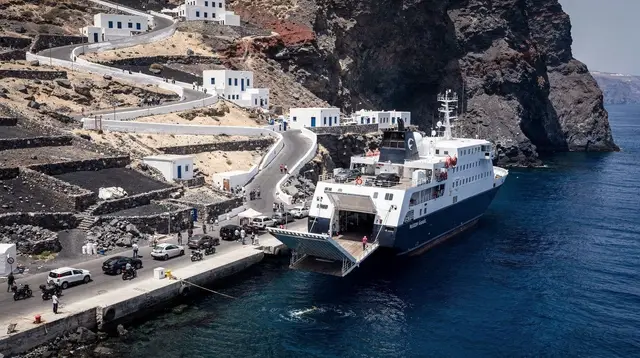
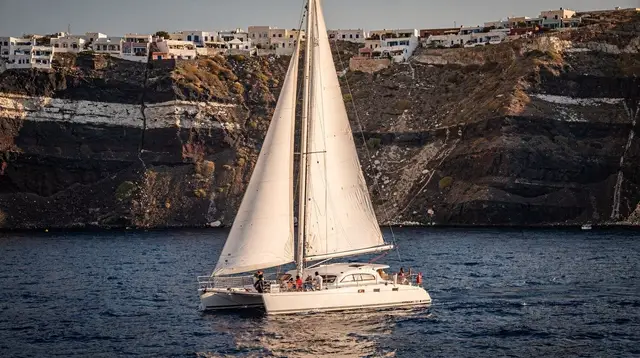
Most islands in this guide have a village, a port, and a reason to book a room. Polyaigos has none of that, and that absence is the whole point. It is the largest uninhabited island in the Aegean, a rough wedge of cliffs and coves sitting just north of Kimolos, and the only way most travelers will ever see it is from the deck of a boat that started its day in Milos or Pollonia. This page treats it that way: not as a destination to check off, but as a stretch of coastline worth understanding before you sail past it.
An Islet You Sail Past, Not Into
Polyaigos sits in the channel between Kimolos and the smaller islands further north in the western Cyclades, close enough to Kimolos that on a clear day the two can look like a single landmass from a distance. Up close, the difference is obvious. Kimolos has a harbor, a hilltop village, tavernas and a handful of guesthouses. Polyaigos has none of that — no jetty, no road, no building of any kind, and no boat schedule that lists it as a stop. Every visit to Polyaigos is really a visit to its coastline, seen from a deck or a swim off the back of a boat, on a route that almost always also touches Milos or Kimolos on the same day.
That distinction matters because it is easy to blur the two islands when reading a cruise itinerary that lists “Polyaigos and Kimolos” in the same breath. A Kimolos stop usually means time ashore — a walk through the village of Chorio, a coffee by the harbor at Psathi. A Polyaigos stop means the boat slows down, follows the coastline, and lets passengers swim in one or two coves before moving on. If a day trip promises both islands, expect a village visit on one and a swim stop on the other, not a matching pair of experiences.
Why No One Lives Here
Polyaigos has never supported a permanent settlement in modern times. The terrain is steep and dry even by Cycladic standards, with no natural harbor sheltered enough to anchor a fishing fleet year-round, and no source of fresh water reliable enough to sustain a village. For much of its history the island served as seasonal grazing ground — shepherds from Kimolos and Milos would ferry goats across for the summer rather than settle there themselves — and that pattern, rather than continuous habitation, is why the island still carries wild goats along its ridgelines today.
The lack of development turned out to be an asset once conservation became the more valuable framework. Polyaigos and the strait around it now fall under Natura 2000 protection, one of the reasons the coastline still looks the way it does: no marinas, no beach bars, no cleared paths. If you are the kind of traveler who finds an untouched coastline more interesting than a developed one, that absence of infrastructure is the appeal rather than a gap to complain about.
What You Actually See From the Boat
Cruise routes around Polyaigos hug the coast rather than crossing open water toward it, which means the island reveals itself gradually — pale cliffs dropping straight into the sea, folded rock formations, and a scatter of coves where the water shifts from deep blue to a shallow turquoise close to shore. Several of these coves are sheltered enough for a boat to anchor and let passengers swim or snorkel directly off the stern; there is no sand to walk onto and no path inland, so the swim stop is the extent of the “landing.”
Sea caves are one of the recurring features boats point out along the way, cut into the cliff base by centuries of wave action, similar in character to the volcanic and limestone formations found at Kleftiko and Sarakiniko on Milos, though Polyaigos’s coastline is less visited and correspondingly quieter. Expect a slower, more scenic pace here than at Milos’s better-known photo stops — this is the part of the itinerary built around looking at the coastline and swimming in it, not around a single dramatic viewpoint.
Wildlife: Falcons, Seals and a Protected Coastline
The Natura 2000 designation around Polyaigos exists largely because of what nests and swims here rather than what could be built. The cliffs are known nesting grounds for seabirds, including Eleonora’s falcon, a migratory falcon that breeds on remote Aegean cliffs in late summer specifically because those cliffs are undisturbed by people — timing that happens to overlap with the island’s peak cruise season. Boats that keep a respectful distance from the cliff faces sometimes spot these falcons hunting low over the water in the late afternoon.
The surrounding waters are also cited as habitat for the Mediterranean monk seal, one of the rarest marine mammals in Europe, though sightings are occasional rather than guaranteed and no operator can promise one. None of this makes Polyaigos a wildlife safari — it is a scenic boat stop where the setting happens to be ecologically significant, and operators generally frame it that way rather than overselling an encounter that may not happen on a given day.
How to Get There: Cruises From Milos and Pollonia
There is no direct route to Polyaigos from Santorini, and no ferry stops there at all. The practical path is to reach Milos or Kimolos by ferry first — Santorini connects to both with a change of boat or a longer sailing depending on the season, covered in more detail in the guide to island hopping from Santorini — and then book a local cruise that includes Polyaigos in its route. Nearly every operator running boats out of Milos town or the fishing village of Pollonia offers some version of this itinerary, usually paired with Kimolos so the day includes both a swim stop and a village visit.
A half-day cruise from Milos that traces the Polyaigos coastline is the most common way to fit this in without giving up a full day, and it typically returns to port by early afternoon. Travelers who want the village stop on Kimolos as well as the swim coves of Polyaigos tend to prefer the full-day cruise that combines Polyaigos and Kimolos with a lunch stop on board, which trades a longer day for seeing both places properly rather than glimpsing one from a distance.
For those based in Pollonia rather than Milos town, a private cruise departing directly from Pollonia toward Polyaigos cuts out the transfer into Milos town and works well for smaller groups who want to set their own pace. Travelers who want to end the day on the water rather than mid-afternoon might instead look at a private sunset cruise from Pollonia toward Polyaigos, which shifts the same coastline into golden-hour light rather than midday sun.
The table below is a rough comparison, not a price guarantee — always confirm current pricing and whether lunch and drinks are included before booking.
| Cruise style | Departure | Typical length | Best for |
|---|---|---|---|
| Half-day coastal cruise | Milos town | ~5 hours | A quick add-on without losing a full day |
| Full-day cruise with lunch | Milos town | Full day | Combining Polyaigos with a Kimolos village stop |
| Private cruise | Pollonia | Half or full day | Smaller groups, flexible pace |
| Sunset cruise | Pollonia | Half day, evening | Golden-hour light on the cliffs |
Larger multi-stop itineraries that fold in more of the coastline, such as the eight-hour route covering Polyaigos, Kimolos and Milos’s own coastline in one trip, exist for travelers who would rather see everything in one long day than split it across two shorter outings. Whichever option you choose, none of them involve going ashore on Polyaigos itself — every itinerary keeps the island as a coastline to sail along and swim off, which is worth confirming in the listing description before you book if that distinction matters to your plans.
If the appeal is more about the boat than the destination, it’s also worth reading how catamaran and sailing-boat cruises compare and the difference between semi-private and shared cruise formats before choosing — the boat and group size shape this kind of day more than the route does.
Best Time to Sail Past Polyaigos
Cruise operators run these routes primarily from late spring through early autumn, with June through September offering the calmest and most reliable sea conditions. The meltemi wind, which picks up strongly across the Cyclades in July and August, can and does cancel or reroute boat trips in this part of the Aegean — the open channel between Kimolos and Polyaigos has little shelter, so operators are quick to postpone rather than risk an uncomfortable or unsafe crossing.
Shoulder-season months (late April, May and October) can offer quieter water and fewer boats sharing the same coves, at the cost of a slightly higher chance of a canceled sailing on a windy day. Whatever the season, treat any Polyaigos cruise as weather-dependent and avoid scheduling it for your only full day on Milos or Kimolos.
Pairing Polyaigos With Milos and Kimolos
Polyaigos works best as one stop within a longer stay based on Milos or Kimolos, not as a reason to travel to the region on its own. Travelers building a one-week Santorini and Milos itinerary typically set aside a single day near the end of their Milos time for a boat trip that includes Polyaigos alongside Kimolos or the western coves of Milos itself, such as Kleftiko and Sarakiniko.
Those chasing a longer route through the region, following the Cyclades island-hopping routes guide, can slot Polyaigos into a Milos–Kimolos–Sifnos sequence without adding an extra overnight stop, since the entire visit fits inside a single day.
For swimmers who want more structured time in the water rather than a swim stop between cliffs, it’s worth comparing this kind of scenic cruise against a dedicated snorkelling trip elsewhere in the Cyclades — Polyaigos rewards a slow pass along the coastline more than a serious snorkelling session, since the boat rarely lingers at any one cove for long. And if the appeal of this whole idea is simply spending a day looking at coastline from the water instead of standing on it, that’s a theme worth reading more about in why we send you out on a boat, which makes the case for exactly this kind of low-key, boat-only day.
The honest summary: Polyaigos is not a place you go to. It is a place you go past, slowly, with a swim in the middle — and for travelers who already have a boat day planned around Milos or Kimolos, that is more than enough reason to make sure the route includes it.
Frequently Asked Questions About Visiting Polyaigos
Can you land on Polyaigos?
There is no organized landing. Boats anchor off the coves so passengers can swim and snorkel from the water; there is no jetty, no path network and nothing built to walk to on shore.
Does anyone live on Polyaigos?
No. Polyaigos is uninhabited today. It has no village, no permanent residents and no facilities of any kind — that is precisely what distinguishes it from Kimolos next door.
How do you get to Polyaigos from Santorini?
Take a ferry from Santorini to Milos or to Kimolos, then book a local cruise from Milos town, Pollonia or Kimolos that includes Polyaigos in its route. There is no ferry that stops at Polyaigos itself.
Is Polyaigos the same as Kimolos?
No. Kimolos is an inhabited island with a village, a port and places to stay. Polyaigos is a separate, uninhabited islet just north of it, visited only by boat and only from the water.
What is there to see on a Polyaigos cruise?
Steep, undeveloped cliffs, sheltered turquoise coves for swimming, sea caves along the coastline, and a good chance of spotting seabirds. The appeal is the untouched scenery rather than any site or village to walk through.
Is Polyaigos worth adding to a Milos itinerary?
As a stop on a half- or full-day cruise, yes — it adds quiet swimming coves and a contrast to Milos’s busier beaches. As a separate destination in its own right, it is not, since there is nothing on land to visit.
Are there animals on Polyaigos?
The waters and cliffs around Polyaigos are part of a protected Natura 2000 area, known for nesting seabirds, including Eleonora’s falcon in season, and occasional sightings of the Mediterranean monk seal along the quieter coves.
Can you swim at Polyaigos?
Yes — swimming and snorkelling from the boat in the coves is the main activity, since there is no beach infrastructure or path to a shore-based swimming spot.