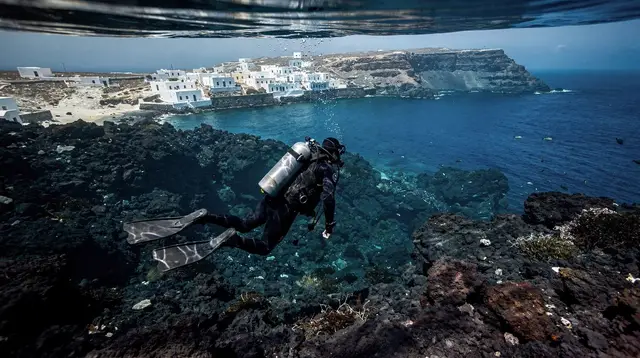
Snorkelling in Santorini: The Best Spots Without a Boat or a Certification
Where can you snorkel in Santorini without a boat or diving certification?
Ammoudi Bay, Vlychada, Kamari, and Perissa all offer shore-entry snorkelling with just a mask, snorkel, and fins. Akrotiri's White Beach and Black Beach have clearer water but are reachable only by small boat from Akrotiri or Vlychada.
You Don’t Need a Boat or a Licence to See What’s Under the Surface
Most of what gets written about Santorini’s water is aimed at divers with a certification card, or at people chartering a boat for the day. This page is for everyone else — anyone who wants to put on a mask and fins, wade in from a beach, and see what a volcanic coastline actually looks like below the waterline. No training, no tank, no booking required for most of it.
That said, snorkelling here isn’t quite like snorkelling over a coral reef. The coastline is young, geologically speaking — carved by an eruption a few thousand years ago rather than built by millennia of coral growth — so the underwater scenery leans toward black boulders, ash-grey shelves, and the occasional patch of surprisingly clear water rather than colourful reef. If you want fish life and depth, our scuba diving guide covers certified dive sites properly; this page stays entirely in mask-and-snorkel territory.
Reading the Water: What Makes Santorini Different
Santorini and its neighbouring islets are the eroded rim of a caldera left behind by a Late Bronze Age eruption, dated to roughly 1600 BCE (the exact year is still debated among archaeologists and geologists). That history shapes the coastline you’ll be swimming along: sheer cliffs dropping straight into deep water in the caldera itself, and gentler black or red volcanic sand beaches on the south and east coasts where snorkelling is actually practical from shore.
A few things carry across every spot on this page:
- The sand is volcanic — black or red — and it gets hot. By midday in July or August it can genuinely burn bare feet. Carry water shoes or sandals even if you’re only stopping for a swim.
- Shade is scarce. Most of these beaches have little natural cover; a sun umbrella or rental sunbed is worth the few euros.
- The meltemi wind matters. This strong summertime northerly, most active from July into August, can stir up sediment and chop on exposed coasts and make visibility poor for a day or two at a time. Our guide to the meltemi explains when it tends to blow.
- Lifeguard cover is inconsistent. Some organised beaches like Perissa and Kamari have seasonal lifeguards; quieter coves generally don’t. Swim within your ability and don’t go out alone in open water.
Ammoudi Bay: Snorkelling Below Oia
Tucked at the base of the cliff below Oia, Ammoudi Bay is a small fishing harbour rather than a beach, but it’s one of the easiest places on the island to snorkel straight off the rocks. The water is deep close to shore, clear on calm days, and there are a couple of natural platforms locals use to jump in. It’s shaded for part of the day by the cliff above, which helps on a hot afternoon.
Getting here means either the walk down from Oia (steep, worth the return trip by donkey or on foot, not by car) or arriving by small boat. Because it sits directly beneath the village, it also doubles as one of the better places to watch the Oia sunset from sea level rather than fighting the crowds at the castle above.
Vlychada: Ash Cliffs and a Quieter Shoreline
Vlychada, on the island’s south coast, is best known for the wind-sculpted grey-white ash cliffs that back the beach — a landscape that looks more lunar than Greek. The sand here is a mix of grey volcanic material, and the water is generally calmer than on more exposed coasts, which makes it a good, low-effort spot for snorkelling close to shore.
It’s also one of the less crowded beaches within easy reach of the main towns, largely because it sits a bit off the main tourist circuit near the marina. If you’re looking for a snorkelling stop that isn’t packed with sunbeds, this is one of the better bets. Full detail on getting there and what to expect is in our Vlychada beach guide.
Kamari and Perissa: The Easiest Entry Points
On either side of the Mesa Vouno headland sit Kamari and Perissa, the island’s two most developed beach resorts. Both have black volcanic sand and pebble, gently sloping entries, and enough sunbed and taverna infrastructure that you can turn a snorkel session into a full afternoon without much planning.
Neither is going to compete with Vlychada or Ammoudi for underwater scenery — the seabed is mostly sand rather than rock — but the calm, shallow water makes them the most forgiving spots for a first snorkel of the trip, or for anyone travelling with children. Our Perissa vs Kamari comparison breaks down which suits your base better.
Red Beach: Why We Point You Toward a Boat, Not a Path
Red Beach, near Akrotiri, is one of the most photographed beaches on the island — a small cove backed by rust-red cliffs. It’s also one you should check on before planning to walk in. The cliffside path has suffered rockfalls in 2018, 2023, and again in December 2025, and access has been restricted on and off since; as of 2026 it remains only partially open, and conditions change without much notice.
Given that, the more reliable way to actually see Red Beach and swim near it is from the water — most caldera and coastal boat trips pass close by, letting you take in the colour of the cliffs without relying on a footpath that may or may not be open that day. For up-to-date specifics on the closures, see our Red Beach access and safety guide.
Akrotiri’s White Beach and Black Beach: Boat-Only, Genuinely Worth It
This is the pairing that most casual visitors never make it to, because both beaches are reached exclusively by boat — there is no road, no footpath, no way to walk in from Akrotiri village or anywhere nearby. Small boats run from Akrotiri’s old port and from Vlychada to both.
White Beach sits beneath pale, almost chalky cliffs, with clear water and a scattering of sea caves along the base of the rock — genuinely one of the better places on the island to snorkel, precisely because so few people make the trip. Black Beach, a short distance along the same stretch of coast, has darker volcanic sand and cliffs and a similarly quiet, undeveloped feel.
Neither beach has facilities beyond what a boat operator might bring — no tavernas, no rental huts, sometimes not even shade — so bring water, sun protection, and anything else you’ll want for the day. Full logistics are in our White and Black Beach guide; it’s also worth pairing a visit with the nearby Akrotiri excavations or the Akrotiri lighthouse, both an easy add-on from the village.
Palea Kameni: Swimming to the Hot Springs
Palea Kameni, one of the two black islets in the middle of the caldera, isn’t a place you land on — there’s no dock, no beach to walk onto. Instead, boats anchor offshore and passengers swim the last stretch to reach the hot springs, a patch of water tinted rust-orange by naturally occurring iron.
Two things worth knowing before you jump in: the water is warm rather than hot, more like a mild bath than a spa, and it will genuinely stain light-coloured swimwear — a fact that catches a lot of first-timers off guard. Pack a dark suit if you plan to swim here, and don’t expect to get it fully clean afterward. Its neighbour, Nea Kameni, is the actual volcanic crater most cruises stop at first, reached by a dry landing rather than a swim; our Palea Kameni hot springs guide has more on both islets and how the two visits usually pair together on a single trip.
Many caldera sightseeing routes combine a swim at Palea Kameni with sunset views back toward Oia and Imerovigli later in the afternoon — a way to get both the swim and the view without arranging separate trips:
a caldera cruise that pairs a swim stop near the hot springs with sunset views from the waterWhat to Bring (and What You Genuinely Don’t Need)
The appeal of shore snorkelling here is how little gear it actually takes:
| Item | Needed? | Notes |
|---|---|---|
| Mask and snorkel | Yes | Bring your own or rent locally; fit matters more than brand |
| Fins | Optional | Helpful in open water like Ammoudi or Palea Kameni, less needed on shallow sandy beaches |
| Water shoes | Strongly recommended | Volcanic sand and pebble get hot and can be sharp underfoot |
| Wetsuit | Not needed | Water is warm enough from late spring through autumn for most swimmers |
| Dive certification | No | Only required for scuba diving, not snorkelling |
| Dry bag | Useful | For phone and valuables on boat-only beaches with no facilities |
If the taste of open-water snorkelling leaves you wanting to go deeper and stay down longer, both a beginner-friendly introduction and a full certified outing are bookable without much lead time:
a first-timer scuba dive experience that needs no prior certificationFor anyone already certified and wanting a proper dive rather than a taster, there’s also:
a guided diving tour to sites around the island for certified diversWhen to Go: Season, Wind, and Water Temperature
Water is swimmable from around May through October, but the comfortable window for most people runs June to September, when sea temperatures sit at their warmest. The trade-off is the meltemi: this seasonal north wind picks up through July and into August and can turn calm mornings choppy by afternoon, especially on the island’s more exposed coasts. Shoulder months — early June or September — tend to offer a good balance of warm water and calmer seas.
Full month-by-month detail, including how wind and water temperature shift across the year, is in our Santorini weather month by month guide. If you’re weighing snorkelling against other water activities like jet skiing or paddleboarding, our broader water sports guide rounds those up, and the diving and snorkelling category page lists bookable options across the island.
A Note on Safety
The 2025 seismic swarm between Santorini and Amorgos — which ran for about forty days from late January and produced tens of thousands of tremors — unsettled a lot of travel plans that year, but it ended without an eruption and has been over for some time. It doesn’t change anything about swimming or snorkelling conditions today; the water hazards worth actually paying attention to are the ordinary ones — hot sand, limited shade, inconsistent lifeguard cover, and the meltemi’s effect on visibility and chop. Our safety and 2025 earthquakes guide covers the full context if you want it.
Beyond that, the basics apply everywhere on this list: don’t snorkel alone in open water like Ammoudi or Palea Kameni, watch for boat traffic near harbours and anchorages, and check local conditions before relying on any cliffside path — Red Beach being the clearest example of a route that can close without warning.
Snorkelling in Santorini: Common Questions
Do I need a certification to snorkel in Santorini?
No. Snorkelling only requires a mask, snorkel, and fins, and is open to anyone comfortable swimming in open water. Certification is required only for scuba diving, which is a separate activity covered in our dedicated diving guide.
Can I walk to the White Beach or Black Beach near Akrotiri?
No. Both beaches sit below cliffs with no road or footpath, and are reached only by small boat from Akrotiri’s old port or from Vlychada. Anyone telling you there’s a walking trail is mistaken or thinking of a different beach.
Is it true that swimming to Palea Kameni stains your swimsuit?
Yes. The hot springs off Palea Kameni carry a high iron content that leaves a rust-orange tint on light-coloured fabric, and it doesn’t wash out easily. Wear a dark swimsuit if you plan to swim there.
Why is the sand so hot at Santorini’s beaches?
Most of Santorini’s beaches are volcanic sand or pebble, black or red in colour, which absorbs heat far more than pale sand. By midday in summer it can be too hot to walk on barefoot, so water shoes or sandals are worth carrying even for a short swim.
Is Red Beach safe for snorkelling right now?
The cliffs above Red Beach have suffered rockfalls in 2018, 2023, and again in December 2025, and the footpath access has been restricted on and off since. Check current access locally before planning to walk in, and consider viewing or swimming near it from a boat instead.
What’s the best time of year for snorkelling in Santorini?
Late May through early October gives the warmest, calmest water, though the meltemi wind can churn up the sea and reduce visibility on exposed coasts in July and August. Shoulder months like June and September often combine warm water with fewer windy days.
Diving and Snorkelling on GetYourGuide
Verified deep-linked GetYourGuide tours. Book through these links and we earn a small commission at no cost to you.
GetYourGuide does not provide a product photo for this activity — the image shows the meeting point, photographed by us.