Scuba Diving in Santorini: Certified Dive Sites and Clubs
Do you need a certification to scuba dive in Santorini?
Yes. Every dive site around the caldera and the outer coast requires a recognised open-water certification and full equipment, supplied and supervised by a local dive club. There is no shallow, gear-free version of these dives — that experience is snorkelling instead.
Diving a volcano instead of a reef
Most people who come to Santorini picture the caldera from above: a white village strung along a cliff, a boat far below. Scuba diving flips that view. Instead of looking down into the caldera, you drop into it — along a wall of solidified lava, over black sand slopes, and through swim-throughs cut into rock that was still molten a few thousand years ago. Read how the Santorini caldera was formed first if you want the geology behind what you’re swimming past; on a good day you can trace the layers of ash and lava in the wall the way you’d read rings in a tree.
This page is for divers who are already certified, or who plan to certify on the island, and who want to know which sites exist, what a club actually provides, and when the weather works against you. It does not cover snorkelling, which needs no certification and stays on the surface — that’s a separate activity, covered in best snorkelling spots in Santorini. It also doesn’t cover renting a boat yourself; if that’s what you’re after, see renting a boat in Santorini without a licence instead. Every dive described here is run by a club, with a certified instructor, tanks, regulators and a boat.
Certification: not optional, not negotiable
Every operator on the island applies the same rule, because it isn’t theirs to bend: diving below a shallow, supervised pool depth requires a recognised open-water certification (PADI, SSI or an equivalent body). If you’re not certified, you have two options — a supervised introductory dive in shallow, sheltered water with an instructor holding onto you the whole time, or a multi-day open-water course that certifies you on Santorini itself and finishes with real dives at the sites below.
What you cannot do is show up without a card and expect to be taken to the caldera wall or the wrecks off the south coast. Clubs check certification cards before boarding, and for good reason: several sites here have current, depth and entry conditions that an untrained diver has no way to judge.
Equipment is supplied as part of any booked dive — wetsuit, tank, regulator, BCD, weights, mask and fins. Bring your own mask if you have a strong prescription or a fit you trust; everything else is standard rental gear, checked and serviced between customers.
a guided diving tour that includes full equipment and a certified instructor is the simplest way to book a single day of diving without arranging tanks, a boat and a guide separately.
Where you actually dive
Santorini’s dive sites split roughly into two groups: inside the caldera, where the appeal is the volcanic wall and depth, and along the south and west coast, where reefs, small wrecks and calmer water make for easier, longer dives.
| Site or area | What you’ll see | Typical depth | Best suited to |
|---|---|---|---|
| Caldera wall, off Oia | Sheer volcanic rock face, layered ash and lava | 12–30 m | Certified divers comfortable with depth and current |
| Reef off Ammoudi Bay | Rocky reef, small fish life, calmer entry | 5–18 m | Newer certified divers, training dives |
| South coast near Akrotiri Lighthouse | Rock formations, occasional wreck debris | 10–25 m | Mixed groups, good visibility days |
| Coastline near White and Black Beach | Volcanic cliffs meeting the sea, boat-access only | 8–20 m | Divers already booked on a boat-based day |
| Sheltered coves near Vlychada | Ash-cliff coastline, calmer water in wind | 6–15 m | Windy days, beginners, refresher dives |
None of these numbers are promises — depth, route and which site you actually reach depend on the day’s sea state, group experience and what the club’s boat can safely manage. A good operator will tell you which site you’re diving before you pay, and will change it without apology if conditions demand it.
two guided dives off Oia in a single outing is the most direct way to reach the caldera wall itself, for divers who already hold a certification and want two dives back to back.
If you’re not certified yet
Clubs based mainly around Fira and Oia run short courses that combine classroom time, a pool or shallow-water session, and two to four open-water dives at the calmer sites in the table above — Ammoudi’s reef and the sheltered coves near Vlychada are the usual training grounds, precisely because they’re forgiving if a first-time diver’s buoyancy is still shaky. A course typically runs over two to three days, and the certification you leave with is valid worldwide, not just on the island.
If you’d rather test the water before committing to a multi-day course, a beginner-friendly caldera diving experience gives you a single supervised dive with an instructor controlling your depth and pace throughout — a taste of the caldera wall without the full certification process.
The meltemi problem
The single biggest variable in whether a dive happens at all is the meltemi, a strong wind from the north that builds through July and peaks in August. Full detail on how it behaves through the year is in the meltemi wind explained, but the practical point for divers is this: several dive sites, including most of the caldera wall, are exposed to open water and become unsafe or simply unpleasant to reach by boat once the wind is up. Clubs watch the forecast daily rather than the calendar, and a booking made a week in advance can still be moved or cancelled the morning of.
What a responsible operator does in a strong meltemi:
- Reroutes the boat to a sheltered site, usually along the south or west coast rather than the open caldera
- Shortens or delays the dive window to a calmer part of the day, often early morning
- Cancels outright and reschedules rather than run a boat in a sea state it can’t manage safely
- Refunds or rebooks without argument — this is a routine, expected disruption here, not a rare failure
None of this means diving is impossible in high summer. It means building in a spare day if diving is a priority for your trip, and treating any confirmed booking in July or August as provisional until the morning of.
Boat-only sites: White Beach and Black Beach
Two of the more striking pieces of coastline near Akrotiri — locally called White Beach and Black Beach for the colour of their cliffs — have no path down from land. The only way to reach them, dive nearby, or even see them up close, is by boat. Some dive operators include a pass along this stretch of coast as part of a longer day, and it’s worth asking specifically whether a stop or a dive here is included, since not every itinerary covers it. If seeing this coastline matters more to you than diving does, note that it also appears on general boat trips and snorkelling routes covered in Santorini’s water sports guide — you don’t need scuba gear to pass by it, only to dive along it.
Choosing a club
Every operator on the island supplies certified instructors and serviced equipment as a baseline — that part isn’t a differentiator. What actually varies:
| What to check | Why it matters |
|---|---|
| Group size on the boat | Smaller groups mean more individual attention and a calmer pace underwater |
| Which sites they name upfront | An operator willing to name specific sites, rather than “the caldera,” is planning around real conditions |
| Cancellation and rebooking policy | You will likely need it at least once during a July–August trip |
| Whether photos/video are included | Underwater photography add-ons vary a lot in price and quality between clubs |
| Course length for certification | Two-day courses exist but leave little buffer if a day is lost to weather |
Most clubs operate out of the old port area below Fira or from the marina near Vlychada, since both give sheltered launch points even when the open caldera is choppy.
A day of diving, roughly
A typical single-day outing starts with an early pickup — often before 8 a.m. to beat the wind and the day’s boat traffic — a briefing at the dive centre, a boat transfer to the day’s chosen site, two dives with a surface interval between them, and a return by early afternoon. Bring a swimsuit, a towel, sun protection you can apply before suiting up, and water. Lunch is sometimes included on longer trips; ask when booking rather than assuming.
If you’re diving as part of a broader Santorini itinerary rather than a dedicated diving trip, it pairs naturally with a slower day — most divers don’t want to also drive to Oia for sunset the same evening. Save the Fira-to-Oia caldera path or a wine estate visit for the day before or after.
Getting there without a car
You don’t need to drive yourself to a dive site — every club that runs boat dives includes transfer from your accommodation to the port or marina as part of the booking, and back again afterward. That’s one less thing to plan around the buses in Santorini schedule, which runs on its own timetable and isn’t built around dive departure times.
Safety and the 2025 earthquake swarm
Divers sometimes ask whether the seismic activity recorded around Santorini and Amorgos in early 2025 affects diving conditions today. It doesn’t, in any way that changes how or where clubs operate: the swarm was a period of seismic unrest, not volcanic activity, produced no eruption, and had ended by the time normal operations resumed. For the full context, see Santorini safety and the 2025 earthquakes. The only genuinely relevant hazard on any given dive day is weather — the meltemi above, not seismicity.
Best months to book
Based on typical sea conditions rather than water temperature alone, late May through June and September into early October give the most reliable diving, with fewer cancelled days and calmer boat crossings to the caldera-wall sites. July and August bring the warmest water and the longest daylight but also the highest chance the meltemi reroutes or delays your dive. For a fuller month-by-month breakdown of what the wind and sea are doing, see Santorini weather month by month and the best time to visit Santorini.
Frequently asked questions about diving in Santorini
Do I need to be certified to dive in Santorini?
Yes, for the sites covered here. Clubs run introductory try-dives for complete beginners in shallow, controlled water, but the volcanic walls, wrecks and drop-offs around the caldera and the south coast are only opened to divers holding a recognised open-water certification, or to those completing one on the island.
What makes Santorini’s dive sites different from a typical Mediterranean dive?
The seabed is volcanic rather than limestone: black sand slopes, lava formations, swim-throughs and the underwater caldera wall itself, dropping steeply just off the coast. Visibility and water temperature vary by site and season, and a few spots sit over old lava flows with a genuinely different texture and colour than the rest of the Aegean.
Can the meltemi cancel a dive?
Yes. The meltemi, a strong north wind that peaks in July and August, regularly cancels or reroutes boat-based dives and crossings to sites reachable only by water. Clubs monitor it daily and will move you to a sheltered site or reschedule rather than take a boat out in poor conditions.
Can I dive to see the White Beach or Black Beach near Akrotiri?
Both beaches sit at the base of cliffs south of Akrotiri and are reachable only by boat — there is no path down to either. Some dive and snorkel boats pass close to this coastline, but check with your operator whether a stop or dive at these specific bays is included before booking.
Which season is best for diving in Santorini?
Late May through June and September into early October usually give the calmest seas and the most reliable boat schedules, before and after the strongest meltemi weeks. July and August have the warmest water but the highest chance of a windy cancellation.
How does diving differ from snorkelling here?
Snorkelling stays on the surface with a mask and fins, needs no certification, and works well over shallow rocky coves. Diving takes you along the seabed and the underwater caldera wall using a regulator, tank and buoyancy gear, under the direct supervision of a certified instructor, and reaches depths and formations snorkelling never touches.
Wine Tasting on GetYourGuide
Verified deep-linked GetYourGuide tours. Book through these links and we earn a small commission at no cost to you.
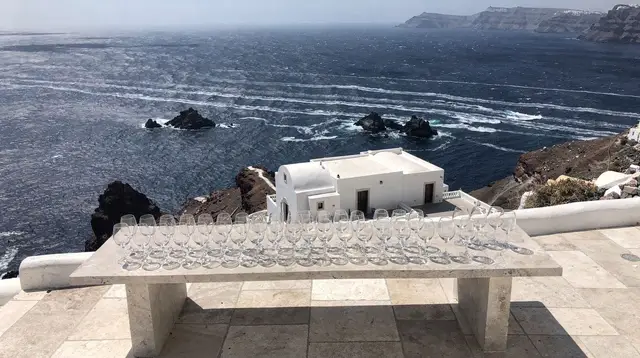
GetYourGuide does not provide a product photo for this activity — the image shows the meeting point, photographed by us.