The Cost of a Caldera View
I did not expect a piece of geology to set a price. But that is more or less what happens on the rim of Santorini’s caldera — a rim built by the eruption our piece on how a caldera is made walks through — and once you notice it, you cannot unsee it on the rest of the island’s price list.
A View That Prices Like a Room
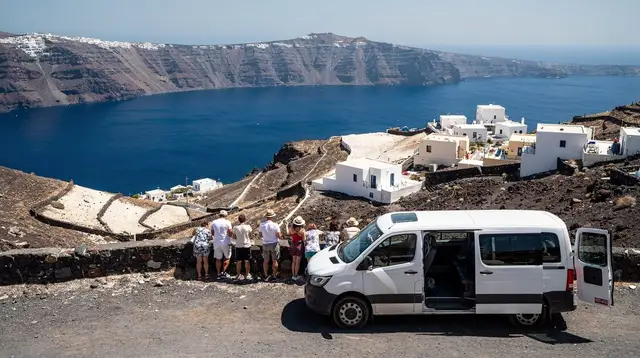
Oia, Imerovigli and Fira sit on top of a cliff that drops 250 to 300 metres into the sea, looking straight across a flooded volcanic crater at the black cone of Nea Kameni. That is the entire product: a chair, a table or a bed facing west, with nothing between you and the horizon but air — though reaching that chair usually means stairs and cobbled lanes, which raise real questions covered in our guide to accessibility in Santorini.
There is no equivalent supply anywhere close, so the villages that hold it — Oia, Imerovigli, Firostefani and Fira — set the ceiling for the whole island’s prices from June to September. Kamari, Perissa, Vothonas or Messaria, a few kilometres inland or down at sea level, never charge the same, because they are not selling the same thing — Kamari and Perissa sell their own draw instead, the ruins of Ancient Thira on the ridge above them.
I think of it as an economy of the caldera itself: a limited, unrepeatable piece of geography, sold nightly to whoever wants to sleep in front of it. The strangest part is how quickly that economy switches off.
Open Five Months, Quiet Seven
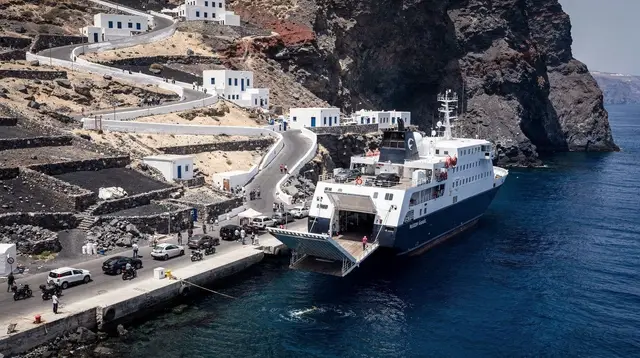
Spend a January afternoon walking the caldera rim and you will find shutters down on hotels, empty terraces at restaurants that were fully booked in August, and almost no boats moving in the water below, with far fewer ferries calling at Athinios port than during the summer rush. A meaningful share of the caldera’s hotels, restaurants and cruise operators close outright from November to March. It is not neglect; it is arithmetic.
A boat, a kitchen or a cliffside suite built around five months of near-total demand often cannot justify staying open through a season with a fraction of the visitors — even operators covered in our Santorini caldera cruise guide close, do maintenance, and reopen in spring. For a full picture of what that means for a winter trip, see how the island behaves once the crowd leaves in our guide to Santorini in winter.
That closure pattern is the other half of why summer costs what it does, part of the wider picture our guide to prices, tipping and what things actually cost lays out. The same rooms, tables and boats that would otherwise spread their costs across twelve months instead have to earn a year’s income in five, and the price reflects it.
The Shoulder Season Trade
This is where late April, May and October earn their reputation as the island’s best compromise, covered in more depth in our shoulder season guide. Most caldera businesses are open by late April and still running through October, the Oia sunset point is noticeably less crowded, and rates sit well under the June-to-September peak. You give something up: the sea is still cold in May, and cooling again by mid-October, and a handful of smaller boats and restaurants keep winter-adjacent hours even in the shoulder months, so it is worth checking our guide on what to bring on a caldera cruise before booking one outside peak summer. But you get the same view, the same cliff, the same sky over the volcano, for less money and less elbow-to-elbow standing at the Kastro in Oia.
I would not call winter a bargain version of summer, either. It is a different island — quieter, colder, with far fewer boats running and a real chance that a place you had your heart on set is simply shut, though the walk itself stays open, as our Fira to Oia caldera hike guide notes. Our month-by-month breakdown lays out exactly what opens and closes when, month by month, rather than treating the whole low season as one block.
Where You Sleep Changes the Bill More Than When
Timing is one lever; location is the other, and it is the one people underestimate. A base a few minutes inland — Karterados or Messaria, say — or down on the south coast near Kamari or Perissa, costs meaningfully less than an equivalent room in Oia or Imerovigli, in any month.
You are not buying less island; you are simply not paying nightly rent on the view. You can still walk the free caldera path that links Fira to Oia, watch the sunset from a public terrace, or book an evening on the water for the price of a boat ticket rather than a hotel upgrade.
I have watched the sun go down over the caldera from a hired boat more often than from a hotel balcony, and honestly I do not think the memory suffers for it, especially with a glass of Assyrtiko in hand. A sunset cruise into the caldera puts you facing the cliff instead of fighting for a spot on top of it, and it costs a fraction of a caldera-view room for the night.
For a slower version of the same idea, a short caldera hike timed to end at sunset gets you the same light for the price of a pair of shoes. And if wine is part of the plan anyway, a late-afternoon wine tour that finishes with the view folds the sunset into something you were already paying for.
For the mechanics of choosing where to actually sleep, this page will not go further than that — our accommodation guide is where that decision belongs, village by village, without a single figure attached that could be stale by the time you read it.
What I’d Actually Plan Around
If I were setting a budget today, I would treat “caldera view” as a line item you choose to buy or skip, separately from the rest of the trip. A night or two facing the volcano, timed for late afternoon into sunset, buys the experience without requiring every night of the stay to carry that premium. Pair it with cheaper nights inland or on the south coast, and the total bill looks nothing like what a week entirely in Oia would cost, especially once a low-cost day at Akrotiri replaces another caldera-view lunch.
Crowd and price move together here too: the villages along the rim are worst between roughly 10am and 5pm on days when cruise ships are in, which our guide to Oia’s sunset without the crowds and its companion piece on sunset spots beyond Oia both work around. None of that changes the underlying economics, but it does change how much of the crowd you pay to stand in.
The Short Version
The caldera view is priced like the scarce thing it is: a narrow strip of cliff, a five-month season, and a closure that empties much of the rim from November to March. You cannot negotiate the geology — the eruption that shaped it is covered in our piece on how the Santorini caldera was formed — but you can choose when you go and where you sleep, and those two choices move the bill more than anything else.
For the full seasonal comparison and a sense of how many days actually make sense for a first visit, our guides on how many days to spend on the island and the overall Santorini budget guide go further than a single sunset can. If a lower-cost trip is the goal from the start, our budget itinerary builds the whole stay around exactly this trade-off.
FAQ: Budgeting for a Caldera View in Santorini
Is the caldera really more expensive than the rest of the island?
Yes, structurally. A room that frames the sunset over the volcano competes with almost nothing else on earth, so the villages perched on the cliff — Oia first, then Imerovigli and Fira — set the ceiling for the whole island’s pricing, well above Kamari, Perissa or Vothonas inland.
Why do so many places close in winter?
Because the caldera’s business model depends on a five-month rush. A hotel, a sunset restaurant or a caldera cruise boat built around June-to-September demand often cannot cover its costs on a trickle of winter visitors, so many simply shut from November to March rather than run at a loss.
What is the best time to get the view without the summer price?
Late April through May, and October, are usually the sweet spot: most caldera businesses are open, the crowd at the Oia sunset point is thinner, and rates sit well below the June-to-September peak. The sea is colder in May and cooling again in October, which is the trade-off.
Does visiting off-peak mean missing things?
Some. Certain caldera cruises, restaurants and smaller hotels do close in winter, and this page does not promise a specific room or a fixed price — see the seasonal and budget guides linked below for how thin the winter offering gets and what stays open.
Is it cheaper to stay away from the caldera villages?
Generally yes. A base in Karterados, Messaria or on the south coast near Kamari or Perissa costs less than a caldera-facing room in Oia or Imerovigli, and you can still reach the view for a sunset walk, a cruise or a dinner without paying for it every night.
Does the view itself cost anything?
Standing on a public path or a village square costs nothing. What you pay for is a room, a table or a boat positioned to face it — the Fira-Oia caldera path itself is free to walk, for instance, even though the villages along it price a bed for the night very differently.
Trip-planning essentials on GetYourGuide
Verified deep-linked GetYourGuide tours. Book through these links and we earn a small commission at no cost to you.
GetYourGuide does not provide a product photo for this activity — the image shows the meeting point, photographed by us.