The City That Had Time to Leave
Every ruin I have ever stood in has had the same undertone: something ended here, and usually badly. Akrotiri is the one exception I keep coming back to, because as far as anyone can tell, nothing ended here at all. Not for the people, anyway.
An entire town, and no one left in it
Akrotiri sits under a bioclimatic roof on the southern tip of Santorini, a Minoan settlement that has been excavated since 1967 and is still, in places, being excavated now. Walk the covered walkways and you pass multi-storey houses, drainage systems, storage jars still standing in rows, and walls painted with some of the most vivid frescoes to survive from the Bronze Age Aegean. What you do not pass, anywhere, is a body.
That is the detail that changes how the whole site feels. Pompeii, the place everyone reaches for by comparison, is haunted by the casts of people caught mid-motion. Akrotiri has no equivalent. After more than half a century of careful digging, archaeologists have not found human skeletons in the town, and they have not found the kind of gold, jewellery and portable valuables that people usually try to save when they flee in a hurry. The furniture is there. The pots are there. The people, and apparently the things they cared most about carrying, are not.
Reading a town for what it doesn’t have
An archaeological site is normally a record of what happened. Akrotiri is closer to a record of what didn’t. The prevailing interpretation, and the one that has held up as excavation has continued, is that the population left before the eruption that eventually buried the town, and that they had enough warning to do it in an organised way rather than as a stampede.
Some of the evidence for that reads almost like a timeline. A number of buildings show damage that looks like it came from earthquakes, cracked walls, collapsed sections, and in some cases that damage had already been partly repaired before the ash arrived. Somewhere between the tremors and the eruption itself, in other words, life at Akrotiri seems to have carried on for a while, disrupted but not abandoned. Then, at some point, it stopped, and the town was empty when the pumice came down.
Nobody has found where everyone went. There is no resettlement site or mass grave tied specifically to Akrotiri’s population, which is part of why this stays an open question rather than a closed one. It is entirely possible the details are sitting on the sea floor, or on an island whose Bronze Age layer no one has looked at with this question in mind. I find that unfinished quality more compelling than a tidy answer would be, because it keeps the town honest about what it actually shows: a lot of very good evidence for departure, and no evidence at all for where people ended up.
The date nobody can quite agree on
I want to be careful here, because this is the point where a lot of writing about Santorini gets sloppy. The eruption that sealed Akrotiri is usually placed at around 1600 BC. It is not fixed to that year, and it is not likely to be fixed to any single year in the near future.
Two different methods keep landing in slightly different places. Radiocarbon dating, run on olive branches, seeds and other organic material caught up in the eruption layer, tends to cluster around 1600 BC. Traditional archaeological chronology, built from links between the eastern Mediterranean’s Bronze Age cultures, Egyptian records among them, has tended to favour a date closer to a century later.
Both sides have spent decades refining their case, and neither has produced the kind of decisive evidence that would settle it outright. When I write “around 1600 BC” on this site, that vagueness is deliberate, not lazy. Anyone who gives you an exact year for this eruption is smoothing over a real, ongoing argument among the people who study it for a living.
What isn’t in dispute is the scale of the thing. This was one of the largest volcanic eruptions of the last several thousand years, the same event that carved out the caldera you look into from every terrace in Fira and Oia today. The town under the bioclimatic roof at Akrotiri was buried by it, then sealed and preserved by it, in more or less the same act.
Why the emptiness stays with me
I don’t think Akrotiri needs a myth attached to it to be worth visiting, though it’s had one attached for a long time anyway, and I have written separately about where that idea comes from and why it doesn’t hold up as history. What draws me back is simpler than any of that. Most ruins are elegies. This one is closer to a held breath: a town that appears to have gotten out in time, frozen at the moment right after the last door closed, with the eruption itself the only thing that never made it into the record.
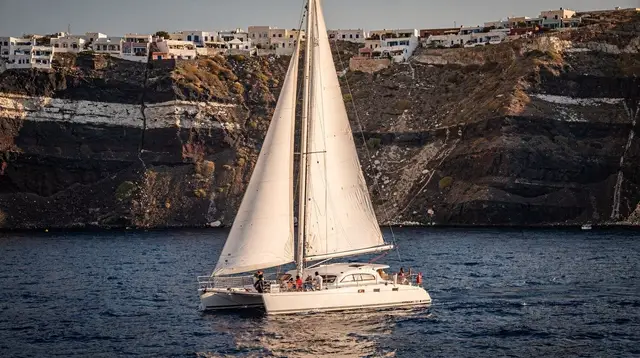
I usually end a visit to Akrotiri by going back up to the caldera rim, or better, out onto the water where you can see the whole crescent of cliff that the eruption left behind. Seeing the size of what was displaced, from a boat looking back at Santorini’s caldera walls, makes the emptiness under that roof a few kilometres away feel less like an archaeological footnote and more like the edge of something genuinely enormous.
If you want that view for yourself, most sunset and daytime sailings out of the old port pass close enough beneath the caldera cliffs to give you the same sense of scale, whether you take it as a daytime cruise around the caldera, a sunset cruise along the cliffs, or, if you’d rather have the deck to yourself, a private yacht sailing past the volcanic islets.
If you’re planning the visit itself, the practical details, opening hours, entry price, what to expect from the covered site, live on the Akrotiri destination page rather than here. This piece was only ever about the one question the ruins keep asking without quite answering.
A wider picture of the eruption
Akrotiri is one piece of a much larger event, and it helps to see how the others fit around it. The caldera itself, the crescent of cliff that Fira, Firostefani, Imerovigli and Oia are all built along, is the physical scar left by the same eruption; I’ve laid out how it formed, piece by piece, in a separate explainer on the caldera’s formation. The Museum of Prehistoric Thera in Fira holds many of the frescoes lifted from Akrotiri’s walls, which is worth knowing before you go, since the site itself shows you the rooms and the museum shows you what was painted on them.
It’s also worth being clear about what Akrotiri is not. It has nothing to do with Ancient Thira, the Dorian hilltop city between Kamari and Perissa on the ridge of Profitis Ilias — that city came many centuries later and was never touched by the Bronze Age eruption. And the popular link between Santorini and Atlantis, which visitors ask about constantly, is a nineteenth and twentieth century idea layered onto this history rather than a conclusion the archaeology itself supports; I’ve dealt with that claim on its own terms in the Atlantis question.
None of that changes what stays with me most about Akrotiri: not the volcano, not the myth, but the plain fact that when archaeologists finally reached the rooms under the ash, the people who had lived in them were already gone. Whether you come to Santorini for the caldera views from Oia, the wine at Santorini’s vineyards, or the walk from Fira to Oia along the caldera path, it’s worth giving the excavated town under Santorini’s south coast an hour of quiet attention. It’s one of the only places on the island where the story isn’t about what the eruption destroyed, but about who it apparently didn’t catch.
Questions people ask about Akrotiri’s missing population
Why have no human remains been found at Akrotiri?
No skeletons have turned up in decades of digging, and the valuables people would normally have grabbed in a panic are largely missing too. The standard reading is that the town was evacuated, probably in stages, before the eruption that buried it.
How do we know people left before the eruption, and not during it?
Foreshocks seem to have damaged buildings before the ash fell, and some of that damage was already being repaired when the eruption came. That sequence, tremors, then patched walls, then burial, reads as a population reacting to a warning rather than being caught by surprise.
When exactly did the eruption happen?
There is no agreed exact date. Radiocarbon dating points to around 1600 BC; Egyptian and Aegean archaeological chronologies favour a date roughly a century later. Both camps have defended their numbers for decades, and this piece uses “around 1600 BC” precisely because a firmer date would be dishonest.
Could people have survived if they stayed?
Almost certainly not through the main eruption itself, which buried the town under many metres of pumice and ash. The absence of bodies is usually read as evidence people left in the run-up to it, not that they survived it in place.
Is Akrotiri the same site as Ancient Thira?
No. Akrotiri is the Bronze Age Minoan town on the south coast, sealed by the eruption. Ancient Thira is a much later Dorian city on the Mesa Vouno ridge between Kamari and Perissa, with no direct connection to the Minoan settlement or its eruption.
Where did the people of Akrotiri go?
Nobody knows for certain. No mass grave or resettlement site tied specifically to Akrotiri’s population has been identified, which is itself part of why the town’s emptiness feels so open-ended rather than simply solved.
tours.Explainer
Verified deep-linked GetYourGuide tours. Book through these links and we earn a small commission at no cost to you.
GetYourGuide does not provide a product photo for this activity — the image shows the meeting point, photographed by us.