Climbing the 588 Steps to Fira
Deciding not to take the cable car
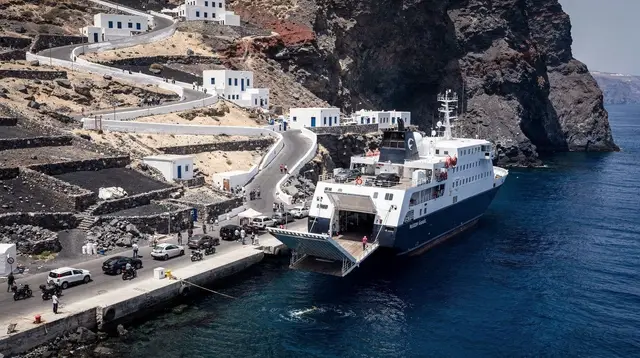
I made the decision at the rail of a tender boat, watching the cliff go from a grey smudge to something that actually had a shape: switchbacks cut into rock the color of a bruise, a string of white cubes at the top that would turn out to be Fira. My cruise had docked out in the bay — most do, since Skala, the old port under the town, only takes tenders and excursion boats, never the big ships themselves. From the jetty there are exactly three ways up: the cable car, a donkey, or your own legs on 588 stone steps. I had a few hours before my boat back out for the afternoon light, and I wanted to feel the cliff instead of being lifted over it.
So I skipped the queue for the cabins entirely and started walking.
What the steps are actually like
The number gets repeated everywhere — 588 — as if it were a fact you could plan around, and in a narrow sense it is. What it does not tell you is the grade. The lower third, right off the jetty, is steep and switches back on itself in tight turns, worn smooth and slightly rounded by more than a century of hooves and shoes. It is also, by ten in the morning, covered in donkey droppings and not always shaded, so the smell and the footing both take some getting used to before the path settles into a rhythm.
Higher up, past the halfway mark, the incline eases and the town starts closing in overhead — laundry lines, a chapel dome, the underside of someone’s terrace. That part felt less like exercise and more like arriving somewhere on foot the way people always used to, which is exactly what I’d come down there for.
I stopped counting steps around three hundred and just counted switchbacks instead. It took me a little under fifty minutes with two water breaks, in early September heat that was already uncomfortable by nine. Fitter people do it faster; nobody does it fast in July.
The donkeys, honestly
I want to be straightforward about the animals, because a lot of what circulates online is either outraged or dismissive, and neither matched what I saw. There is no ban on donkeys or mules working the path — that claim shows up constantly and it is simply not true. What does exist is a weight limit introduced in 2018, after years of pressure over animal welfare, and a tightening of the wider rules was being discussed for the 2026 season on top of that.
Walking past them, some animals looked tired, some looked bored, most looked fine. The handlers know the route and the limit is enforced with scales at the loading point, not left to guesswork. I didn’t ride one, partly because I wanted the walk and partly because I’d rather make that call with the current rules in front of me than with an opinion I formed before I arrived. That’s really the only honest position I can offer: read what the limit is when you book, decide for yourself, and don’t let anyone — including me — moralize you into or out of it.
Cable car, donkey, or feet — what actually differs
None of these options is wrong. They just trade different things.
| Way up | Rough time | What you’re trading |
|---|---|---|
| Cable car | About 3 minutes | Fastest, weather-independent, queues badly at peak cruise hours |
| Donkey / mule | 20–30 minutes | No walking effort, but you’re on a working animal on a steep, narrow path |
| On foot (588 steps) | 30–60 minutes | Slowest and hottest option, but it’s the only one that lets you actually see the cliff |
Fares for the cable car and the practicalities of timing it against your ship’s schedule belong on a different page — I’m not going to guess numbers here. What I can tell you from having done all three routes on separate visits is that the steps are the only way to actually watch Fira arrive above you, one terrace at a time, instead of skipping straight to it.
Timing it so it doesn’t wreck you
If I did it again — and I will, next time I’m off a ship at Skala — I’d start earlier. By the time I reached the top the midday sun was flattening every shadow on the caldera and I wanted nothing more than a cold drink in the shade of Fira’s main square. Morning, before nine, or the couple of hours before sunset when the boats are heading back out, are both far more forgiving than noon.
Carry more water than feels necessary. Wear shoes with actual grip, not sandals — the stone is polished and occasionally wet with donkey traffic. And don’t schedule anything tight immediately after; I needed a proper sit-down before I could enjoy Firostefani’s quieter lane along the rim.
Why I’d still recommend it
The steps aren’t the practical choice. They’re the slow one, the hot one, the one that leaves your calves complaining the next day. But they’re also the only route that puts you inside the cliff instead of over it — close enough to touch the same rock that early visitors and traders climbed for centuries before anyone strung a cable car up it in the 1980s.
If you’re arriving by cruise and only have a morning, I’d still say try the cable car up and consider the steps down, so gravity does the harder work. If you’ve got a full day, walk both directions once and you’ll understand the town’s geography — the caldera path toward Imerovigli and the rock of Skaros — in a way that no viewpoint photo quite explains.
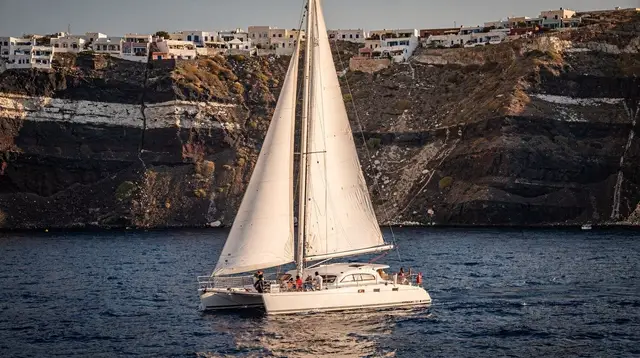
Later that same afternoon, back on the water, I watched the cliff from the deck of a sunset cruise along the caldera and picked out the exact switchback where I’d stopped to catch my breath. It’s a strange, satisfying thing, recognizing a staircase from the sea. If your schedule allows a full loop of the caldera by boat rather than just the climb, a day cruise around the caldera and volcanic islets covers the water side of the same landscape you’ll have just walked above.
FAQ: walking the 588 steps in Fira
Are the 588 steps the same as the cable car route?
No. They run alongside each other on the same cliff face between Fira’s old port and the town, but the steps are the older, original path and the cable car is a separate installation added later. You can take either one independently.
Is riding a donkey up the steps banned?
No, there is no ban. A weight limit for riders was introduced in 2018, and a further tightening of animal-welfare rules was under discussion for the 2026 season. Whether to ride one is a personal choice, not a rule you need to work around.
How long does it take to walk the 588 steps?
Around 30 to 60 minutes for most people, depending on fitness, heat, and how many photo stops you take. Cruise passengers with a tight window should budget on the longer end and add time to rest at the top.
Is it safe to walk down instead of up?
Yes, and many people find it easier on the legs, though the stone is polished by decades of hooves and can be slippery in places. Sturdy, closed shoes matter more than direction.
What’s the best time of day to attempt it?
Early morning before roughly nine, or the couple of hours before sunset when cruise traffic is heading back to the boats. Midday in July or August is genuinely hard going, with no shade for most of the route.
Do I need to book anything to walk the steps?
No booking is needed for the steps themselves — they’re a public path, free to use in either direction, at any hour.
Can I combine the steps with a boat tour?
Yes. Plenty of visitors walk up or down from Fira old port as part of a morning ashore, then join a caldera cruise or sunset sailing later the same day from the same jetty.
Where do the steps actually start and end?
They start at the base of the cliff by the old port jetty in Skala and end in the streets of central Fira, near the top cable car station and main square.
tours.Reportage
Verified deep-linked GetYourGuide tours. Book through these links and we earn a small commission at no cost to you.
GetYourGuide does not provide a product photo for this activity — the image shows the meeting point, photographed by us.