Santorini vs Naxos: Should You Add a Second Island?
Is Naxos worth adding to a Santorini trip?
Yes, for travelers who want village-to-beach walking distance and a slower pace. Naxos sits roughly ninety minutes from Athinios by fast ferry, and unlike Fira or Oia, its main town and coastal villages open directly onto sandy beaches. It complements Santorini rather than duplicating it.
What Naxos Adds That Santorini Doesn’t Have
Santorini’s identity is the caldera: a crescent of cliff-top villages looking down into a flooded volcanic crater. It is dramatic, but it comes with a structural limit that catches first-time visitors off guard. Fira, Oia, Firostefani, and Imerovigli sit two to three hundred meters above the water with no direct shoreline access at all. The beaches on Santorini — Kamari, Perissa, Vlychada — are on the opposite side of the island, volcanic black or red sand that heats up fast underfoot, reached by road rather than by a walk down from your hotel.
Naxos works differently. It’s the largest island in the Cyclades, sitting in the group’s geographic center, and its main town and several of its coastal villages open directly onto long, pale sand beaches. You can walk out of a guesthouse in Agios Georgios and be in the water in a few minutes. That single difference — beach access built into the geography of the towns themselves rather than requiring a drive — is the practical reason travelers add Naxos to a Santorini itinerary.
This page compares the two islands specifically for that decision: not which is “better” in the abstract, but whether Naxos is worth the ferry crossing for your particular trip.
The Ferry Connection
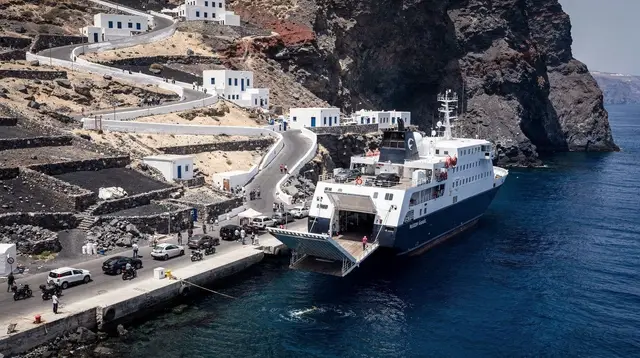
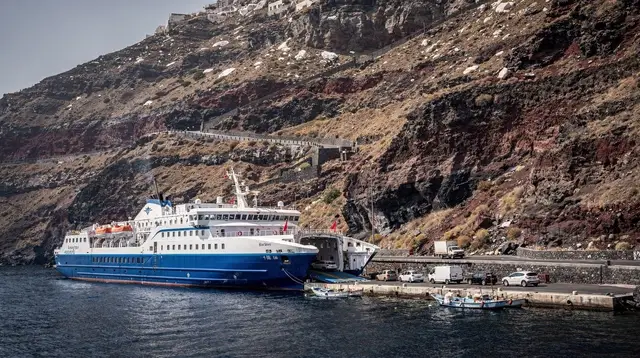
Naxos is reached from Athinios, Santorini’s only ferry port, on the same high-speed catamarans and conventional ferries that serve the rest of the central Cyclades. The crossing runs roughly an hour and a half on the faster boats, though schedules shift by season and operator, and a conventional ferry will take noticeably longer. Treat any duration you read, including this one, as an estimate rather than a timetable — always check the current schedule before booking, since sailings are reduced in winter and can be affected by wind.
For a full breakdown of routes, operators, and how to book, see the combined ferry ticket and hotel transfer to Naxos, which bundles the crossing with pickup on either end — useful if you’d rather not manage port logistics with luggage in the Athinios crowd. Our general Santorini ferry guide covers the port itself, and island hopping from Santorini lays out how Naxos fits into wider Cyclades routes.
Travelers building a longer multi-island trip from Athens rather than starting on Santorini sometimes prefer to sequence the islands differently; the Athens-based island-hopping itinerary covering Santorini, Naxos, and Mykonos is built around exactly that starting point.
Santorini vs Naxos at a Glance
| Santorini | Naxos | |
|---|---|---|
| Landscape | Volcanic caldera, cliff-top villages | Mountainous interior, fertile valleys, coastal plains |
| Beach access | From villages away from the caldera, reached by road | Often walkable from town and coastal villages |
| Sand color | Black or red, volcanic, hot underfoot | Pale gold, softer underfoot |
| Signature view | Caldera and sunset from Oia or Imerovigli | Portara ruin at the harbor entrance, mountain villages |
| Crowds | Heavy in the caldera villages, especially midday | Noticeably quieter, even in peak season |
| Prices | Higher, especially caldera-view hotels | Generally lower |
| Wine and archaeology | Assyrtiko vineyards, Akrotiri | Kouros statues, Venetian-era kastro in Naxos Town |
| Best for | Views, photography, wine, dramatic scenery | Beaches, hiking villages, a slower pace |
Neither column is a downgrade of the other — they’re different islands built on different geology, and the comparison only matters if you’re deciding how to split your time.
Who Should Add Naxos
Naxos suits a specific kind of traveler more than a universal one. It’s a strong add if:
- You’ve spent three or more days in Santorini’s caldera villages and want a break from the crowds that build up around Fira and Oia by mid-morning.
- Swimming and beach time matter more to you than clifftop views — Naxos’s beaches are simply easier to use for a full day than anything on the caldera side of Santorini.
- You want to see a working Cycladic interior — olive groves, marble quarries, mountain villages — rather than a coastline shaped almost entirely by tourism.
- Your trip already runs a week or longer, giving you room for at least two nights away from Santorini without feeling rushed.
It’s a weaker fit if you have three days or fewer total. In that case, the ferry crossing and settling-in time on a new island will eat into time you’d otherwise spend seeing Santorini properly. For short trips, our one-day through five-day itineraries generally recommend staying put, and how many days in Santorini walks through that trade-off in more detail.
What You’ll Actually Do on Naxos
Naxos Town (Chora) is the obvious base: a working port with a Venetian kastro above it, narrow lanes to get lost in, and the Portara — a freestanding marble doorway from an unfinished sixth-century-BC temple — framing the harbor entrance. It’s one of the most photographed spots in the Cyclades that isn’t in Santorini or Mykonos.
From town, the nearest beaches (Agios Georgios, then Agios Prokopios and Agia Anna further south) are a short walk or a five-to-ten-minute local bus ride, and they stay busy but rarely feel as saturated as Fira or Oia do at midday. Renting a car for a day opens up the mountain villages — Halki, with its old distilleries and the Venetian towers scattered around it, and Apiranthos, built from marble with narrow paved streets that keep it cool even in August.
Naxos is also the practical hub for reaching smaller, quieter islands further into the central Cyclades — Paros and its port town are a short hop away — if your itinerary stretches further than a two-island trip. Our Cyclades island-hopping routes guide covers how to sequence Naxos with Paros or beyond without wasting days on transfers.
Getting Around Without a Rental Car
Transport shapes how much you actually see once you’re off the ferry. On Santorini, the KTEL bus network runs from the main terminal in Fira out to Oia, the beaches, and Akrotiri, though timetables thin out sharply outside July and August. Renting a car or scooter is the usual workaround for reaching villages the buses skip, and our guide to car and scooter rental in Santorini covers licensing rules and where deposits tend to get inflated. ATV and quad rentals are heavily advertised around Fira and Oia, but they carry a higher accident rate than a car or scooter — see the real risk behind ATV and quad rental before booking one just because it looks cheaper.
Naxos runs on a simpler model. A local bus connects Naxos Town to Agios Georgios, Agios Prokopios, and Agia Anna roughly every twenty to thirty minutes in summer, dropping to a handful of runs a day outside the season, which covers most travelers who stick to the coast. Reaching Halki or Apiranthos in the mountains still means renting a car for the day, since the bus network doesn’t extend far inland. Travelers with mobility limitations should weigh the terrain difference too: Santorini’s caldera villages involve steps and steep, uneven lanes that our accessibility guide covers in detail, while Naxos Town and its beach villages are largely flat and easier to navigate on foot or by wheelchair.
What Stays the Same: The Case for Just Santorini
None of this is an argument that Santorini needs fixing. The caldera view from Imerovigli or the walk along the Fira-to-Oia path is not something Naxos replicates, and a lot of travelers come to Santorini specifically for that landscape and nothing else. If your priority is the sunset, the wine, and the caldera itself, staying on Santorini and filling extra days with a catamaran sunset cruise along the caldera or a full-day caldera cruise to the volcanic islets may serve you better than a ferry crossing and a new hotel check-in.
The decision comes down to what you’re missing on Santorini. If it’s beach time and a quieter pace, Naxos answers that directly. If it’s more caldera, more wine, or more of the volcanic landscape itself, that’s better spent staying put — our Santorini beaches guide and wine tasting guide cover how to get more out of the island you’re already on.
A Simple Way to Split the Days
For a one-week trip built around both islands, a common split looks like:
| Days | Where | Focus |
|---|---|---|
| 1–4 | Santorini | Caldera villages, sunset, wine, a volcano and hot springs cruise |
| Ferry | Athinios → Naxos | Roughly ninety minutes by fast ferry |
| 5–7 | Naxos | Naxos Town, beaches, a day in the mountain villages |
This mirrors the structure in our Santorini and Naxos one week itinerary, which adjusts the split for travelers who want more beach time versus more caldera time. Shoulder-season travelers (late April into May, or September into October) tend to get the best of both — see Santorini’s weather month by month for how conditions shift across the year on both islands, since the meltemi wind that affects Santorini’s boat trips in July and August reaches Naxos too.
Booking the Crossing
However you split the week, book the ferry leg in advance during July and August, when the fastest sailings sell out days ahead. The Santorini-to-Naxos ferry ticket with hotel transfer handles both the crossing and the pickup on either side, which removes one of the more stressful parts of island hopping — finding transport at an unfamiliar port with luggage in hand. Outside peak season, tickets are easier to arrange closer to your travel date, though even then it’s worth confirming the schedule rather than assuming a fixed departure time, since routes are reduced from November through March.
Naxos and the Rest of Your Trip
Naxos doesn’t need to be an isolated add-on. If your route already includes Athens, or you’re building a longer Cyclades trip, it slots naturally between Santorini and islands further north. Travelers starting from the mainland sometimes prefer to sequence things the other way — Athens first, then Santorini, Naxos, and on to Mykonos — which is the structure behind the multi-island itinerary linking Athens, Santorini, Naxos, and Mykonos.
Whichever direction you travel, the core decision doesn’t change: Santorini gives you the caldera, the sunset, and the wine; Naxos gives you beaches you can walk to and a noticeably slower island. Most travelers who add Naxos to a Santorini trip are not choosing one over the other — they’re using the roughly ninety-minute ferry to get a fuller, more balanced week out of the central Cyclades than either island offers alone.
Naxos vs Santorini: Common Questions
Is Naxos worth adding to a Santorini trip?
Yes, if you have more than four or five days and want a change of pace. Naxos trades caldera views for walkable beaches, a working agricultural interior, and lower prices. It suits travelers who found Santorini’s crowds or clifftop layout tiring.
How long is the ferry from Santorini to Naxos?
Around ninety minutes on the faster high-speed catamarans from Athinios, longer on conventional ferries. Exact schedules and durations change by season and operator, so treat any figure as an estimate and check the current timetable before booking.
Does Naxos have better beaches than Santorini?
Santorini’s beaches are volcanic, dramatic, and mostly reached from villages perched above them, since the caldera side has no shoreline at all. Naxos has long stretches of pale sand that begin right at village edges. Neither is objectively better; they’re different kinds of coastline.
Can you visit Naxos as a day trip from Santorini?
It’s possible but tight. With roughly ninety minutes each way plus transfers, a single day leaves only a few hours on Naxos itself. An overnight stay of at least one or two nights gives a much fairer sense of the island.
How many days should I spend in Naxos after Santorini?
Two to three nights is a common minimum: one day for Naxos Town and the nearest beaches, another for the mountain villages or Naoussa in neighboring Paros. Longer stays suit travelers who want to slow down after Santorini’s pace.
Is Naxos cheaper than Santorini?
Generally yes, particularly for accommodation and dining outside the peak weeks of July and August. Naxos draws fewer cruise passengers and has more locally run guesthouses, which tends to keep prices lower than Santorini’s caldera-view hotels.
What’s the best month to combine Santorini and Naxos?
Late April through May, or September into October, when ferries run full schedules, the sea is warm enough for swimming, and neither island is at its most crowded. Midsummer works too but expect higher prices and the meltemi wind on both islands.
Popular Santorini experiences on GetYourGuide
Verified deep-linked GetYourGuide tours. Book through these links and we earn a small commission at no cost to you.
GetYourGuide does not provide a product photo for this activity — the image shows the meeting point, photographed by us.