The Island That Drinks the Sea
I only put it together on my third trip. I’d been drinking bottled water in Santorini for years without asking why, the way you do on any Greek island, and it took a taverna owner in Vothonas topping up my glass from a plastic bottle rather than the tap for me to actually ask the question out loud. His answer was short: there’s no water here. Not “the tap water is bad.” No water. No river on the whole island, no spring worth naming, nothing underground you could sink a well into and expect much back. Everything that comes out of a Santorini tap has been pulled out of the sea a few hours earlier.
That single fact reorganizes a lot of what you notice on Santorini once you know it.
A crescent of rock with nothing to hold water
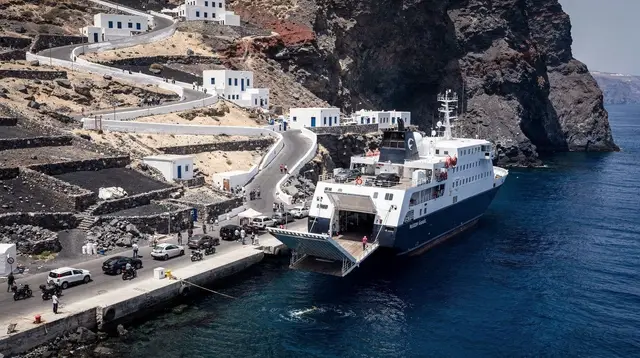
Santorini isn’t really an island in the usual geological sense — it’s the surviving rim of a caldera, the collapsed shell left after a Bronze Age eruption blew the center out of what used to be a single round volcano. That history is everywhere if you go looking for it, from the sheared cliff faces of the caldera to the black cone of Nea Kameni sitting in the flooded crater.
But it also means the island has almost no soil depth, no real watershed, and no impermeable rock layer to hold an aquifer. Rain falls in winter, runs straight off the slopes or evaporates in the summer heat, and there is nothing underneath to catch it. Compare that to somewhere like Naxos, which has actual mountains and rivers and grows its own produce at scale — Santorini simply isn’t built that way, and I think that contrast is worth sitting with before you get here.
So there’s no river, no lake, no spring you could point a hiking trail at. The monastery on Profitis Ilias, at the island’s highest point, isn’t near a source either — nobody built a well up there because there was never anything to find. Whatever civilization has done on this rock for three thousand years, it has done without a dependable freshwater supply of its own.
Where the water in your glass actually comes from
Today, that gap is filled by desalination. Seawater is pumped in, pushed through reverse-osmosis membranes, and turned into something the pipes can carry — and that is what flows out of every tap on the island, hotel or house alike. It’s a genuinely impressive bit of infrastructure that lets a rock this dry support tens of thousands of visitors a night in August.
It is also, chemically, still seawater with the salt mostly but not entirely removed, which is exactly why it tastes the way it does: faintly briny, a little metallic, not what your mouth expects from water. It’s perfectly potable — I want to be clear about that, because I’ve heard visitors repeat the opposite as fact, and it isn’t — but potable and pleasant are two different things, and the desalinated water clears the first bar without coming close to the second.
That’s why you’ll see locals filling bottles at the supermarket refill machines, why most kitchens keep a separate jug for drinking, and why almost nobody — resident or visitor — actually drinks straight from the tap here even though they safely could. It’s a habit built entirely around taste, not safety, and once someone explains that to you it stops feeling like a mystery and starts feeling like a fairly reasonable adaptation to living on a volcano.
Why this matters more the longer you stay
If you’re here for a single day off a cruise ship, none of this touches you much — you’ll drink bottled water without ever wondering where it came from, same as anywhere. But it starts to matter once your stay stretches past two or three nights, which is where I’d point anyone planning how many days to spend in Santorini rather than treating the island as a photo stop.
A longer stay means more laundry, more showers, more ice, more of everything a desalination plant with a fixed daily output has to cover — and in the peak of summer that output gets stretched thin across an island whose population multiplies several times over with visitors. Pools are the biggest single draw; a private plunge pool at a caldera hotel refills constantly against evaporation in the meltemi wind and the dry heat, and every liter of that is desalinated seawater too.
None of this means you should feel guilty about a shower. It does mean that a week here uses meaningfully more of a genuinely scarce local resource than a week somewhere with an actual river, and it’s a fact I’d rather hand you plainly than let you find out by accident from a hotel water bill or a bemused local, the way I did.
It also explains a few things that otherwise look odd on arrival: why hotels post gentle signs about towel reuse that aren’t just cost-cutting, why so few places grow their own vegetables the way you’d see on Naxos or Paros, and why the Assyrtiko vines here survive entirely on dew and sea humidity rather than irrigation — the same absence of fresh water that shapes your shower shapes the island’s most famous wine.
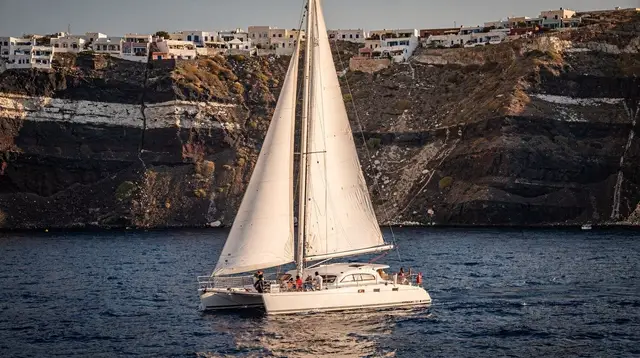
a catamaran day out with lunch and drinks included is, oddly, the easiest way to feel the flip side of this whole story: an island that can’t hold a drop of its own rain sitting in the middle of an enormous, undrinkable sea. Watching the caldera cliffs from the water, after you’ve spent a few days thinking about where your tap water comes from, gives the whole geography a different weight.
What to actually do with this, practically
None of this should change your plans. It should just change a couple of small habits. Bring or buy a refillable bottle rather than working through a case of plastic — most accommodation and several cafés now offer filtered refill points, part of a slow but real shift the island is making, and it fits neatly into a broader Santorini packing list if you’re building one anyway. Don’t panic about brushing your teeth or washing salad in tap water; it’s safe. And if a day out on that same undrinkable sea is already on your list, book a catamaran trip with lunch and drinks on board ahead of time — in high season, boats fill fast.
Do notice, if you’re staying a week and building out an itinerary like Santorini without a car or a full one week in Santorini plan, that a private pool and daily long showers are a real cost to a system running near capacity in August — not a moral failing, just a fact worth knowing, the same way you’d note that the island empties out by November once the desalination-heavy season winds down.
I still order bottled water at dinner here, same as everyone else at the table. But I no longer think of it as a quirk of Greek island life — I think of it as the most honest fact about Santorini that nobody puts on a postcard: a place this beautiful, sitting on this much sea, and unable to drink a drop of it without machinery.
Santorini’s water supply, answered directly
Is the tap water in Santorini safe to drink?
Yes. It is desalinated seawater and officially potable, but it tastes brackish and mineral-heavy, which is why most residents and hotels default to bottled water for drinking.
Why doesn’t Santorini have any rivers or springs?
The island is the volcanic rim of a collapsed caldera with almost no soil depth or catchment area, so rainfall runs off or evaporates instead of forming an aquifer. There is no natural, exploitable freshwater source on Thira.
Where does Santorini’s water actually come from?
Almost all of it is produced on-site by desalination plants that turn seawater into potable water, supplemented in places by water shipped in by tanker during peak summer demand.
Should I drink the tap water to save plastic?
You can — it won’t make you ill — but expect a salty aftertaste strong enough that most people still prefer bottled or a refillable bottle filled from a filtered dispenser where hotels offer one.
Does a long stay use more water than a short one?
Yes, and pools, laundry, and long showers are the biggest single-stay draws on a desalination system with fixed daily output, which is one reason water use gets more visible the longer you stay.
Is this related to the 2025 earthquake swarm?
No. The water supply and the seismic swarm are separate subjects; desalination has been the island’s only source for decades, long before the 2025 seismic activity, which has since ended.
Do the surrounding islands have the same problem?
Most small Cycladic islands share it to some degree, but Santorini’s case is sharper because of its volcanic geology and its visitor numbers relative to its size. If you’re comparing options, an accessibility-focused planning guide or a look at what things actually cost here will flag other island-specific quirks worth knowing before you book.
tours.Explainer
Verified deep-linked GetYourGuide tours. Book through these links and we earn a small commission at no cost to you.
GetYourGuide does not provide a product photo for this activity — the image shows the meeting point, photographed by us.