How Assyrtiko Survives Without Rain
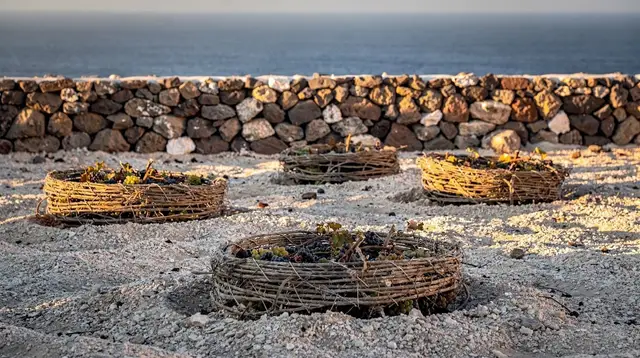
The first time someone pointed out a Santorini vineyard to me, I didn’t believe it was one. I was looking for rows, trellises, something upright and orderly. Instead I saw what looked like a field of low, dark baskets sitting directly on grey volcanic gravel, no stakes, no wires, nothing green above knee height. It took a friend who pours wine for a living to explain that I was looking at some of the most stubborn vines in Europe, and that the basket shape was the whole trick.
That shape has a name: kouloura, which just means “coil” or “wreath” in Greek. Growers take a single vine and wind its cane around itself in a spiral until it forms a low, dense basket, almost like a nest woven from wood instead of grass. The growing tips and eventually the grape clusters end up tucked inside that woven wall, close to the ground, sheltered on every side. It looks decorative from a distance. It isn’t. It’s survival architecture for a plant living somewhere it has no business surviving.
An island with no water to give it
Santorini has no rivers, no lakes, and no usable aquifer, a scarcity that’s obvious to anyone who steps off the ferry at Athinios port and heads straight for a shop to buy water instead of trusting the tap. What comes out of the tap is desalinated seawater, drinkable but faintly briny, and locals mostly drink bottled water rather than trust it for cooking or coffee. That’s the domestic story. The vineyard story is harder still, because unlike a hotel or a household, a vine can’t truck in what it needs. Rainfall on the island is low and concentrated in a short winter window, and by the time the grapes are filling out in the heat of a Cycladic summer, there’s essentially nothing falling from the sky. No irrigation system runs out to these fields. None is permitted, and more to the point, none would make commercial sense here — the water simply isn’t there to spare.
So the vine does something else. It drinks fog.
The kouloura basket keeps each cluster low and shaded, close to the volcanic soil, where nighttime temperature drops let humidity condense as dew. The sea is never more than a few kilometres away in any direction, and the moisture it throws into the night air settles on that black, mineral-rich ground before the sun burns it off again by mid-morning. The coiled vine catches and holds that moisture around its own fruit like a cupped hand. It’s not much water in absolute terms. It’s enough, because the vine has had centuries to adapt to needing almost nothing else.
I’ll admit the geology plays along in a way that feels almost too convenient. The pumice and ash that blanket Santorini after the Bronze Age eruption — the same layer that entombed and preserved the Minoan town now open to visitors at Akrotiri — drain fast and hold heat, but they’re also porous enough to keep a reservoir of dampness a few centimetres down, out of the punishing sun. Roots go deep and wide searching for it — some Assyrtiko vines on the island are genuinely ancient, decades or even a century old, not unlike the Doric ruins at Ancient Thira on Mesa Vouno, which have outlasted plenty on this same volcanic rock — because there’s no reason to replant something that has already learned exactly how to live here.
What the grape does with that stress
None of this would matter if the wine weren’t good, and it’s the deprivation itself that seems to produce the result people travel here for. Assyrtiko under this kind of stress stays remarkably high in acid even as sugar and alcohol climb in the heat — a combination that shouldn’t really happen together, and doesn’t happen quite the same way anywhere else I’ve tasted. The result is a bone-dry white that smells faintly of citrus and white flowers but tastes distinctly of stone: flint, wet chalk, sometimes a saline note that isn’t subtle once you notice it. People reach for the word “mineral” a lot when they describe it, and for once the cliché earns its keep.
If you want the fuller technical picture of the grape, the acidity, and why it behaves the way it does chemically, that’s better covered on its own page — see Assyrtiko Explained for the deeper dive. What I want to sit with here is just how much of that character traces back to the plant having almost nothing handed to it.
Assyrtiko isn’t grown alone on the island, either, though it dominates. Aidani, a softer, more aromatic white, is often blended in to round out an otherwise severe wine. Athiri does something similar, adding a little more fruit and a little less edge. On the red side, Mandilaria contributes deep colour and firm tannin, while Mavrotragano — nearly abandoned a generation ago and now fashionable again — makes a dark, structured red that surprises people who assumed this was a white-only island. All of them are trained in some version of the same low, coiled shape, for the same reason: there’s no other way to keep a vine alive here through a rainless summer.
Where the dryness ends up in the glass
The most distinctive expression of that survival strategy isn’t even a dry wine. Vinsanto is made from grapes left to shrivel in the sun after harvest, concentrating what little sugar and flavour the vine managed to produce into something thick, amber, and intensely sweet, then aged for years in barrel. Tasting it next to a young Assyrtiko is the clearest way I know to understand the range this one stressed, unwatered plant is capable of — I’ve written more about that wine specifically at /guides/vinsanto-guide/.
Harvest itself happens early here, often from late July into August, well ahead of most of Europe, because the grapes are racing the heat rather than waiting for autumn — worth factoring in if you’re weighing dates against our guide to the best time to visit Santorini.
Tasting it without overthinking it
You don’t need to understand any of the above to enjoy a glass on a terrace above the caldera at sunset — one of the best sunset spots beyond Oia does the job nicely — and most visitors don’t try to. But if you do want to taste several side by side and actually compare technique and style, a proper tasting does more than any explanation.
I’ve laid out how the island’s producers differ — cooperative versus family estate, cliffside tasting room versus working winery — on /guides/santorini-wineries-compared/, and a broader primer on how to structure a tasting visit sits at /guides/santorini-wine-tasting-guide/. For the vineyards themselves rather than the wine, /destinations/santorini-wineries/ and the villages around /destinations/pyrgos/, /destinations/exo-gonia/, and /destinations/vothonas/ are where most of the kouloura fields actually sit, within sight of the caldera edge.
Getting between them without a rental car is entirely doable — our guide to Santorini without a car covers the bus and taxi logistics — though plenty of visitors rent an ATV or quad instead to cover the inland roads at their own pace. Anyone travelling with limited mobility should check our notes on accessibility in Santorini before picking a winery, since several sit on uneven gravel with no paved path from the car park.
Oddly, one of the best ways to appreciate what these vines are working against is to leave the vineyard entirely and get out on the water, looking back at the island the way the eruption left it. A Santorini day cruise around the caldera puts the whole volcanic rim in view at once — the same black rock and thin soil the vines are rooted in, seen from a distance where the scale of the deprivation is obvious. Some travellers prefer renting a boat in Santorini without a licence and setting their own course around the caldera instead of joining a group, which works just as well for taking in the same rim of rock.
For something quieter and less crowded, a small-group luxury cruise around the caldera covers similar ground at a gentler pace. And if you’d rather save the water view for the end of the day, a guided sunset tour along the caldera villages or a sunset cruise past Oia both let you watch the light change over exactly the terrain that makes this wine what it is. If you’d rather watch that same light from solid ground, our guide to Oia sunset without the crowds covers where to stand before the crowds arrive. None of that requires a wine background. It just helps the glass make more sense afterward.
For more on how that terrain came to look the way it does, /guides/how-the-santorini-caldera-was-formed/ covers the eruption itself, and /blog/the-island-that-drinks-the-sea/ goes further into how the island manages — or doesn’t — without fresh water at all. And for a place to base yourself while you work through a few tastings, /destinations/oia/ and /destinations/imerovigli/ both sit within easy reach of the inland wine villages.
Assyrtiko and dry farming, answered directly
Is Santorini wine irrigated at all?
No. Irrigation isn’t used on the island’s traditional vineyards. The vines rely entirely on soil moisture from dew and sea mist, plus whatever falls during the short winter rains, stored in the porous volcanic ground until summer.
Why are the vines shaped like baskets?
The coiled kouloura shape keeps the grape clusters low, shaded, and enclosed, protecting them from the strong meltemi winds and helping them capture overnight humidity that condenses close to the ground.
Does the lack of water make the wine taste different?
Yes. The vine’s stress tends to concentrate flavour and preserve acidity even as sugar rises in the heat, which is a large part of why Assyrtiko stays crisp and mineral rather than flat or overripe.
Is Assyrtiko the only grape grown on Santorini?
It’s the dominant one, but Aidani and Athiri (both white) and Mandilaria and Mavrotragano (both red) are also grown, usually on the same dry-farmed, low-trained vines.
How old are Santorini’s vines?
Many are decades old, and some are said to be over a century old. Because the vines are ungrafted and well adapted to the island, growers rarely see a reason to replant them.
When is the grape harvest on Santorini?
Earlier than most of Europe, typically from late July through August, timed to beat the peak summer heat rather than to wait out a rainy autumn.
Do I need to visit a winery to understand any of this?
No, but it helps. Seeing a kouloura vine up close, low and coiled on bare volcanic gravel, makes the whole explanation click in a way a glass of wine on its own doesn’t.
Wine Tasting on GetYourGuide
Verified deep-linked GetYourGuide tours. Book through these links and we earn a small commission at no cost to you.
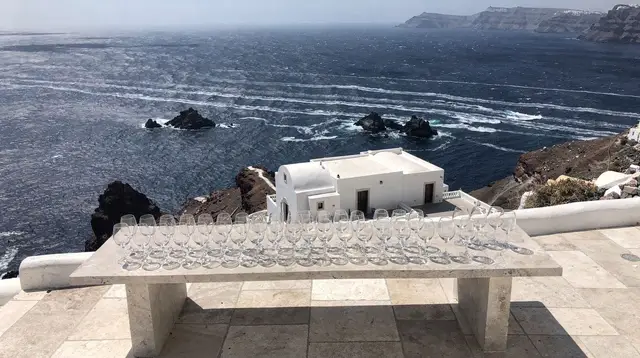
GetYourGuide does not provide a product photo for this activity — the image shows the meeting point, photographed by us.