The Red Beach Problem
I’ve walked out toward Red Beach three separate times over the years, and each time the beach looked a little different — not because the sea had rearranged it, but because the cliff above it had.
A beach defined by the thing above it
Most people picture Red Beach as a color: rust-red rock dropping into blue water near Akrotiri. That’s true, but it undersells what’s actually going on geologically. The cliff is oxidized volcanic ash and loose scoria, stacked in layers that were never meant to hold a footpath. It’s soft. It sheds material constantly, in small amounts you’d never notice and, every few years, in amounts you very much would.
That’s the part that doesn’t make it into most photos: Red Beach isn’t a stable postcard, it’s an active slope. And an active slope with a footpath cut across its base is a maintenance problem that never really gets solved, only managed.
The pattern, laid out plainly
I want to be precise here rather than dramatic, because the story of Red Beach’s access has been told badly in both directions — either as “it’s basically fine” or “it’s basically closed.” Neither has been consistently true. What’s actually happened is a sequence:
| Year | What happened | Effect on access |
|---|---|---|
| 2018 | Rockfall on the cliff path | Path closed, later partially reopened |
| 2023 | Further erosion and rockfall | Path closed again, warning signage added |
| December 2025 | Additional cliff collapse | Access remains partially restricted into 2026 |
Three events in seven years isn’t a freak accident, it’s a trend. The cliff is doing what unstable ash cliffs do, and the path keeps getting caught underneath it.
I’ll say the obvious thing clearly, because I’ve seen it stated wrong online more than once: the December 2025 collapse was not connected to the seismic swarm that shook the wider Santorini-Amorgos area in early 2025. That swarm — over 28,000 tremors across about forty days — never produced an eruption and had wound down months earlier.
What happened at Red Beach in December was ordinary slope failure on ground that was already known to be unreliable. Different mechanism, same headline risk of “Santorini plus cliffs plus falling rock,” which is probably why the two get muddled. If you want the full picture on the swarm itself, separate from beach access, I’ve written about it at Santorini safety and the 2025 earthquakes.
Why “just be careful” isn’t the answer
The instinct, reading about a closed path, is to assume it’s bureaucratic caution — a liability sign, easily ignored by anyone willing to accept the risk themselves. I don’t think that’s the right frame for this particular cliff. Ash and scoria don’t fail gradually with visible cracking the way you’d expect from rock; they let go quickly, often after rain or simply after enough freeze-thaw and wind erosion has undercut a section from below. There’s no reliable warning sign to watch for, which is exactly why restricting the path is a more honest response than posting a sign and hoping people are cautious.
That also means I can’t responsibly tell you “here’s how to do it safely,” because there isn’t a safety technique that beats an ash cliff’s schedule. What I can tell you is how to know where things stand before you go.
What I actually do now
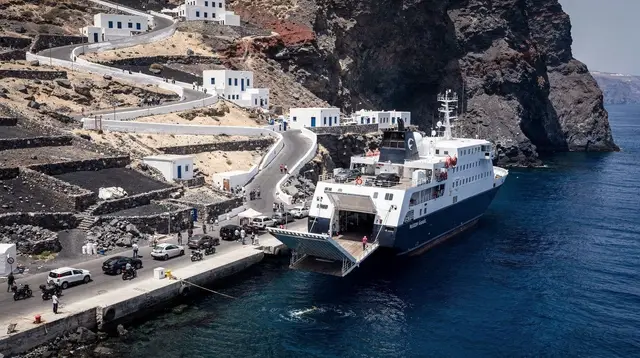
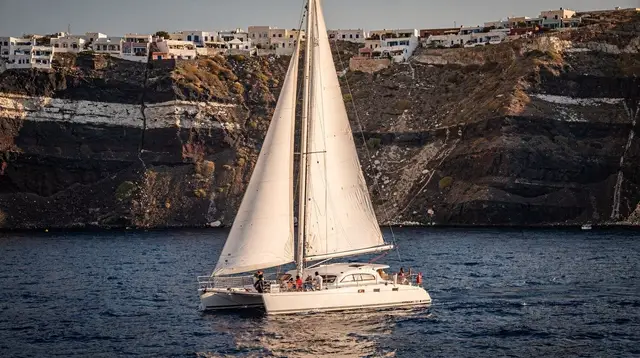
On my last two visits, I didn’t try to walk in from Akrotiri at all. I went by boat instead, on a route that runs along the south coast and slows down in front of the cliff. You see the same rust-and-black striping, from water level, without anyone underneath the unstable section. It’s a genuinely good way to see the beach — arguably a better one, since walking in only shows you the strip of sand, while the boat shows you the whole cliff face and how it drops into the sea.
The Red Beach, Megalochori, and Oia sunset tour is built around exactly that kind of pass-by, paired with a village stop and a sunset finish, so the beach becomes one stop among several rather than the whole point of the day. If you’d rather fold it into a longer day on the water, a full day cruise around Santorini usually swings past the same stretch of coast along with Nea Kameni and Palea Kameni.
If someone tells you flatly that the path is open, or flatly that it’s closed, treat that as a starting point, not an answer. Conditions here have changed multiple times in less than a decade, sometimes within the same season. Check locally — a tour desk in Fira or Akrotiri village, or the operator you’re booking through — before you build a plan around walking in. The practical detail on what to look for, and how the fenced sections tend to be marked, lives on the Red Beach access and safety page; this piece is really about why that caution exists rather than a substitute for checking on the day.
The wider pattern on this coast
Red Beach isn’t the only place on the island where soft volcanic ground meets a footpath. The Fira to Oia caldera path crosses similarly loose material in a few stretches, though nothing at the scale of Red Beach’s repeated collapses. Vlychada, a little further along the south coast, shows the same kind of wind-carved ash cliffs — it’s just that nobody built a path directly beneath them. That contrast is instructive: the risk at Red Beach isn’t that the geology is uniquely dangerous for Santorini, it’s that a walking route happens to run right under it.
For a broader sense of which of the island’s beaches suit a walk-in visit and which are better seen from the water, the Santorini beaches guide lays out the access situation site by site, and Perissa vs Kamari covers the two long, easy, fully open beaches on the other side of Mesa Vouno if you want black sand without any cliff-access question at all.
Where this leaves you
I’d rather tell you plainly that I don’t know exactly what the path will look like on the day you read this than repeat something I read once and never verified. What I do know: the cliff has failed three times since 2018, the most recent as recently as December 2025, and the pattern suggests this isn’t finished. Check before you go. See it from the water if you’re unsure. And if you want the sunset built around a boat rather than a crowd on a clifftop, the Santorini sunset tour takes that route past Red Beach on the way to open water, which has become my own default answer to the whole question.
Beaches on GetYourGuide
Verified deep-linked GetYourGuide tours. Book through these links and we earn a small commission at no cost to you.
GetYourGuide does not provide a product photo for this activity — the image shows the meeting point, photographed by us.