A Week of Meltemi
The first sign was the flags on the terrace in Imerovigli standing straight out from their poles, not moving, not fluttering, just rigid, like someone had starched them. That was Monday, early August, and I had booked a week here with nothing more ambitious planned than swimming, eating, and watching the caldera change colour at the end of each day. By Wednesday I understood I had booked a week with the meltemi instead.
What the wind actually does to a week here
Nobody warns you about the meltemi in the brochure copy, and I understand why — it is not dramatic in the way a storm is dramatic. There is no rain, no thunder, mostly a hard blue sky. It is just a steady, insistent, occasionally violent wind from the north that builds through July and August and does not fully let go until September. Locals talk about it the way people elsewhere talk about a stretch of humidity: an annoyance you plan around, not an event you report on.
My week broke into three kinds of days. Two were calm enough that nothing changed. Three had the wind strong enough to cancel or reroute a boat. Two were strong enough that even walking along the rim of Skaros Rock felt like being shoved sideways every few steps. I had read the meltemi wind explained before I came, so none of it surprised me exactly — but reading about a wind and standing in it for a week are different educations.
The boat that didn’t leave
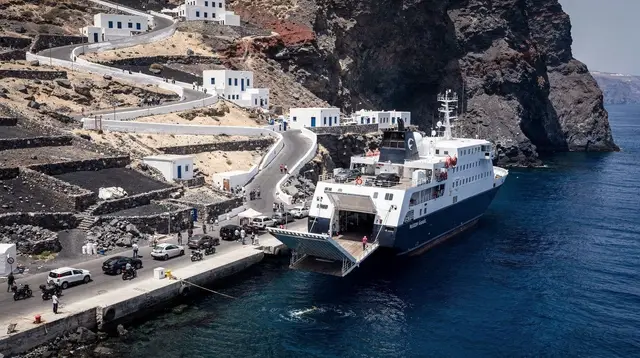
Tuesday morning I had a caldera cruise booked, one of the classic loops out toward the volcano and the hot springs with a sunset stop tacked on. At nine the operator called to say the afternoon slot was being pushed to the following day — nothing personal, the same call was going out to half the boats leaving Athinios and the old port that morning. I’d read enough about how these calls work, from the caldera cruise guide to notes on what to bring on a caldera cruise, to know this wasn’t a fluke: catamarans handle wind differently from the smaller wooden caldera boats, and a gusty forecast bumps the smaller, slower fleet first.
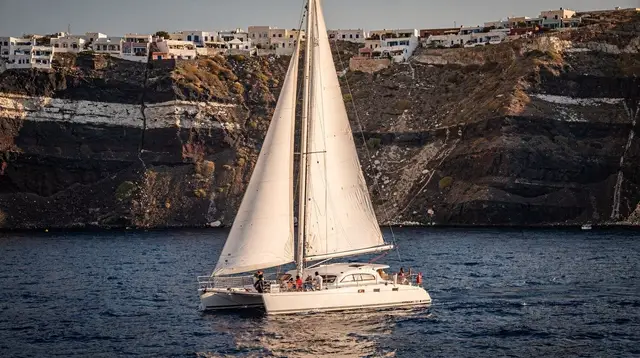
I ended up moving my booking to a sunset sailing on the caldera two days later, once the forecast had eased. It is worth knowing, if you’re weighing options the way I was, that the difference between a catamaran and a sailing boat matters more in meltemi weeks than in calm ones — the wider, more stable catamarans keep running through conditions that put smaller sailboats in the harbour.
If you’re set on chartering something yourself rather than joining a group tour, the same logic applies to renting a boat without a licence: read the day’s flag warnings at the marina before you commit, because a rental office that hands you keys on a red-flag day is not doing you a favour.
The south coast, reconsidered
With the boat off, I drove down to Perissa instead, expecting an easy beach afternoon. It was not that. The black sand was blowing in thin sheets across the shore, stinging bare legs, and the sea had a short, choppy texture that made floating unpleasant rather than relaxing. Kamari, a few kilometres over and slightly more sheltered by the shoulder of Mesa Vouno, was calmer but still nothing like the postcard flat-calm mornings I’d had the previous weekend.
This is the part of a meltemi week nobody puts in the marketing: it is not just about boats. Southern beaches, more exposed to the open sea than the caldera side, get genuinely uncomfortable — sunbeds get parasols blown flat, swimming becomes a workout against a current, and the appeal of lying still in the sun mostly evaporates.
The terrace that empties itself
The other pattern I noticed, and the one that surprised me most, was the caldera terraces. Every restaurant and bar built into the cliff in Oia and Imerovigli has that famous view, and on a calm evening they fill early and stay full. During my windiest days, the same terraces would be busy at lunch and then visibly thin out from mid-afternoon onward, as the wind picked up and made an open-air table less appealing than an indoor one.
Staff at one place told me this happens every meltemi week of the season — nothing unusual, just the rhythm of the wind arriving on schedule most afternoons and pushing people inside or downhill. I ended up chasing quieter, more sheltered spots for sunset beyond the obvious crowd, which had the accidental benefit of also being less exposed to the gusts than the cliff-edge tables everyone else was abandoning.
What I’d tell someone booking July or August
None of this ruined the week — I still got my sunset cruise, still swam, still watched the sky do the thing it does over the caldera in the evening. But I would have planned differently if I’d expected it. A few honest notes, from someone who didn’t:
| What I assumed | What actually happened |
|---|---|
| One boat booking would be enough | I needed a flexible date and a backup day |
| South-coast beaches would be interchangeable | Kamari and Perissa handled the wind very differently day to day |
| Caldera terraces are busiest at sunset | Several emptied out from mid-afternoon in strong wind |
| The meltemi is occasional | It shaped roughly half of my seven days |
If a calmer, more predictable week matters more to you than the peak-season buzz, it’s worth reading about the shoulder season or checking Santorini’s weather month by month before you lock in July or August dates. For anyone still deciding when to come at all, the best time to visit lays out the trade-offs without pretending any single month is perfect.
And if a boat day matters to your trip, build in slack: a full-day caldera and volcano cruise or a land-based sunset tour both give you a fallback that doesn’t depend on sea conditions, and a private evening tour is easier to reschedule around a single traveller’s plans than a fixed group departure.
Questions about a meltemi week in Santorini
Is the meltemi dangerous?
No — it is a strong, dry, seasonal wind, not a storm system. It cancels or delays some boat trips and makes exposed beaches and clifftop terraces less comfortable, but it is a normal feature of a Cycladic summer, not an emergency.
When does the meltemi blow?
Most strongly from July through August, tapering off by September. It is not a year-round wind; outside high summer it is milder and far less disruptive to boats and beaches.
Will my caldera cruise get cancelled?
It might be postponed rather than cancelled outright — operators commonly move a departure to a calmer slot within the same day or the next. Larger catamarans tend to keep running in conditions that ground smaller sailing boats.
Which beaches handle the wind best?
Beaches more sheltered by the coastline, such as Kamari under Mesa Vouno, generally cope better than fully exposed stretches. Conditions still vary day to day, so check locally rather than assuming.
Should I avoid July and August because of the meltemi?
Not necessarily — it’s one factor among several, including heat and crowds. If a calmer trip matters more than peak-season energy, the shoulder months of May and October are worth comparing.
Does the meltemi affect Oia’s sunset?
The sunset itself isn’t affected, but strong gusts can make clifftop viewpoints less pleasant to stand at for an hour beforehand, which is part of why a boat or a more sheltered terrace can be a more comfortable alternative on a windy evening.
How do I know if a day will be windy before I book?
Local forecasts and marina flag warnings are the most reliable short-term signal; operators themselves usually know a day ahead whether they’ll need to adjust departure times.
tours.Reportage
Verified deep-linked GetYourGuide tours. Book through these links and we earn a small commission at no cost to you.
GetYourGuide does not provide a product photo for this activity — the image shows the meeting point, photographed by us.