What the Cruise Levy Actually Changes
Doing the arithmetic on a €20 charge
I keep seeing the same complaint in comment sections under Santorini articles: “they’re taxing cruise passengers now, that’ll sort the crowds out.” I wanted to know if that’s actually true, or if it’s one of those policies that sounds decisive and changes almost nothing on the ground. So I sat down with the numbers instead of the headline.
The mechanics first, because they’re less obvious than they sound. Santorini and Mykonos apply a cruise passenger levy that moves with the season: €20 per person from June through September, €12 in April, May and October, and €4 from November to March. Every other Greek cruise port charges a flatter €5, €3 and €1 across the same three bands. Santorini and Mykonos aren’t following a national schedule here — they’re singled out, at roughly four times the rate everywhere else, because both islands draw a volume of cruise traffic that’s out of proportion to their size.
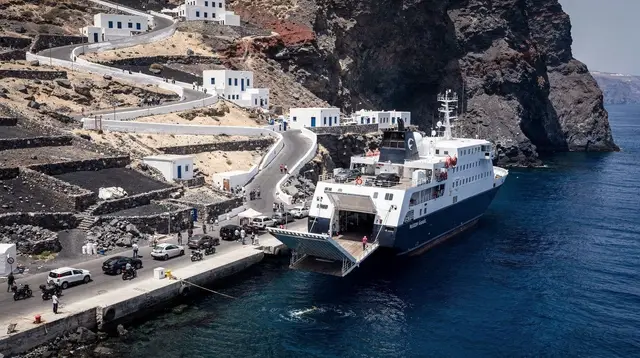
Here’s the detail that trips people up, including me the first time I read about it: nobody collects this at a booth. There’s no line, no turnstile, no cash desk at Athinios where a port officer takes your €20. The cruise line bills it to your onboard account, the same ledger that tracks your drinks package and your specialty dinner reservation, and settles with the port authority separately.
You could disembark, spend six hours in Fira and Oia, and never once see evidence the levy exists. That matters for how I think about its effect: a charge nobody has to physically hand over is a charge that’s much easier to absorb quietly into a fare than one collected in front of you at the gangway.
What the levy actually costs, at scale
Do the multiplication and the levy stops looking small. A mid-sized ship carrying 3,000 passengers on a July call generates €60,000 in levy revenue for that single day’s visit. A larger vessel with 4,500 aboard generates €90,000. Multiply that across a summer with several calls a week and you’re looking at a meaningful new cost line for the cruise operators — not nothing, and not the kind of number a line absorbs without eventually passing some of it forward into fares.
But a cost line on a balance sheet in Miami or Southampton is a different thing from fewer people walking through Firostefani at noon. The levy is priced to be paid, not to be avoided. There’s no threshold above which a cruise line decides Santorini isn’t worth the stop — the island remains one of the most requested Mediterranean itinerary calls there is, levy or not.
The cap is doing the actual work, if anything is
The more interesting lever, to me, is the separate cap of 8,000 cruise passengers per day. That’s a hard ceiling, not a price signal. On a day when the port schedule would otherwise land two large ships totaling 9,000 or 10,000 arrivals, the cap forces a trim — someone doesn’t get to call that day, or numbers are managed down to fit. On an ordinary day with a single ship carrying 2,500 people, the cap is irrelevant because nobody was close to it in the first place.
So the honest read is that the levy and the cap solve different problems. The levy is a revenue mechanism — money that flows to the port authority regardless of how crowded a given day feels on the caldera path. The cap is the actual crowd-control instrument, and even that only bites on the handful of days when scheduling would have stacked ships on top of each other. Most days, neither one changes your experience of the island at all.
What I’d tell someone deciding between a cruise call and a stay
If you’re comparing a single day off a ship against booking a few nights, the levy shouldn’t factor into your decision — it’s baked into your fare or your onboard bill either way, and you’ll likely never see it itemised. What should factor in is timing: on days with heavy ship traffic, Fira and Oia are saturated from roughly 10am to 5pm regardless of what the port authority charges anyone. That crowding pattern predates the levy and will outlast it unless the cap starts binding on far more days than it currently does.
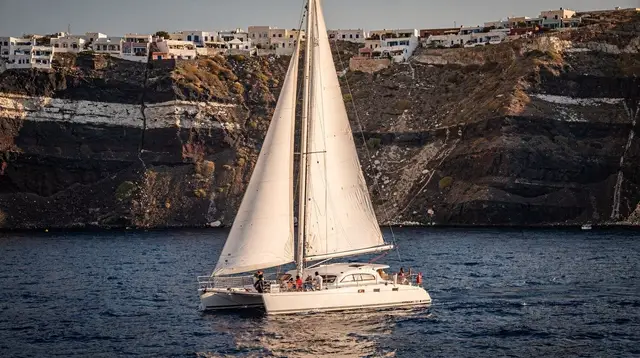
For a day visit, the smartest move I keep recommending is to get off the caldera rim entirely during those peak hours. A caldera cruise puts you on the water looking at the cliffs instead of competing for a photo spot on top of them, which sidesteps the crowding question completely rather than trying to time around it.
If you want the classic run past the volcanic islets and a swim at the hot springs, the standard day cruise around the caldera covers that ground without needing you to plan around ship schedules. Travelling from Crete rather than staying on Santorini itself, the day trip from Heraklion is worth knowing exists, since it reframes the whole “cruise day” question as something you can do from a different island base entirely.
If your one day happens to line up with sunset, a sunset cruise along the caldera solves the Oia crush better than any policy does — you’re watching the cliffs turn colour from the water while everyone else fights for a ledge at the kastro. For a longer, less rushed version of the same idea, the private sunset cruise with a barbecue on board stretches the evening rather than compressing it into a single photo window.
None of this is about dodging a €20 charge you’ll barely notice on your onboard bill. It’s about recognising that the levy and the passenger cap are aimed at the port authority’s books and at the worst-case scheduling days, not at your particular afternoon. For more on what a single cruise day actually looks like logistically, I’d point you to one day in Santorini from a cruise ship and the best shore excursions from the port rather than repeat that ground here.
And if the crowding itself — not the fee structure — is what worries you, what actually happened in Santorini in 2025 and eight thousand a day go further into why the island feels the way it does on a heavy cruise day, cap or no cap.
Questions about Santorini’s cruise levy
How much is the Santorini cruise levy in 2026?
It scales with the season: €20 per passenger from June through September, €12 in April, May and October, and €4 from November to March. Other Greek cruise ports charge €5, €3 and €1 for the same three bands.
Who actually pays the cruise levy — me or the cruise line?
You do, but not at a booth. The amount is added to your onboard account by the cruise line and settled with the port authority behind the scenes, the same way gratuities or drinks packages are billed.
Is the levy the same as an entry fee I pay at the port?
No. There is no turnstile or cash desk for it at Athinios or the old port. That is a different, smaller irritant reserved for Nea Kameni’s landing fee, which is paid in cash on the islet itself.
Does the 8,000-passenger cap mean fewer people in Fira and Oia?
It sets a ceiling, not a target. On a day when two large ships would otherwise land 9,000 or 10,000 people, the cap trims the excess. On an ordinary day with one mid-sized ship, the cap changes nothing because arrivals never approached it.
Why do Santorini and Mykonos charge more than other Greek ports?
Both are named specifically in the levy structure because both draw disproportionate cruise volume relative to their size. The higher rate reflects that imbalance, not a general Cyclades-wide policy — see how the islands compare in Santorini vs Mykonos.
Does the levy affect how much shore excursions cost?
Not directly. It is a port charge on the cruise line, separate from what you pay a tour operator or a boat excursion for the day, and it is not itemised on excursion pricing.
Will the cruise levy stop the crowding at sunset in Oia?
Unlikely on its own. Sunset crowding is driven by land-based day-trippers and overnight guests as much as by cruise arrivals, and the levy does nothing to spread out when people choose to be at the caldera edge — for that, see best sunset spots beyond Oia or plan around it with a full itinerary for a cruise day.
Caldera Cruises on GetYourGuide
Verified deep-linked GetYourGuide tours. Book through these links and we earn a small commission at no cost to you.
GetYourGuide does not provide a product photo for this activity — the image shows the meeting point, photographed by us.