Three Days in Santorini in Winter
Santorini in winter is not Santorini in August with the volume turned down. It’s a smaller island: a working core of Fira, Firostefani, Imerovigli and Oia stays open, the caldera cruises thin out, most wineries shutter until spring, and whole neighborhoods around Kamari, Perissa and Vlychada go quiet until the hotels reopen in April. This itinerary is built for travelers who want that version of the island on its own terms, not a bargain-bin summer. Three days is enough time to see Fira properly, spend a full weather-proof day between Akrotiri and Pyrgos, and give Oia the slow, uncrowded visit it rarely gets between June and September.
A Different Island, Not a Discounted One
The trade-off is straightforward. What you lose in winter is the caldera cruise scene, the full winery circuit, and long café evenings on terraces that close for the season. What you gain is space: no ninety-minute wait for a spot at Oia’s castle before sunset, no queue for the Akrotiri ticket booth, and hotel and flight prices well below the June-to-September peak. Check the shape of the season before you land — see our month-by-month Santorini weather guide — because a January trip and an April one are genuinely different islands.
It’s also worth knowing what happened here in early 2025. A seismic swarm between Santorini and Amorgos began on January 27, ran for roughly six weeks, and produced tens of thousands of small tremors without any eruption. It has since ended and the island is back to normal, but it’s the kind of thing worth reading about once rather than encountering half-remembered on social media; our safety guide covering the 2025 earthquakes lays out the facts plainly.
What Closes Between November and March
| Category | Winter status |
|---|---|
| Fira, Firostefani, Imerovigli, Oia | Open, with a reduced but real core of hotels and restaurants |
| Akrotiri excavation | Open on its normal schedule, under a covered roof |
| Caldera sunset cruises | Mostly paused; a handful of operators run on demand |
| Wineries and tasting rooms | Largely closed; a few open reduced hours |
| Kamari, Perissa, Vlychada beach resorts | Mostly closed until spring |
| KTEL buses | Running, on a thinner winter timetable |
| Nea Kameni and Palea Kameni boat trips | Reduced sailings, weather-dependent |
If wine is the reason you’re coming, this isn’t the trip: build that visit around our high-season Santorini wine itinerary instead, when the domaines and tasting rooms are actually staffed and pouring.
Day 1: Fira and the Caldera Rim, Without the Crowds
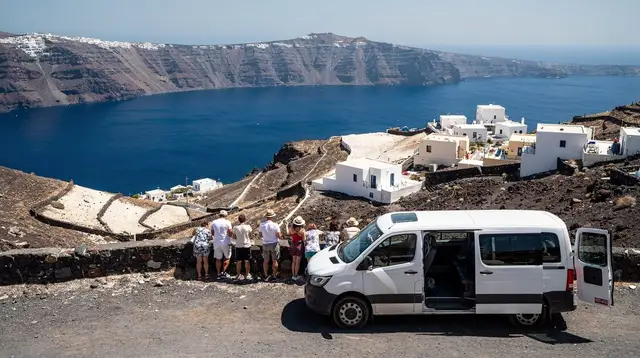
Base yourself in Fira for the first night. Whatever the season, it’s the island’s transport hub, and in winter it’s also one of the few places guaranteed to have restaurants open after dark. Spend the morning walking the caldera-edge path from Fira through Firostefani toward Imerovigli — the same route that’s shoulder-to-shoulder in August is nearly empty in December, and the view of the volcanic islets in the middle of the caldera doesn’t change with the calendar.
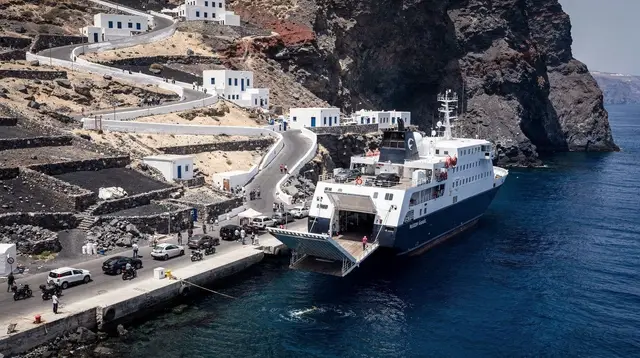
If you’re arriving by ferry through the port of Athinios or flying into JTR, sort out the logistics first; our guide to getting to Santorini covers both routes and how the winter schedules compare with summer. Travelers connecting through the old port at the base of the Fira cliff should also read up on the cable car and the 588 steps before deciding how to get up — in winter wind, the steps and the donkey path are less pleasant options than they sound.
Spend the afternoon in Fira itself: the Museum of Prehistoric Thera holds the frescoes lifted from Akrotiri, and it’s an easy, indoor way to fill a couple of hours if the weather turns. For dinner, stick to the handful of tavernas that stay open through winter rather than gambling on somewhere that looks appealing but is shuttered until April — a quick check on where to stay pays off here too, since not every winter hotel in Fira keeps its own kitchen running; see our guide to where to stay in Santorini for which neighborhoods hold up best off-season.
Travelers short on time, or arriving on a winter cruise call, can cover Fira, Pyrgos and Oia’s highlights in a single guided day instead of spreading them across three: a half-day minibus tour taking in Pyrgos, Oia and Fira’s highlights in one loop is built for exactly that kind of compressed, off-season schedule.
Day 2: Akrotiri’s Buried City and the Hill Village of Pyrgos
This is the day the whole itinerary is built around, because it’s the one day where the weather genuinely doesn’t matter. Akrotiri, the Bronze Age town buried by the same eruption that carved out the caldera around 1600 BCE, sits under a bioclimatic roof that keeps the site open through rain and wind alike. No skeletons have ever been found there, which suggests the population had time to leave before the eruption; walking the preserved streets and stairwells is one of the few Santorini experiences that isn’t weather-dependent at all.
For the background before you go, read our Akrotiri excavations guide, and for a guided walk through the site itself: a guided tour through the excavated city, with a local archaeologist explaining what’s underfoot turns the ruins from an interesting walk into a coherent story.
From Akrotiri, work your way inland to Pyrgos, the island’s old hilltop capital before Fira took over. Pyrgos is one of the clearest winners of an off-season trip: its kastro and tangle of narrow lanes are genuinely quiet even in shoulder season, let alone December, and it’s the one village on the island where you can climb to the top for a full view of Santorini without competing for the spot. Our Pyrgos village guide covers the walk up and what to look for once you’re there. Buses connect Akrotiri, Fira and Pyrgos on the same winter KTEL network, so this whole day is doable without a car — see the next section for the specifics.
Day 3: Oia at Its Own Pace
Save Oia for the last day, and go in the morning as well as the evening rather than only chasing the sunset. In summer, Oia’s blue-domed lanes are so full by mid-morning that walking them is a negotiation; in winter, you can actually see the village — the Byzantine castle ruins, the sea captains’ houses built into the cliff, the path down to Ammoudi Bay — without the crowd that otherwise defines the place.
Sunset is still the reason most people come, but the winter version plays by different rules. The kastro viewpoint that fills up two hours ahead of time in August is far less contested in December, though it’s still worth arriving with margin. Whichever spot you pick, remember the hour itself has moved: sunset falls around 5:15pm in late December, nearly three and a half hours earlier than the roughly 8:50pm sunset of late June. Our guide to Oia’s sunset without the crowds lists the alternative viewpoints that work even better once the castle wall itself isn’t the constraint it is in summer.
For a guided version of the evening, including the walk down to the water at Ammoudi: a private evening tour through Oia down to Ammoudi Bay, timed around sunset covers both halves of the village in one outing. If you’d rather combine Fira, Oia and a shorter transfer window into a single organized run — useful on a short winter day with limited daylight — a minibus tour linking Fira’s highlights with an Oia sunset stop is built around exactly that kind of tight winter schedule.
Getting Around Santorini in Winter
None of this requires a rental car. The KTEL bus network radiates out from Fira’s central station and reaches Oia, Akrotiri and the villages along the way, though the winter timetable runs thinner than the summer one and stops earlier in the evening — check the current schedule the morning you travel rather than assuming last season’s times still hold. Our guide to Santorini’s buses covers routes and frequency in more detail.
Taxis fill the gaps, but the island has only a few dozen of them for the whole of Santorini, so book ahead for early starts or late returns rather than expecting to flag one down. For a fuller planning picture before you land, our general guide to getting to Santorini also covers airport and ferry connections at the winter end of the schedule.
Winter Sunset Times and Why the Schedule Changes
The single most common mistake in planning a Santorini trip outside summer is building the day around a sunset time seen in someone else’s June photos. It doesn’t hold. Late December’s sunset around 5:15pm means dinner starts earlier, afternoon light disappears sooner, and a day trip that runs comfortably in July can end in the dark in December. Build slack into the schedule above rather than assuming an 8pm sunset like the one that defines the island’s high season.
Questions About a Winter Trip to Santorini
Is Santorini worth visiting in winter?
For most travelers, yes, as long as the goal is a calmer island rather than a cheaper version of July. Fira, Firostefani, Imerovigli and Oia stay open year-round, restaurants and shops thin out but don’t disappear, and the caldera views cost nothing regardless of the season.
What actually stays open in Santorini between November and March?
The caldera villages of Fira, Firostefani, Imerovigli and Oia keep a working core of hotels, cafes and tavernas open. Akrotiri’s archaeological site runs on its normal schedule under its covered roof. What closes is the seasonal layer: most caldera cruises, many wineries, beach bars, and a share of hotels in Kamari, Perissa and Vlychada.
Do I need a rental car for this itinerary?
No. Fira, Oia, Pyrgos and Akrotiri all sit on the KTEL bus network out of Fira’s central station, and taxis or a private minibus tour cover the gaps when buses thin out in the evening. A car adds flexibility but isn’t required for these three days.
What time does the sun set in Santorini in winter?
Much earlier than most visitors expect: sunset falls around 5:15pm in late December, compared with roughly 8:50pm in late June. Plan the day’s last activity accordingly, and don’t build a schedule around a summer sunset time you saw online.
Is Akrotiri open if it rains or the wind picks up?
Yes, and that’s precisely the point of putting it on a winter itinerary. The excavation sits under a bioclimatic roof, so a downpour or a stiff gust elsewhere on the island doesn’t touch the site. It’s the single best fallback plan for bad weather in Santorini.
Can I still do a wine tasting or visit the wineries in winter?
Some tasting rooms stay open on a reduced schedule, but the route as a whole is largely shut down between November and March, which is why this itinerary leaves it out. If wine is the priority, the high-season Santorini wine itinerary is the better template.
Is Santorini safe to visit after the 2025 earthquakes?
Yes. The seismic swarm between Santorini and Amorgos ran from late January 2025 for around six weeks and produced tens of thousands of tremors without an eruption; it has since ended, and the island has returned to normal. It’s worth knowing the background — our safety guide covers it in full — not a reason to cancel a trip.
How cold does Santorini get in winter?
Cold by Cycladic standards, not by northern European ones: daytime temperatures typically sit in the low-to-mid teens Celsius from December to February, with wind doing more to make a day feel raw than the thermometer does. Pack layers and a windproof jacket rather than a heavy coat, and read the season through before you pack, in our month-by-month weather guide. For a sense of what the island feels like once the crowds and the season both thin out, our long read on the island that empties in November is worth a look before you land.
Trip-planning essentials on GetYourGuide
Verified deep-linked GetYourGuide tours. Book through these links and we earn a small commission at no cost to you.
GetYourGuide does not provide a product photo for this activity — the image shows the meeting point, photographed by us.