Thirassia, the Other Side
A rock I had been looking at all week
For four days I had photographed Oia from every angle the guidebooks suggest, and one they don’t: the ferry chugging out of the old port, looking back. Across the water sat a long, low shape I kept assuming was empty — a ridge of rock with a scatter of white above it, no lights at night, no crowd at dusk. It took me until day five to ask what it was. Thirassia. The other half of the crescent, cut off by the same collapse that carved the caldera around Oia and Fira. I had been staring at it the whole time without knowing its name.
Getting there is not the interesting part of this story, and I won’t pretend otherwise. Boats leave from the caldera and from Ammoudi Bay below Oia; the practical details — timetables, which harbour to use, what a crossing costs — belong on the Thirassia and Ammoudi Bay pages, not here. What I want to describe is what happens once you step off.
The harbour that isn’t trying
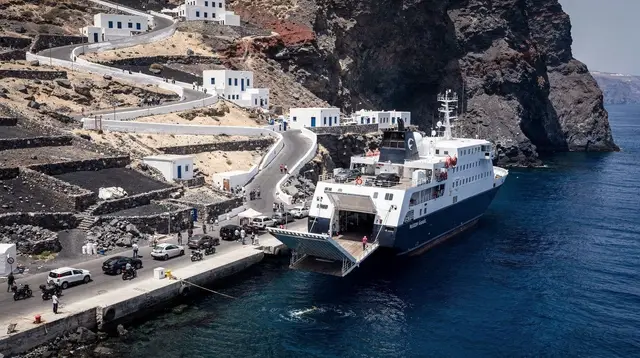
Riva, the small port where most boats put in, is a row of stone houses, two tavernas with tables angled toward the water, and a zigzag path climbing the cliff behind them. There is no ticket booth, no queue, no gift shop selling volcanic sand in a bottle. A cat was asleep on a folded fishing net. Someone was untangling a line by hand. Nobody looked up when the boat arrived, which after a week of Fira and Oia — where every arrival at the old port is a small event, cable car queue and all — felt almost rude in how little it cared that I was there.
I want to be honest about what this island offers, because it would be easy to oversell it. Thirassia does not have a museum, a winery, a beach worth planning a day around, or a village square with live music. What it has is a fifteen-minute climb to Manolas, the only real village, strung along the clifftop with the same whitewashed churches and blue shutters as its famous neighbour, minus almost every visitor. I sat at a taverna with a view that, on paper, rivals anything in Imerovigli or from Skaros Rock, and I had it to myself except for two other tables.
Looking at the caldera from the wrong side
This is the part that actually changed how I see Santorini. Every photograph I had taken of the caldera put me on the rim, looking down at the water and the two dark shapes of Nea Kameni and Palea Kameni in the middle.
From Manolas, I was looking across at the rim itself — the pale line of Oia’s houses, the cliff dropping into blue, the whole postcard reduced to a smudge on the horizon. It is the same volcanic wall that swallowed a Bronze Age town, seen from its far edge instead of its crowded one. Reading about how the caldera was formed is one thing; standing on the piece of rim that got separated from the rest is another.
It also reframed something I’d been vaguely uneasy about since arriving: the 2025 earthquake swarm that closed schools and sent people away from the island for weeks. From Thirassia, with almost no development to lose and no eruption in the end, the whole episode felt smaller and more geological — a reminder that this ground moves, not a warning sign hanging over the trip. I’m not going to pretend I understand the seismology. I’ll just say that seeing the caldera from an island that has stayed genuinely underbuilt made the region’s volcanic nature feel less like a hazard sign and more like the reason any of this exists.
What Thirassia is not
I keep circling back to what isn’t here, because that’s the whole point and it’s easy to arrive with the wrong expectations. There is no infrastructure for the way most people travel: no ATM I could find, no shop selling sunscreen or sun hats, no schedule board, no English menu translated for a coach tour. If you need a bathroom, a taverna will let you use theirs, and you should probably order something. If you twist an ankle on the climb, there is no clinic. This is not a complaint. It is the condition that makes the silence real. An island with a proper tourist office would also have a proper crowd.
I watched one of the caldera cruise boats stop briefly at Riva on its way past — a quick swim call, twenty minutes, back on board — and understood why most people only ever see Thirassia as a pause between Oia’s sunset and the volcano stop at Nea Kameni. It works as a pause. It works better as the point.
Why I’d send you here
If you’ve already stood in the crowd at Oia’s kastro, already queued for the cable car, already taken the postcard shot from Fira looking north — Thirassia is the version of Santorini where you stop being photographed and start doing the looking. It won’t fill a day. It doesn’t try to. Give it an afternoon on a wider boat trip, sit down at whichever taverna has a free table, and let the island that usually gets looked at become, for a couple of hours, the one doing the looking.
Frequently asked questions about visiting Thirassia
What is there to do on Thirassia?
Very little by design: a short walk up from the small harbour to the village of Manolas, a couple of tavernas, and a view of Oia across the water. Most visitors stay two to three hours.
Is Thirassia the same as Santorini?
No. Thirassia is a separate, much smaller island that was cut off from Santorini by the same volcanic collapse that formed the caldera. It has its own tiny population and no cars to speak of.
Can you stay overnight on Thirassia?
A handful of rooms exist, but most people visit as part of a boat trip and leave the same day. There is no nightlife and very few beds, so book ahead if you want to stay.
Why do people say Thirassia is quieter than Oia?
Because it genuinely is. It receives a fraction of Santorini’s cruise and ferry traffic, has no cliffside hotels, and its only village sits above a working harbour rather than a row of sunset bars.
Do you need a guide to visit Thirassia?
No. The village is a ten-minute walk uphill from the water and impossible to get lost in. Most visitors just wander, sit down for lunch, and walk back.
Is Thirassia better than Oia for photos?
It offers a different photo, not a better one: Oia’s white houses and blue domes from a distance, rather than up close. If you want to be in front of the caldera instead of looking at it, Thirassia is the angle you’re missing.
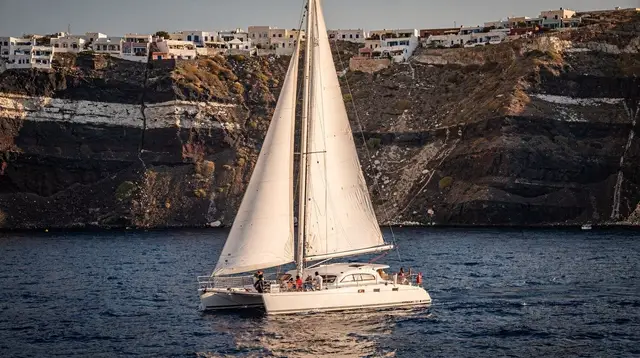
If a boat trip is how you’ll get there, the catamaran cruise that stops at Thirassia builds the crossing into a full day on the water, and the port cruise combining the volcano, the hot springs and Thirassia pairs it with the two other classic caldera stops. For a shorter option, the sunset cruise around the caldera passes close enough to see Thirassia’s cliffs lit up as the light drops.
tours.Reportage
Verified deep-linked GetYourGuide tours. Book through these links and we earn a small commission at no cost to you.
GetYourGuide does not provide a product photo for this activity — the image shows the meeting point, photographed by us.