Santorini and Crete in One Week
Two islands, not one long weekend
Most Santorini itineraries stop at the caldera. This one doesn’t, because a week is long enough to see Santorini properly and still get on a boat to somewhere entirely different. The first four days stay close to home: the cliffside villages, Akrotiri’s buried city under its bioclimatic roof, and the volcanic islets sitting in the middle of the caldera. Then a ferry from Ormos Athinios takes you to Crete for the back half of the trip.
This route is for travellers who would rather combine two islands than multiply the details of one. If you want the wine route worked into the days, or a itinerary built around chasing the best light, A 3-Day Santorini Photography Itinerary for Light, Not Lines covers that ground in a shorter, more concentrated format. Here, the goal is balance: enough of Santorini’s headline sights to feel like you’ve seen the island, then a real change of scenery.
| Day | Focus | Overnight |
|---|---|---|
| 1 | Arrival, Fira and the caldera rim | Santorini |
| 2 | Oia, Ammoudi Bay, sunset | Santorini |
| 3 | Akrotiri and Red Beach | Santorini |
| 4 | Nea Kameni volcano and Palea Kameni hot springs | Santorini |
| 5 | Ferry to Crete | Crete |
| 6 | Full day on Crete | Crete |
| 7 | Second Crete day, departure | — |
Day 1: Arrival and getting your bearings in Fira
Flights and ferries both tend to land in the afternoon, so the first day is deliberately light. Settle in around Fira, the island’s chief town, and use the remaining daylight to walk the caldera-edge path toward Firostefani. This stretch is paved and easy, a gentle introduction to the geography that will define the rest of the week: villages perched on a cliff, the sea 250 to 300 metres below, and no beach in sight up here — the sand is on the other side of the island, at Kamari and Perissa.
If you arrived by ferry through Athinios, note the road up from the port: a steep switchback climb with no shortage of traffic at busy arrival times. Reading the Athinios port guide before you go helps you plan the transfer instead of improvising it at the dock. In Fira itself, the old port and cable car are worth locating now even if you don’t ride down today — you’ll want them later in the week if you take a cruise from the water instead of the clifftop.
End the day with dinner in Fira and an early night. Days two through four are the busiest of the trip.
Day 2: Oia, Ammoudi Bay and the sunset everyone talks about
Oia is Santorini’s most photographed village, and for good reason: blue domes, white walls stacked into the cliff, and a view down the caldera that changes with every hour of light. Spend the morning here before the crowds build, wandering the lanes above the old Byzantine castle ruin. By late morning, walk or take a short taxi down to Ammoudi Bay, a small fishing harbour at the foot of the cliff with a handful of seafood tavernas right on the water — a good, quieter lunch stop away from the village above.
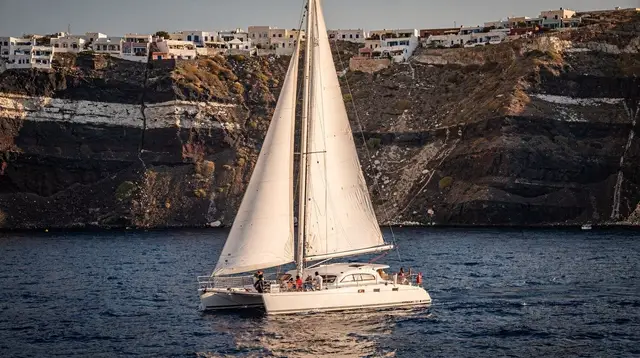
Sunset is the reason most people build a whole day around Oia, and the castle viewpoint fills up ninety minutes to two hours before the sky turns in high season. Rather than fight for a spot on the wall, consider watching from the water instead, where you face the cliff rather than compete for a place on it.
a private sunset tour that pairs Oia’s viewpoints with Ammoudi Bay below covers both halves of the village in one afternoon without the logistics of doing it solo. If you’d rather stay on land but skip the scramble for a wall spot, a guided walk timed to the sunset works well too — see the notes on watching Oia’s sunset without the crowds for village-based alternatives like Firostefani and Imerovigli, both a short walk from Fira.
Day 3: Akrotiri’s buried city and Red Beach
Today shifts from villages to archaeology. Akrotiri is a Minoan town buried under volcanic ash by the eruption of around 1600 BCE, excavated since 1967 and now covered by a bioclimatic roof — meaning it’s one of the few sights on the island worth doing regardless of weather. No human remains have been found at the site, which suggests the population had time to evacuate before the eruption. The exhibit rewards an unhurried hour or two rather than a quick pass-through.
a guided walk through the excavated site adds context that’s easy to miss reading signage alone — the layout of the town, what’s been reconstructed versus left as found, and how the dig connects to the wider Aegean Bronze Age. For more background before or after the visit, the Akrotiri excavations guide lays out the timeline and what’s on display at the associated museum in Fira.
In the afternoon, head to nearby Red Beach, named for the rust-coloured cliffs above it. Access has been affected by rockfalls in recent years, and the cliffside path has been closed more than once — check current conditions before you go, since the walk-in route is not always reliably open. Seeing the cliffs from the water on a boat trip is a dependable alternative when the path itself is restricted.
Day 4: Nea Kameni’s crater and the hot springs of Palea Kameni
The volcanic islets sitting inside the caldera are the most physically dramatic stop on the trip, and the easiest way to see them is a half- or full-day boat cruise. Boats typically call first at Nea Kameni, the active cone, where you walk roughly thirty minutes up a path of loose volcanic cinder to the crater rim. There’s an entrance fee of around five euros, usually paid in cash on the island and not included in most cruise prices — worth having small change ready for.
From there, most itineraries continue to Palea Kameni, where you don’t disembark but swim from the boat to a patch of iron-rich water near the shoreline. It’s warm rather than genuinely hot, and it will stain light-coloured swimwear, so leave your favourite white bikini in the cabin.
a day cruise that combines the volcano walk with the hot springs swim is the standard way to do both in one outing, and most versions also work in a swim stop and views of the caldera cliffs from below — a different perspective than anything you’ll get from the villages above. Full background on what to expect at each stop is in the Nea Kameni volcano guide.
Note that there’s no visible lava on the island today; the last eruption was in 1950, and the seismic swarm of early 2025 — a roughly forty-day sequence of tremors between Santorini and Amorgos — didn’t result in an eruption either. It’s worth reading the current safety guide covering the 2025 earthquakes if the topic comes up in your planning, mostly to separate what happened from what didn’t.
Day 5: The ferry to Crete
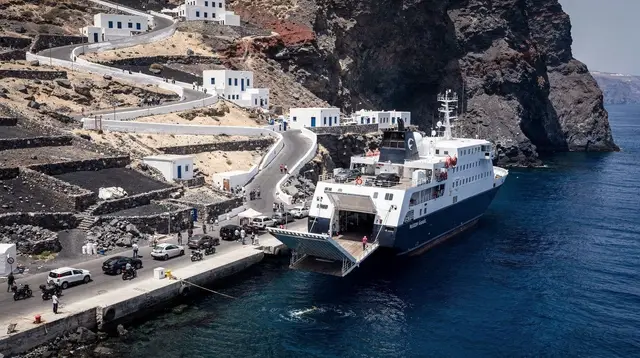
This is a travel day, and it’s worth treating it as one rather than squeezing in extra sightseeing beforehand. Ferries to Crete depart from Ormos Athinios, the island’s only ferry port, and the crossing takes roughly two hours on the faster catamarans — longer on conventional ferries, and the exact time depends on the company, the vessel, and which Cretan port it’s sailing to. Treat any duration you see quoted online as a rough guide rather than a fixed schedule, and check your specific sailing rather than assuming.
Book your ferry ahead in July and August, when popular sailings can sell out. The Santorini ferry guide walks through how routes and companies differ, and the guide to the day trip route between the two islands is useful even though you’re staying longer than a day — it covers the port logistics on both ends. Arrive at Athinios with time to spare; the port has no real waiting area and can back up quickly before a departure.
On arrival in Crete, take the rest of the day easy. However you land, it will feel bigger than Santorini almost immediately — Crete is Greece’s largest island, with a coastline, a mountain interior and a pace that has little in common with the compact caldera you’ve just left.
Day 6: A full day on Crete
Crete rewards a full, unhurried day more than a checklist. Depending on where you’ve landed, this might mean a wander through an old town’s harbour and backstreets, a half-day trip inland to a Minoan palace site, or simply picking one coastal town and slowing down. Crete’s own archaeological sites — most famously Knossos — sit on a different scale and timeline than Akrotiri, worth seeing precisely because the contrast with Santorini’s Bronze Age town is so direct: one civilisation’s palace complex, another’s buried domestic town.
If your itinerary planning started from the Crete side, it’s worth knowing the reverse route exists too — travellers based there sometimes do a one-day cruise from Rethymno over to Santorini rather than staying on both islands. That works as a taster, but it means seeing Santorini in a single rushed day, which is exactly what this itinerary is built to avoid.
Spend the evening at a leisurely pace — a slow dinner, a walk along the water — recovering some of the schedule this trip demands in its Santorini half.
Day 7: A second Crete day, then departure
Use the last full day for whatever Crete’s first day didn’t cover: a beach afternoon, a market, or a second inland excursion if your onward flight allows it. Crete’s size means a single week here could easily fill itself, so treat this as a taste of the island rather than a complete visit — plenty of travellers who do this route come back to Crete alone on a future trip.
Time your departure day around your flight or ferry connection rather than cramming in one more site. If you’re flying out of Crete, build in more transfer buffer than you think you need; if you’re returning briefly through Santorini, note that connections back through Athinios add another crossing to an already full week.
What this itinerary leaves out, on purpose
Two things get deliberately less attention here than on other Santorini itineraries. The wine route through the island’s interior — its kouloura-trained vines, the Assyrtiko tastings, the wineries around Pyrgos and Megalochori — barely features, because doing it properly needs its own day rather than a rushed afternoon squeezed between the volcano and a ferry. If that’s the trip you actually want, a dedicated wine-focused itinerary makes better use of the time than bolting a single tasting onto this route.
The same goes for photography. This itinerary hits Oia at sunset once, which is enough to see it, but it doesn’t chase golden hour across multiple viewpoints or build in the flexible timing a serious photo trip needs. A 3-Day Santorini Photography Itinerary for Light, Not Lines is built for that instead, over a shorter overall span with more time at each spot.
What this route does well is give you a real second island rather than a single long weekend on one. Four days on Santorini is enough to leave satisfied rather than rushed, and three days on Crete is enough to know whether you want to come back for more.
Frequently asked questions about combining Santorini and Crete
How long is the ferry from Santorini to Crete?
Around two hours on the faster boats, longer on conventional ferries. The exact time depends on the company and the vessel, and on which Cretan port it calls at, so treat any figure as an estimate rather than a timetable.
Do I need to book the Santorini-Crete ferry in advance?
In July and August, yes — sailings sell out, especially on weekends. In the shoulder months there is usually more flexibility, but booking a few days ahead still avoids the worst surprises.
Which Crete port should I sail into from Santorini?
Several routes exist, landing on different parts of Crete’s north coast. Compare sailing times and onward transfers before booking, since the port you choose shapes how you spend the rest of the week.
Is four days enough on Santorini before moving on?
It’s enough to see the caldera villages, Akrotiri, the volcano and one sunset properly, without the pace of a one-day visit. It is not enough for the wine route or a slow photography-focused stay — those deserve their own trip.
Can I fit in Nea Kameni and Akrotiri on the same day?
It’s possible but tight, since the volcano crater walk and the archaeological site both reward unhurried time. This itinerary keeps them on separate days on purpose.
Is this itinerary practical without a car?
Yes. Buses, organised tours and the ferry cover every stop here. A car helps mainly for reaching quieter corners of Santorini’s interior, which this route doesn’t prioritise.
What does this itinerary skip?
It leaves out Santorini’s wine route and a slower, light-focused pace, both covered in more depth by the dedicated wine and photography itineraries. This route is built for travellers who would rather see two islands than every corner of one.
tours.7 days
Verified deep-linked GetYourGuide tours. Book through these links and we earn a small commission at no cost to you.
GetYourGuide does not provide a product photo for this activity — the image shows the meeting point, photographed by us.