Santorini by Helicopter: What a Caldera Flight Actually Shows You
Is a Santorini helicopter tour worth it?
It compresses the entire caldera — the 12 by 7 km crescent, the 250-300 m cliff, and the islets of Nea Kameni and Palea Kameni — into a single short flight. It suits visitors short on time or after a wide overview rather than a slow boat trip, but no lava or active flow is visible; the volcano's last eruption was in 1950.
Why see the caldera from above
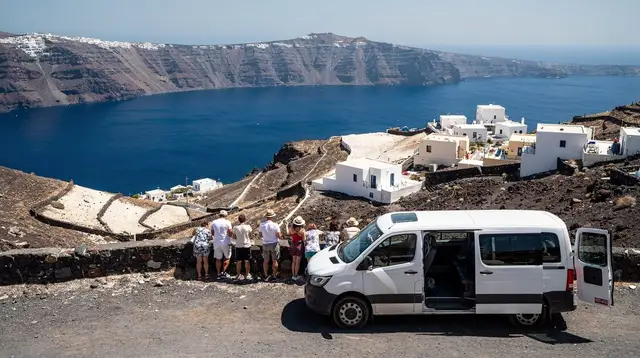
Santorini’s shape is hard to grasp from the ground. Standing in Oia or Fira, you see one stretch of cliff and one slice of sea. What you don’t see, at eye level, is the thing that makes the island famous in the first place: a roughly 12 by 7 kilometre basin, ringed by a crescent of land on three sides, with two dark islets sitting almost dead centre. That whole shape only reads clearly from the air, and a helicopter is the fastest way to get there.
This page covers what a Santorini helicopter tour actually shows, who it makes sense for, and — just as importantly — what it doesn’t show. There is no lava to see. There hasn’t been for decades. Anyone booking a flight expecting glowing rock or an active flow is booking the wrong image of the island.
What the flight shows over the caldera
A standard sightseeing route lifts off, climbs over the Santorini caldera, and traces the inner rim. From a few hundred metres up, the geometry becomes obvious in a way it never is on foot:
- The full crescent of the main island, curving from the southern cliffs near Akrotiri up past Imerovigli and around to Oia.
- The inner cliff itself, dropping 250 to 300 metres straight into the sea — a wall that from a boat below feels enormous, and from above reads as a single continuous edge.
- Thirassia, the quieter island directly across the water, which most visitors never set foot on but can see whole from a helicopter in seconds.
- The two black islets in the centre of the basin, Nea Kameni and Palea Kameni — the visible remnants of the volcanic system that produced the caldera in the first place.
- The cliff-edge villages strung along the rim — Fira, Firostefani, Imerovigli, Oia — as a continuous line of white rather than a series of separate stops.
Seen together, it’s easier to understand why the caldera formed the way it did: the crescent, the islets and the drowned centre are all pieces of the same collapsed structure, and a flight is the only way to see all of them in one frame.
What you will not see: lava
This needs stating plainly, because it’s the most common misconception behind the booking. There is no lava visible anywhere on Santorini today, from the air or the ground. The volcano’s last eruption was in 1950. Before that, activity in 1939-1941, 1925-1928 and 1707 built the black cones that now make up Nea Kameni, but none of that rock is glowing, flowing, or in any way active to look at. What a flight over Nea Kameni actually shows is scorched, dark cinder, bare of vegetation, with faint steam sometimes visible near vents — a landscape shaped by past eruptions, not one currently erupting.
If the appeal of a helicopter tour is watching an active volcano, this is the wrong island for that image. If the appeal is understanding the scale and shape of a genuinely dramatic volcanic landscape, a flight delivers that clearly.
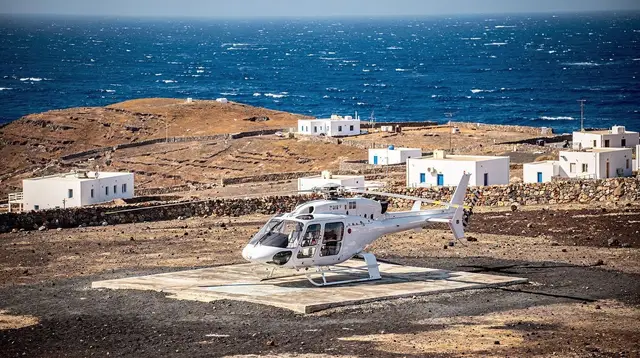
a 30-minute private helicopter flight over the caldera is the standard way to see this shape in one short trip.
Who this is actually for
A helicopter flight is a specific kind of product, and it suits a specific kind of traveler more than others:
- Visitors short on time. A caldera boat cruise, even a short one, takes half a day once transfers and boarding are factored in. A helicopter flight compresses the same overview into 20 to 30 minutes.
- Travelers with a comfortable budget. This is the most expensive way to see the caldera, by a wide margin, and it should be chosen with that clearly understood rather than compared directly to a boat ticket.
- People who want the shape, not the detail. A flight shows you the whole basin at once but doesn’t let you swim at Palea Kameni’s hot springs or walk the crater path on Nea Kameni. If direct contact with the islets matters more than the overview, a caldera cruise is the better fit.
- Point-to-point travelers. Beyond sightseeing, helicopters also work as a genuine transport option — a private one-way transfer from Athens to Santorini skips the ferry and airport queues entirely for those who value time over cost.
Helicopter vs. boat: two different views of the same place
Neither option replaces the other — they show the caldera from opposite angles.
| Helicopter flight | Caldera boat cruise | |
|---|---|---|
| Viewpoint | From above, whole basin at once | At sea level, close to the cliffs |
| Typical duration | 20-30 minutes | Several hours (half-day or more) |
| Stops at the islets | No — flyover only | Yes — usually Nea Kameni’s crater and Palea Kameni’s springs |
| Best for | Overview, time-pressed visitors | Slower pace, swimming, sunset |
| Cost level | High | Moderate to high |
| Weather sensitivity | Wind and visibility dependent | Meltemi winds can also cancel sailings |
For a side-by-side look at cruise formats specifically, see caldera cruises compared. A sunset cruise in particular gives a very different, slower experience of the same cliffs — worth knowing about even if a flight is the plan, since a sunset cruise around the caldera is the classic alternative for anyone who decides they’d rather be on the water than above it.
Route options beyond sightseeing
Helicopter operators on Santorini don’t only fly loops over the caldera. A few point-to-point routes are worth knowing about if travel time matters more than cost:
- Santorini to Mykonos. Skipping the ferry queue at Athinios and the multi-hour crossing, a one-way helicopter transfer to Mykonos turns a half-day journey into a short hop — useful for anyone combining the two islands on a tight schedule. For the standard ferry-based version of this route, see the Santorini to Mykonos guide.
- Athens to Santorini. A private transfer avoids both the airport and the ferry terminal, landing directly rather than routing through Santorini’s airport or the port at Athinios covered in the ferry guide.
Both of these are transport decisions as much as sightseeing ones, and they’re worth weighing against standard flight and ferry options in the island hopping guide before booking.
Best time of day to fly
Morning departures typically give the clearest air over the caldera, before the day’s heat builds haze along the cliffs. By early afternoon, especially in July and August, a thin white haze can soften the view of Thirassia and the outer coastline, though the crescent shape and the islets still read clearly. Late-day flights bring softer light on the cliff villages but depend on the meltemi calming enough for a smooth ride. There is no single “best” hour — only trade-offs between clarity, temperature and wind — so operators generally recommend a morning slot if photographs of the widest possible view matter most.
Who a flight doesn’t suit as well
A helicopter isn’t the only way to get an overview of Santorini, and it isn’t the easiest fit for every traveler who wants one.
- Traveling with young children. A sightseeing helicopter seats only a handful of passengers in one shared cabin, with engine and rotor noise close by and no quiet corner to retreat to. Families after an easier day that still covers the caldera and the cliff villages usually get more out of the options in the family-friendly activities guide, several of which run at a slower pace and cost well under the price of a flight.
- Limited mobility. Boarding usually means a short step up into the cabin with no ramp and no wheelchair-accessible seating, and operators don’t always list accessibility details on the booking page itself. Anyone planning around a mobility limitation should check the accessibility guide for Santorini before assuming a seat can be arranged.
- Wanting the classic sunset or blue-dome photo. The postcard shots of Oia’s domes or the caldera at sunset are taken from fixed viewpoints at ground level, not from a moving aircraft with a door that stays shut for safety and a flight path that rarely lingers over one spot. For that kind of image, the best photo spots guide covers where those shots are actually taken from and at what time of day.
None of this rules a flight out — it just narrows who it suits best, on top of the time and budget points already covered above.
Practical notes before booking
A few things worth knowing that don’t come up until you’re at the counter:
- Weight and passenger limits apply, as with any small aircraft — check the operator’s specifics when booking, especially for private charters carrying luggage.
- Weather can cancel or reschedule a flight. The meltemi, the strong seasonal wind that affects boats in July and August, affects helicopter visibility and stability just as much. Build a buffer day into the itinerary if the flight matters.
- No fixed sunset departure time exists. Santorini’s sunset shifts from around 20:50 in late June to around 17:15 in late December, so any flight timed around golden light needs to be confirmed against the date of travel, not assumed.
- The 2025 earthquake swarm has no bearing on today’s flights. A seismic swarm between Santorini and Amorgos ran from late January 2025 for about forty days, produced tens of thousands of small tremors, and ended without an eruption. It’s part of the island’s recent history — covered in full in the safety guide — but it isn’t a live concern for anyone booking a flight now.
- A flight doesn’t replace a ground visit to the islets. If the volcano itself is the main interest rather than the wider view, the Nea Kameni volcano guide and the hot springs guide cover what a boat trip actually lets you do once ashore or in the water — including the landing fee, paid in cash, that a flight has no equivalent of.
Frequently asked questions about Santorini helicopter tours
Can you see lava from a Santorini helicopter tour?
No. There is no visible lava anywhere on Santorini, from the air or the ground. The volcano’s last eruption was in 1950, and Nea Kameni today shows scorched rock, steam vents and bare cinder rather than any flow.
How long does a Santorini helicopter flight last?
A standard sightseeing flight over the caldera runs around 30 minutes. Longer point-to-point options exist, such as a transfer to Mykonos or from Athens, which take closer to an hour depending on the route and aircraft.
What will I actually see from the air?
The full crescent shape of the main island, the inner cliff dropping 250 to 300 metres into the sea, the cliff-edge villages of Fira, Firostefani, Imerovigli and Oia, and the two dark islets of Nea Kameni and Palea Kameni sitting in the middle of the caldera basin.
Is a helicopter tour better than a caldera boat cruise?
They show different things. A helicopter gives a fast overview of the whole caldera shape from above; a boat cruise puts you at sea level, close to the cliffs, and usually stops at Nea Kameni’s crater and Palea Kameni’s hot springs. Neither replaces the other.
Do helicopter tours fly during the sunset hours?
Some private flights can be timed around late afternoon light, but Santorini’s sunset time shifts by hours across the year, so no fixed sunset departure time can be guaranteed. Confirm timing directly when booking rather than assuming a set slot.
Are helicopter tours affected by the 2025 earthquake swarm?
No. The swarm that began in January 2025 near Santorini and Amorgos ended after roughly forty days with no eruption, and flights have operated normally since. It is worth knowing the background, not a reason for concern when booking a flight today.
Who is a helicopter tour best suited for?
Visitors with a comfortable budget and limited time — a short stopover, a single free morning, or travelers who prioritize seeing the island’s overall shape over spending half a day at sea on a caldera cruise.
Helicopter Flights on GetYourGuide
Verified deep-linked GetYourGuide tours. Book through these links and we earn a small commission at no cost to you.
GetYourGuide does not provide a product photo for this activity — the image shows the meeting point, photographed by us.